September 10, 1939
Protecting Britain’s lifeline
The Battle of the Atlantic, the fight for control of shipping routes between North America and Europe, was the longest of the Second World War—and Canadians were involved even before the country officially declared war on Sept. 10, 1939.
As country after country fell in Europe before the Nazi onslaught, Britain’s very survival depended on what it could receive by sea. The success of every Allied effort in Europe depended on delivery of machinery, arms, fuel and men. Germany believed it could win the war by squeezing off Britain’s North Atlantic lifeline.
It began its assault on Sept. 3, 1939, with a U-boat attack that sank SS Athenia, a liner carrying 1,400 Montreal-bound crew and passengers. It is believed four Canadians were among the 128 dead.
Within two weeks, the first convoy for Britain sailed from Halifax, escorted by Canadian destroyers HMC Ships St. Laurent and Saguenay and British cruisers.
For Canada and Newfoundland, the Battle of the Atlantic meant convoy duty: shepherding precious cargo and troop ships across hostile ocean, in all weathers and all seasons. The Royal Canadian Air Force provided air support. By war’s end, Canadian merchant vessels alone made more than 25,000 trans-Atlantic trips.
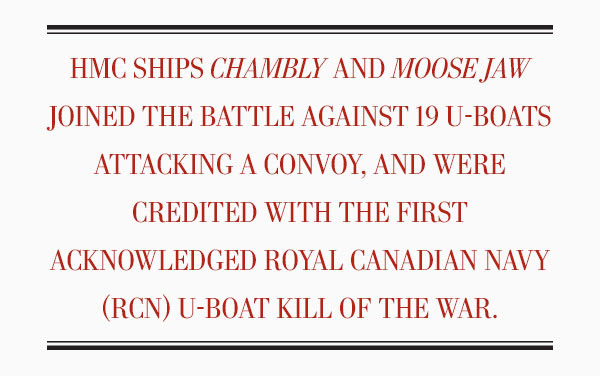
Both hunters and prey often huddled together, ships in convoys with armed escorts for protection, marauding U-boats in wolf packs. On Sept. 10, 1941, HMC Ships Chambly and Moose Jaw joined the battle against 19 U-boats attacking a convoy, and were credited with the first acknowledged Royal Canadian Navy (RCN) U-boat kill of the war.
From just six ocean-going ships and about 3,500 personnel, the Royal Canadian Navy grew to the world’s third largest, boasting about 400 vessels and nearly 100,000 men and women in uniform. The merchant marine saw similar growth, from fewer than 40 ships and about 1,500 sailors to nearly 400 ships and 12,000 mariners. Canadian shipyards produced over 4,000 vessels, including 300 warships and 410 cargo ships.
But at first, they couldn’t produce them fast enough; U-boats often outnumbered escort vessels. After the United States entered the war in December 1941, the whole of the North American seaboard became U-boat hunting grounds. Already stretched thin, Canada was also asked to protect shipping headed south.
Things were grim in 1942. Emboldened U-boat captains began picking off ships close to Canadian shores, destroying more than 70 vessels, including 21 in the Gulf of St. Lawrence. In March 1943, 108 Allied ships, with 569,000 tonnes of cargo, were sunk by U-boats.
More ships, development of equipment suited to U-boat battles and development of long-range aircraft capable of providing cover farther out to sea, helped turn the tide for the Allies beginning in 1943, but the threat continued to the final day of the war in Europe.
The toll on Canada was high—33 RCN ships and motor torpedo boats, more than 60 Canadian-registered merchant ships were among the 2,900 Allied ships lost. Nearly 2,200 merchant mariners, 1,990 RCN and Women’s Royal Canadian Naval Service personnel and 752 members of the RCAF were lost during the 68 months of the battle.



ax.jpg?1536075322477)







 Royal Canadian Legion, US Branch #25