Tag Archives: Legion Magazine

97-year-old Lancaster pilot has no regrets ✈️

From the Legion Magazine.


New WW II Deluxe Collection!
Front lines
Jack Widdicombe: From combine to Lancaster and back

Jack Widdicombe:
From combine to Lancaster and back

Story by Stephen J. Thorne

Lancaster pilot Jack Widdicombe was a wide-eyed Prairie farm boy about to be thrust into the inferno of Second World War Europe when he boarded a double-decker bus and toured London shortly after arriving in England.

The 21-year-old native of Foxwarren, Man., and a pal set out to see the sights and instead encountered block after block of rubble. Twenty-three bombing missions over Nazi territory and 1,200 hours of combat flying lay ahead of him.

READ MORE

Battle of the Atlantic

September 10, 1939
Protecting Britain’s lifeline

The Battle of the Atlantic, the fight for control of shipping routes between North America and Europe, was the longest of the Second World War—and Canadians were involved even before the country officially declared war on Sept. 10, 1939.

As country after country fell in Europe before the Nazi onslaught, Britain’s very survival depended on what it could receive by sea. The success of every Allied effort in Europe depended on delivery of machinery, arms, fuel and men. Germany believed it could win the war by squeezing off Britain’s North Atlantic lifeline.

It began its assault on Sept. 3, 1939, with a U-boat attack that sank SS Athenia, a liner carrying 1,400 Montreal-bound crew and passengers. It is believed four Canadians were among the 128 dead.

Within two weeks, the first convoy for Britain sailed from Halifax, escorted by Canadian destroyers HMC Ships St. Laurent and Saguenay and British cruisers.

For Canada and Newfoundland, the Battle of the Atlantic meant convoy duty: shepherding precious cargo and troop ships across hostile ocean, in all weathers and all seasons. The Royal Canadian Air Force provided air support. By war’s end, Canadian merchant vessels alone made more than 25,000 trans-Atlantic trips.
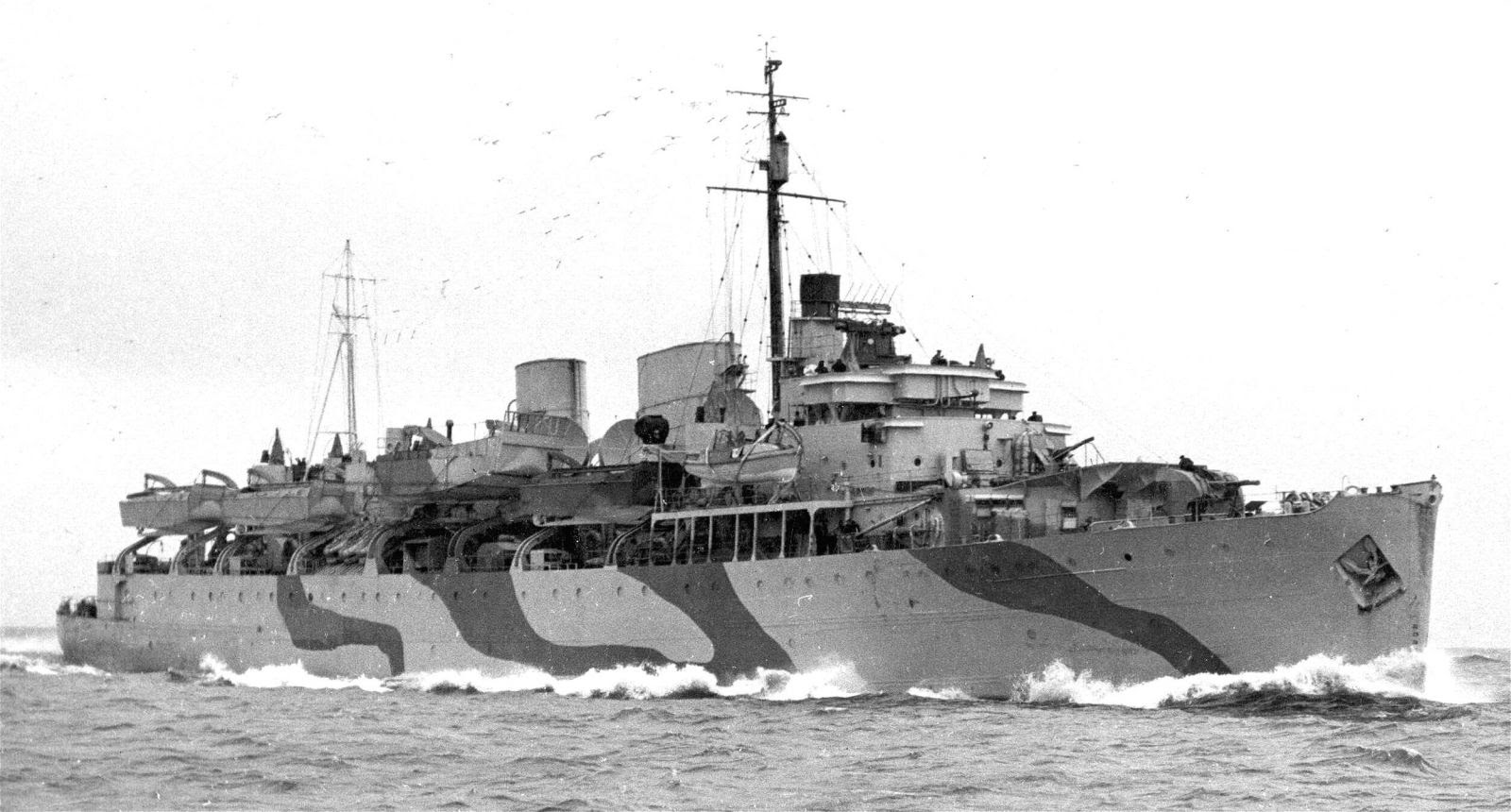
Both hunters and prey often huddled together, ships in convoys with armed escorts for protection, marauding U-boats in wolf packs. On Sept. 10, 1941, HMC Ships Chambly and Moose Jaw joined the battle against 19 U-boats attacking a convoy, and were credited with the first acknowledged Royal Canadian Navy (RCN) U-boat kill of the war.

From just six ocean-going ships and about 3,500 personnel, the Royal Canadian Navy grew to the world’s third largest, boasting about 400 vessels and nearly 100,000 men and women in uniform. The merchant marine saw similar growth, from fewer than 40 ships and about 1,500 sailors to nearly 400 ships and 12,000 mariners. Canadian shipyards produced over 4,000 vessels, including 300 warships and 410 cargo ships.

But at first, they couldn’t produce them fast enough; U-boats often outnumbered escort vessels. After the United States entered the war in December 1941, the whole of the North American seaboard became U-boat hunting grounds. Already stretched thin, Canada was also asked to protect shipping headed south.

Things were grim in 1942. Emboldened U-boat captains began picking off ships close to Canadian shores, destroying more than 70 vessels, including 21 in the Gulf of St. Lawrence. In March 1943, 108 Allied ships, with 569,000 tonnes of cargo, were sunk by U-boats.

More ships, development of equipment suited to U-boat battles and development of long-range aircraft capable of providing cover farther out to sea, helped turn the tide for the Allies beginning in 1943, but the threat continued to the final day of the war in Europe.

The toll on Canada was high—33 RCN ships and motor torpedo boats, more than 60 Canadian-registered merchant ships were among the 2,900 Allied ships lost. Nearly 2,200 merchant mariners, 1,990 RCN and Women’s Royal Canadian Naval Service personnel and 752 members of the RCAF were lost during the 68 months of the battle.

This week in history
This Week in History

September 7, 1942

HMCS Raccoon is sunk by U-165 while on convoy duty near
Pointe-au-Père, Que., killing all 37 crew on board.

READ MORE

Iris Vision Care

Steaming up the track

From the Legion Magazine.


Last Chance to get your Free Pin!
Front lines
Steaming up the track

Steaming up the track

Story and photography by Stephen J. Thorne

Some 650 young athletes, including 317 sponsored by local legions across Canada, met in a steaming hot Brandon, Man., for the 42nd annual National Youth Track and Field Championships. Weekend temperatures hit 40℃ as under-16 and under-18 youth competed for 333 medals in 87 events. They were supported by 300 volunteers, 124 coaches and 60 officials. Here are some pictures.

SEE MORE

The Fight for Italy

August 31, 1944
Breaching the Gothic Line

The breaching of the Gothic Line on Aug. 31, 1944, was just a continuation of hellish fighting for 1st Canadian Corps in Italy.

The last major German defence in Italy was a heavily-fortified line of thousands of bunkers, machine-gun nests, fortified artillery positions and observation posts protecting Italy’s industrial heartland. It was vital to the German war machine, to be protected at all costs.

The line was meant to put a full stop to the Allies’ advance. Its defences included 2,375 machine-gun posts, 479 anti-tank gun, mortar and assault-gun positions, 3,604 dugouts and shelters, 16,006 rifleman positions, 72,517 teller anti-tank mines and 23,172 anti-personnel mines, four Panther tank turrets and 18 gun turrets, supplemented by 117,370 metres of wire obstacles and 8,944 metres of anti-tank ditch.

The Canadians were given the job of ripping a hole in this supposedly impregnable line. Attacks Aug. 30 by infantry and tank divisions along a line marked by Montecchio on the eastern flank, Osteria Nuova in the centre and fortified defences on the western flank near Borgo Santa Maria, breached the line.

On Sept. 1, the Loyal Edmonton Regiment, Princess Patricia’s Canadian Light Infantry and two battalions of the Royal Tank Regiment led the advance through the breach. The Gothic Line took a heavy toll on Canadian troops–4,511 casualties including 1,016 killed.

The Germans retreated north, but the fighting got no easier. Crag by crag, ridge by ridge, Canadian troops battled German forces on through the mountains, then across soggy plains.

The war ended in Italy on May 2, 1945, just one week before Germany surrendered, ending the Second World War in Europe.

This week in history
This Week in History

August 30, 1945

HMCS Prince Robert sails into Kowloon, Hong Kong, liberating Canadian prisoners of war.

READ MORE

Simply Connect

FREE SHIPPING on now | Special offer for our readers!

From the Legion Magazine.


Free Shipping - Scroll down for details!
Free WWI Armistice Pin when you spend over $30!
World War II Collection Deluxe 8-Volume Set
World War II Collection Deluxe 5-Volume Set
NEW Stainless Steel Bottles!
Canada and the Second World War: The Battles
FREE SHIPPING! LIMITED TIME OFFER!

SPEND OVER $30
FREE WW I ARMISTICE PIN!

SPEND OVER $45
FREE WW I ARMISTICE PIN + FREE SHIPPING!

CLICK HERE TO BROWSE OUR ENTIRE COLLECTION!

The bombing of East Grinstead

From the Legion Magazine.


New WW II Deluxe Collection!
Front lines
The bombing of East Grinstead

The bombing of East Grinstead

Story by Stephen J. Thorne

Seventy-five years ago, on July 9, 1943, a Dornier Do 217E became separated from the rest of its 10-plane Luftwaffe flight as it entered a cloudbank on its way to bomb London.

Likely based near the town of Toulouse, France, close to the Spanish border, the German bombers had crossed the English coast at Hastings on one of hundreds of raids that dropped tens of thousands of tonnes of bombs over the course of the Second World War, killing some 60,000 British civilians and injuring 80,000 more—most of them Londoners.

READ MORE

Canada and the Great War: The Battles

August 26, 1918
Charles Smith Rutherford

When Lieutenant Charles Rutherford, only 26, took part in the Fourth Battle of the Scarpe on Aug. 26, 1918, he had already earned the Military Medal at Passchendaele in 1917 and the Military Cross earlier in the month in the Battle of Amiens. He was about to add the Victoria Cross to his honours.

In the vanguard in the advance on Monchy-le-Preux, France, Rutherford was leading an assault party of 5th Battalion, Canadian Mounted Rifles, when he became separated from his men. He came across a pillbox harbouring two enemy officers backed by 43 men and three machine guns. He gestured them to come out with his revolver. When they declined his invitation, he accepted theirs to go closer, his boldness adding credence to a convincing bluff. He persuaded the officers they were surrounded, hoodwinking them into surrendering. He also inveigled one of the enemy officers to stop a nearby machine gun playing havoc with his men, who were then able to come more quickly to his aid.

When further advance of the assault was held up by machine-gun fire from yet another pillbox, Rutherford led a Lewis gun section in and captured 35 more prisoners, and their guns.

The Victoria Cross was awarded “for most conspicuous bravery, initiative and devotion to duty,” reads the citation. “The bold and gallant action of this officer contributed very materially to the capture of the main objective and was a wonderful inspiration to all ranks in pressing home the attack on a very strong position.”

Rutherford began his military career among the ranks, but ended it as a captain. After the war, he served as sergeant-at-arms of the Ontario Legislature and joined the Veterans Guard of Canada during the Second World War.

Rutherford died in 1989, aged 97, believe to be the last of the First World War Victoria Cross recipients in Canada. He is buried in his hometown of Colborne, Ont.

Yes, we really thought it would fly

Yes, we really thought it would fly

Story by Terry Fallis

I had a youthful fascination with planes, rockets, gliders, helicopters and just about everything else that flew. Books helped fuel this interest, including Pilot Jack Knight and Reach for the Sky, Paul Brickhill’s biography of Douglas Bader.

He was the English pilot who lost both legs in a crash in 1931, yet still served in the Battle of Britain as a fighter pilot. What I may not have mentioned before was that my obsession with flight actually extended a little beyond paper airplanes and 50-cent balsa wood gliders.

READ MORE

This week in history
This Week in History

August 25, 1944

Paris is liberated by Allied forces.

READ MORE

Hearing Life