Monthly Archives: February 2025

Tomorrow: Seeking “Sanctuary” in Montreal

A newsletter from a fellow Canadian organization in the Bay Area.


Canadian Studies Announcements

In This Issue:

Upcoming Events

• From the Shadows: Reflections on Sanctuary in Montreal Over the Long 20th Century

• Panel: Asserting Indigenous Title to Unceded Wolastoqey Territory

Other Events

• Political Archery and Moving Targets: How Canada Made it a Crime to Perpetrate “Conversion Therapy” and What it Will Take to Fully Eradicate the Practices

• Film Screening: Maliglutit

TOMORROW

From the Shadows: Reflections on Sanctuary in Montreal Over the Long 20th Century

Tues., Feb. 18 | 12:30 pm | 223 Philosophy Hall | RSVP

In the first decades of the twentieth century, the notion of sanctuary was repurposed in an effort to protect migrants and refugees from deportation and create broad-based social justice movements aimed at reforming existing immigration regimes in the United States and Canada. The New Sanctuary Movement, or what has been called the Sanctuary City Movement or Solidarity City Movement, galvanized supporters while also drawing the ire of critics. These movements also called into question the very notion of sanctuary, its purpose, and how social change might be effected.

The city of Montreal, known as Tiohtià:ke in Kanien’kéha and Mooniyang in Anishinaabemowin, declared itself a sanctuary city in 2017. However, in the face of large-scale immigration in the wake of the first Trump administration’s so-called “Muslim Ban” and other restrictions on refuge, it quickly walked back this decision, opting instead to describe itself as a “responsible city”. The ease with which both the declaration and the change in course were effected offers an opening to interrogate the meaning and substance of sanctuary in our contemporary moment as well as the many ways it has manifested historically.

This presentation explores the history of sanctuary in Montreal, a city long characterized by mobility and contested settlement, to interrogate the ways in which the seeking and forging of refuge has evolved. Using a series of case studies, this presentation underscores the shift from secrecy to public sanctuary in particular and raises questions about the extent to which contemporary sanctuary practices can address the fundamental injustices at the core of experiences of refuge and displacement.

About the Speaker

Dr. Laura Madokoro is an associate professor in the Department of History at Carleton University, unceded Algonquin territory in Ottawa, Canada. Her research explores the transnational history of migration, refuge, settler colonialism and humanitarianism in the long 20th century. Her current research focuses on the history of imperial displacements. Dr. Madokoro’s published works include Elusive Refuge: Chinese Migrants in the Cold War (Harvard, 2016) and Sanctuary in Pieces: Two Centuries of Flight, Fugitivity, and Resistance in a North American City (MQUP, 2024). She is also an active member of several research collectives including the Montreal History Group, Critical Refugee and Migration Studies Canada, and the editorial collectives for activehistory.ca and refugeehistory.org.

If you require an accommodation to fully participate in this event, please let us know at least 7 days in advance.

UPCOMING EVENT

Panel: Asserting Indigenous Title to Unceded Wolastoqey Territory

Tues., Feb. 25 | 12:30 pm | 223 Philosophy Hall | RSVP

In 2021, six Wolastoqey communities launched a landmark lawsuit asserting an Indigenous title claim over more than five million hectares of territory in eastern Canada, one of the largest in the country’s history. They assert that the area, which covers more than half of the province of New Brunswick, was never ceded under the Peace and Friendship Treaties which various tribes signed with the British Crown in the 18th century. In a first of its kind, defendants in the suit include not just the federal and provincial governments, but also multiple forestry and industrial companies. The Wolastoqey hope that victory will not only increase their influence over issues from land use to taxation, but possibly even result in the return of land to tribal ownership.

The lawsuit has major implications for Indigenous title claims across Canada, and the Wolastoqey have already scored several key victories in their fight to assert their land rights. In November, a New Brunswick judge ruled that a declaration of Aboriginal title could be made to privately-held lands. And change of provincial government has also softened the province’s stance, opening the door to greater cooperation. Join leading negotiators and legal experts from the Wolastoqey Nation as they discuss the case’s current status; the state of Crown-Indigenous relations; and how the suit could change the future of Indigenous nations across Canada.

About the Speakers

Allan Polchies Jr. is the four-term Sakom (chief) of the Sitansisk Wolastoqey (St. Mary’s) First Nation, located in Fredericton, New Brunswick. Sitansisk is the second-largest Wolastoqey community in the province, and one of the six plaintiffs in the title suit. Polchies has served over seventeen years on the band council, and has led the community through its Indigenous title claim.

Renée Pelletier is a partner at Olthuis Kleer Townshend (OKT) LLP, and the lead counsel on the Wolastoqey title claim. She is a member of the New Brunswick and Ontario Bars, specializing in Aboriginal and treaty rights litigation and negotiation. She teaches courses on land claims and self-government at the University of New Brunswick and serves as co-chair of Osgoode Professional Development’s Certificate Program in the Fundamentals of Indigenous Peoples and Canadian Law. She was awarded the Osgoode Hall Law School’s Alumni Gold Key Award for a Career of Distinction in 2024.

Victoria Wicks is an associate at OKT working on the Wolastoqey claim. She completed her law degree at the University of British Columbia, where she obtained a specialization in Aboriginal Law and worked at the Indigenous Community Legal Clinic. Before joining OKT, Wicks clerked at the Court of Appeal for Ontario and practiced at a litigation boutique. She holds an Honours Bachelor of Arts in political science from the University of Toronto and is a member of the Law Society of Ontario.

If you require an accommodation to fully participate in this event, please let us know at least 7 days in advance.

OTHER EVENTS

Political Archery and Moving Targets: How Canada Made it a Crime to Perpetrate “Conversion Therapy” and What it Will Take to Fully Eradicate the Practices

Thurs., Feb. 20 | Noon | 340 Haviland Hall | Learn more

Approximately 9% of sexual and gender minorities globally are exposed to “conversion therapy,” or organized attempts to suppress or deny the identities of queer and trans people. This talk will review an inter-sectoral action-oriented research program that sought to clarify the scope and nature of contemporary conversion practices during the proposal, debate, passage, and enforcement of anti-conversion practice legislation in Canada, 2019-24. Attendees will learn about the characteristics of contemporary conversion practices as well as how community-engaged research led to shifts in Canadian federal policy.

Travis Salway is an associate professor of health sciences at Simon Fraser University. He is a social epidemiologist who works to understand and improve the health of Two-Spirit, lesbian, gay, bisexual, transgender, and queer (2S/LGBTQ) populations. In 2019-2020, he testified for two standing committees of the Canadian House of Commons, resulting in the passage of Bill C-4, making it a crime to practice conversion therapy.

Film Screening: Maliglutit

Fri., Feb. 28 | 7:00 pm | BAMPFA | Buy tickets

Inspired by the Westerns he grew up watching, Canadian Inuit filmmaker Zacharias Kunuk’s Maliglutit (Searchers) strips away some conventional elements of the Western (the arid deserts, horses, and cowboys) to highlight the invincible power of the Arctic landscape and the importance of community and ancestral knowledge for survival. Set in Nunavut, Northern Canada, in 1913, the wife and daughter of Kuanana are kidnapped by a trio of greedy, rapacious men. Calling on his father’s spiritual guide, Kuanana and his son set out to find them. Inuk throat singer Tanya Tagaq provides the hauntingly effective soundtrack. “An emotionally arduous journey with fierce twists and an unrelenting sense of urgency up until the final, hard-fought frame” (Shane Scott-Travis, Taste of Cinema). The screening will feature an introduction by Canadian Studies affiliate professor Shari Huhndorf.

Writeup modified from original provided by BAMPFA associate film curator Kate McKay.

Canadian Studies Program

213 Philosophy Hall #2308

WEBSITE | EMAIL | DONATE

Canadian Studies Program | Univ. of California, Berkeley 213 Philosophy Hall #2308 | Berkeley, CA 94720 US

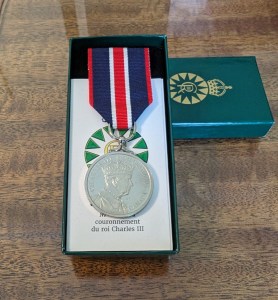
King Charles III Coronation Medal Presentation

Please join us for a formal presentation of the King Charles III Coronation Medal to Branch President, Michael Barbour.  The event is scheduled for Monday, 10 March at 11am at the Canadian Consulate in San Francisco – located at 580 California Street in Suite 1400.

Immediately following the presentation, members of the Branch will be having a no host lunch at Wayfare Tavern (558 Sacramento St, San Francisco, CA 94111).  The menu is available at https://www.wayfaretavern.com/

If you are interested in attending, you must RSVP to mkbarbour@gmail.com by the end of the Tuesday, March 4th – as it is required by the Consulate for security purposes (and will allow us to make an accurate reservation for lunch).

🍁 Dispatch on the 60th Anniversary of the Canadian Flag | 🍁 Communication du Président à l’occasion du 60e anniversaire du drapeau canadien

An item from the folks at the Juno Beach Centre on Flag Day.


View this email in your browser

Dear Canadians,

As President of Canada’s Second World War museum on the D-Day landing beaches, I am honoured to help preserve and share the stories of Canadians who fought for freedom and democracy. The Juno Beach Centre stands as a testament to our country’s courage, sacrifice, and values.

Since we call Juno Beach our home, we fly the flags of our country’s allies who participated in the Normandy landings, including the Stars and Stripes—honouring the American servicemen and women who fought alongside Canadians.

Recently, I’ve been reflecting on the Canada-US relationship. It’s hard to ignore the news about President Donald Trump’s remarks, including the suggestion that Canada could become the 51st state.

I believe it’s important to set the record straight. Canada is a proud nation with a rich history and culture. Our story is unique, and it is one worth celebrating and defending.

At the Juno Beach Centre, we share countless stories that highlight Canada’s independent spirit and its deep commitment to freedom. Our visitors (including 4,800 Americans in 2024 alone) learn that Canada joined the fight against Nazi Germany in 1939—a full two years before our American neighbours. Many Americans even travelled north to join the Canadian armed forces and stand against tyranny.

Canadians and Americans worked together to make D-Day a success. The 31st Canadian Minesweeping Flotilla cleared the approaches to Omaha Beach, ensuring safe passage for American troops. The Canadian Army depended on US-supplied weapons and equipment, like the Sherman tanks used by the assault forces on Juno Beach.

Canada and the USA are strongest when they stand together as partners, each with its own identity and values.
But let me be clear: Canada could never become another state in the American Union. The Juno Beach Centre itself is proof of this.

Come discover how Canada’s unique culture of remembrance was forged by two world wars, and Canada’s civil and military history from 1945 to today. Our newest permanent exhibition, Faces of Canada Today, lets visitors discover the Canada that emerged from the Second World War. The gallery illustrates how modern Veterans continue to serve the ideals of stability, prosperity and peace.

I am proud to lead an organization that serves as a living memorial to one of our proudest moments and a gateway to learning about countless others. The Juno Beach Centre is a reflection of our national identity, a reminder of our history, and an inspiration for our future.

So, I ask you to rally around Canadian symbols like the Maple Leaf and never sacrifice your principles. Fight for our magnificent country and the values our Veterans defended!

The American flag will continue to fly above Juno Beach to honour the American servicemen and women who fought beside our troops—but it will never replace our Canadian flag.

Sincerely,

Chris LaBossiere
President, Juno Beach Centre Association

Sponsor a flag and help the Juno Beach Centre share our unique and proud heritage!

Sponsor a Flag

Chers Canadiens et Canadiennes,

En tant que président du musée canadien de la Seconde Guerre mondiale sur les plages du débarquement du Jour J, j’ai l’honneur de contribuer à préserver et à partager les histoires des Canadiens qui se sont battus pour la liberté et la démocratie. Le Centre Juno Beach témoigne du courage, du sacrifice et des valeurs de notre pays.

Ici, sur Juno Beach, flottent fièrement les drapeaux de toutes les nations alliées qui ont combattu côte à côte pendant le débarquement de Normandie, y compris la bannière étoilée de nos voisins américains.

Récemment, j’ai réfléchi aux relations entre le Canada et les États-Unis. Il est difficile d’ignorer les nouvelles concernant les remarques du président Donald Trump, y compris la suggestion que le Canada pourrait devenir le 51e État.
Je crois qu’il est important de mettre les choses au clair. Le Canada est une nation fière, dotée d’une histoire et d’une culture riches. Notre histoire est unique et mérite d’être célébrée et défendue.

Au Centre Juno Beach, nous partageons d’innombrables histoires qui mettent en lumière l’esprit d’indépendance du Canada et son profond attachement à la liberté. Nos visiteurs (dont 4 800 Américains rien qu’en 2024) apprennent que le Canada s’est engagé dans la lutte contre l’Allemagne nazie en 1939, soit deux ans avant nos voisins américains. Durant ces premières années sombres, des volontaires américains ont traversé notre frontière pour rejoindre les forces armées canadiennes.

Canadiens et Américains ont travaillé ensemble pour faire du Jour J un succès. La 31e flottille canadienne de déminage a nettoyé les abords de la plage d’Omaha, garantissant ainsi un passage sûr aux troupes américaines. L’armée canadienne dépendait d’armes et d’équipements fournis par les États-Unis, comme les chars Sherman utilisés par les forces d’assaut sur la plage de Juno Beach.

Le Canada et les États-Unis sont plus forts lorsqu’ils s’unissent en tant que partenaires, chacun ayant sa propre identité et ses propres valeurs.

Mais soyons clairs : le Canada ne pourra jamais devenir un autre État de l’Union américaine. Le Centre Juno Beach lui-même en est la preuve.

Venez découvrir comment la culture mémorielle unique du Canada a été forgée par deux guerres mondiales, et l’histoire civile et militaire du Canada de 1945 à aujourd’hui. Notre plus récente exposition permanente, Visages du Canada d’aujourd’hui, permet aux visiteurs de découvrir le Canada qui a émergé de la Seconde Guerre mondiale. La salle illustre comment les vétérans d’aujourd’hui continuent de servir les idéaux de stabilité, de prospérité et de paix.

Je suis fier de diriger une organisation qui sert de mémorial vivant à l’un des moments dont nous sommes le plus fiers et de passerelle pour en apprendre davantage sur d’innombrables autres. Le Centre Juno Beach est un reflet de notre identité nationale, un rappel de notre histoire et une source d’inspiration pour notre avenir.

Je vous demande donc de vous rallier aux symboles canadiens comme l’unifolié et de ne jamais sacrifier vos principes. Luttez pour notre magnifique pays et pour les valeurs que nos vétérans ont défendues !

Le drapeau américain continuera de flotter au-dessus de Juno Beach en hommage aux militaires américains qui ont combattu aux côtés de nos troupes, mais il ne remplacera jamais notre drapeau canadien.

Je vous prie d’agréer l’expression de mes sentiments distingués,

Chris LaBossiere
Président, L’Association du Centre Juno Beach au Canada

Parrainez un drapeau et aidez le Centre Juno Beach à partager son patrimoine unique et fier !

Parrainez un drapeau
Twitter
https://www.facebook.com/JunoBeachCentre
Instagram
Website
Copyright © 2024 Juno Beach Centre Association (Canada), All rights reserved.
You are receiving this e-mail because you subscribed on our website, a sign-up form, or through an event. Thank you for your interest in the Juno Beach Centre! Vous recevez cet e-mail parce que vous vous êtes inscrit sur notre site Web, un formulaire d’inscription ou via un événement. Merci de votre intérêt pour le Centre Juno Beach!
Centre Juno Beach:
Voie des Français Libres, BP 104
14470 Courseulles-sur-Mer, France
Office in Canada:
Unit 44 – 760 Brant Street
Burlington, Ontario
L7R 4B7

National Flag of Canada Day

Check out this information from Heritage Canada.


National Flag of Canada Day — February 15

At the stroke of noon on February 15, 1965, Canada’s red and white maple leaf flag was raised for the very first time on Parliament Hill. On the same day in 1996, National Flag of Canada Day was declared.

Our national flag is a symbol that unites Canadians and reflects the common values we take pride in — democracy, inclusion and equity.

On February 15, let’s celebrate 60 years of our Canadian flag!

More information and resources available at https://www.canada.ca/en/canadian-heritage/campaigns/national-flag-canada-day.html