Category Archives: Canadian Studies Program UC Berkeley

This week: Breaking down the trucker protests and Canada’s Afghan legacy

A newsletter from one of our fellow Canadian organizations in the Bay Area.


Canadian Studies Announcements
In this issue:
  • Upcoming event: Hildebrand Graduate Research Showcase
  • Applications open for student research funding
  • Event Recap: “Models for Repatriation of Indigenous Cultural Property from First Nations, Canada”
  • Mark your calendars: Big Give is March 10!
  • External event: Ground Truth Briefing: The Canadian Trucker Protests
  • External event: Hindsight Up Front: Canada’s Takeaways from Afghanistan
  • External event: Book talk on Bootlegged Aliens: Immigration Politics on America’s Northern Border
NEXT EVENT
Hildebrand Graduate Research Showcase
Tuesday, March 15 | 12:30 pm PT | 223 Moses Hall | RSVP here
Learn about the research Canadian Studies funds through our Edward Hildebrand Graduate Research Fellowships, as recipients present short overviews of their projects. This panel will have a special focus on the environment, development, and Indigenous resource sovereignty. This event will be held in-person as well as broadcast via Zoom.
Mindy Price, Ph.D. candidate, Environmental Science, Policy, and Management
“New Agricultural Frontiers: Land, Labor and Sovereignty in the Northwest Territories, Canada”
Now more than 1º Celsius warmer than a century ago and warming at three times the global average, the Arctic and Subarctic are being reimagined as a new frontier for food production. Despite a growing body of evidence that climate change will enable new possibilities for agriculture in the North, much research remains agnostic about how northern agricultural development will affect communities and landscapes and the relations between them. Mindy uses archival research and ethnography in three extended case studies to examine the implications of agriculture development on the social relations of production and consumption in the Northwest Territories, Canada.
Aaron Gregory, Ph.D. student, City and Regional Planning
“Kinship Infrastructures: Indigenous Energy Autonomy and Regulatory Sea Change in Beecher Bay”
Aaron’s research explores the social, technical, and regulatory impacts of a renewable energy system developed by the Scia’new First Nation in Beecher Bay, British Columbia. He examines this project as an emergent approach to Indigenous environmental governance, an infrastructural solution responding to the problem of Indigenous energy sovereignty, and a regulatory provocation designed to challenge a provincial monopoly on energy production and distribution.
Applications open for student research funding
The Canadian Studies Program is currently accepting applications for the Edward Hildebrand Graduate Research Fellowship for Summer 2022 and AY 2022-23. The application is open to any UC Berkeley graduate student whose work focuses primarily or comparatively on Canada. This fellowship is meant to cover direct research costs.
The deadline for summer applications is March 11; applications for AY 22-23 must be submitted by May 6. Please visit our website for more information and full eligibility criteria, and help us share this information with your friends and networks!
The program also accepts requests for undergraduate research support. Undergraduate applications be reviewed on a case-by-case basis.
Event Recap: Models for Repatriation of Indigenous Cultural Property from First Nations, Canada
Last week, Canadian Studies hosted a special panel discussing the work Native people across the US and Canada are doing to rethink policies for collections of Indigenous cultural goods. The panel was composed of several cultural experts affiliated with Canadian First Nations: Lou-ann Neel and Michelle Washington, repatriation specialists at the Royal BC Museum, and Dr. Louis Lesage, a cultural officer of the Huron-Wendat Nation. The panel was moderated by Professor Sabrina Agarwal, an anthropologist and Canadian Studies affiliate who chairs UC Berkeley’s NAGPRA Advisory Committee.
All three panelists discussed their work to repatriate important cultural artefacts and ancestral remains to their tribes of origin. They stressed the importance of recognizing the colonialist intent of many museum collections, and how that history must be confronted to make museum spaces more welcoming to Indigenous visitors and other minority groups. Pointing to their own experiences with Canadian museums and universities, they impressed how essential it is for curators to engage directly and honestly with tribal representatives. However, while each noted the importance of direct engagement between institutions and First Nations people, they stressed this is not enough, and advocated for laws to protect Indigenous cultural heritage and rights.
For those who were unable to join the panel or have additional interest in the subject, we are happy to provide additional resources on the work our panelists have done on repatriation and cultural policy.
We encourage you to read the Royal BC Museum’s Report to British Columbians for a thorough overview of its recent policy reorientation. Thanks in part to Ms. Neel’s work, the museum is now considered a leader in this space. This document draws on her previous work for the museum in composing its Indigenous Repatriation Handbook.
For those interested in making “living museums”, Michelle Washington helped create the exhibit “Our Living Languages” at the Royal BC Museum. As explained in the Victoria News, the exhibit aimed to take Indigenous people and culture out of the realm of history and place them firmly in the present. Ms. Washington’s work for the museum was also profiled in the Toronto Star at the beginning of this month.
For those interested in Dr. Lesage’s work in recovering ancestral remains from the University of Toronto, please see his article “The Repatriation of Wendat Ancestors, 2013“. The article covers the context of the transfer, as well as its broader significance in the movement to create institutional policies that respect Indigenous voices and tradition.
Finally, learn more about Professor Agarwal’s work at UC Berkeley by visiting the homepage for UC Berkeley NAGPRA. This page contains links to new policy guidelines, reports on university’s Native American collections, and updates on recent repatriations. Hear more about the campus’ current repatriation philosophy here.
Mark your calendars – Big Give is next month!
It’s that time of the year again! On March 10, show your support for Canadian studies by making a donation on Big Give, Berkeley’s annual day of giving. Your gift supports quality research and events on Canada, and affirms the value of our program. We’ll follow up with more information soon, but remember – no matter the size, your gift can have a big impact!
EXTERNAL EVENTS
Ground Truth Briefing: The Canadian Trucker Protests
Thursday, February 17 | 8 am PT | Online | RSVP here
Join the Wilson Center’s Canada Institute for a special event covering the ongoing trucker protests in Canada, featuring former Ontario cabinet minister Monique Smith and Senior Vice President of Global Public Affairs Philip Cartwright. The protests, which began as a convoy that traveled across the country from British Columbia to Ontario, have paralyzed Canada’s capital city and blocked critical arteries for trade along the US-Canadian border. Ontario’s government declared a state of emergency on February 11 as automotive plants across the province halted operations due to supply shortages caused by blockades at the busiest land crossing between the United States and Canada. The event will be moderated by Canada Institute analyst Xavier Delgado.
Hindsight Up Front: Canada’s Takeaways from Afghanistan
Thursday, February 17 | 12 pm PT | Online | RSVP here
The Wilson Center’s Canada Institute and Asia Program invite you to discussion of Canada’s role in the war in Afghanistan, part of their Hindsight Up Front initiative. In February 2002, the first Canadian infantry battle group arrived in Kandahar, marking the start of Canada’s twelve-year military presence in the country. Twenty years on from that first deployment, Janice Stein and Eugene Lang, co-authors of The Unexpected War: Canada in Kandahar reflect on lessons learned from Canada’s mission in Afghanistan and the implications for future U.S.-Canadian military collaboration. Their 2007 book became a national best-seller which won the Writer’s Trust Cohen Award for political writing and was short-listed for the Donner Prize for the best book on Canadian public policy. The discussion will be moderated by Canada Institute director and Berkeley Canadian Studies board member Christopher Sands.
Book Talk: Bootlegged Aliens: Immigration Politics on America’s Northern Border
Friday, February 18 | 12 pm PT | Online | RSVP here
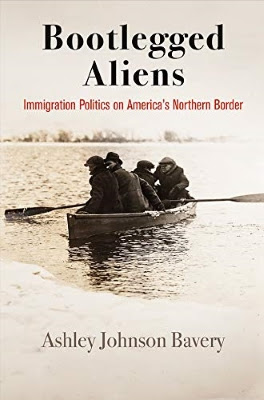
Join Professor Ashley Johnson Bavery for a discussion of her new book, Bootlegged Aliens. The book explores immigration on America’s northern border before World War II, situating Detroit, Michigan as America’s epicenter for unauthorized immigration. In this industrial center, thousands of Europeans crossed the border from Canada each year, prompting nativist backlash and complicating the labor politics of the automobile industry. This event is jointly hosted by the Center for Comparative Immigration Studies at UC San Diego and UCLA Center for the Study of International Migration. UCLA professor Tobias Higbie will join as a discussant.
Ashley Johnson Bavery is assistant professor of history at Eastern Michigan University. Her work has appeared in the Journal of Urban History and the Journal of American History and her book, Bootlegged Aliens: Immigration Politics on America’s Northern Border (2020) won the First Book Award from the Immigration and Ethnic History Society.
Tobias Higbie is a professor of history and labor studies at UCLA, the chair of the Labor Studies and the associate director of the Institute for Research on Labor and Employment. His research explores social movements, migration, and the politics of community in the United States. Higbie’s most recent book, Labor’s Mind: A History of Working Class Intellectual Life (2019), recovers the social world of self-educated working people and the politics of working-class identity during the early 20th century.
Canadian Studies Program
213 Moses Hall #2308
Canadian Studies Program | Univ. of California, Berkeley, 213 Moses Hall #2308, Berkeley, CA 94720

Repatriating Indigenous artefacts; free speech; Black History Month; Queen’s Jubilee

An item from one of our fellow Canadian organizations in the Bay Area.


Canadian Studies Announcements
In this issue:
  • Tomorrow: “Models for Repatriation of Indigenous Cultural Property from First Nations, Canada”
  • Cosponsored event: “Legal and Constitutional Protections for Free Speech in Academia in the US, UK, and Canada”
  • Canada celebrates Black History Month
  • Elizabeth II marks 70 years as Queen of Canada
  • External event: Book talk on Bootlegged Aliens: Immigration Politics on America’s Northern Border
TOMORROW
Panel Discussion: Models for Repatriation of Indigenous Cultural Property from First Nations, Canada
Tuesday, February 8 | 12:30 pm PT | Online | RSVP here
How can repatriation be built from mutual respect, cooperation and trust? North American museums and institutions have historically engaged in the collection and categorization of Indigenous cultural property and knowledge without the consent or active involvement of Indigenous people. The Native American Graves Protection and Repatriation Act (NAGPRA) was enacted in 1990 to return Native American “cultural items” to lineal descendants and culturally affiliated American Indian tribes, Alaska Native villages, and Native Hawaiian organizations. Despite this and further state legislation, many institutions including the University of California, have obfuscated or denied repatriation claims. Across the border, the Canadian government does not currently have legislation addressing the repatriation of Indigenous Ancestors and cultural heritage, but is working to create national support for repatriation through legislation Bill C-391. Some Canadian provinces have passed repatriation acts or provincial museum polices that have facilitated the return of ancestors and belongings. This panel discussion seeks to learn from what is being done in Canada. What is the cultural and nuanced work that builds successful repatriations? How can repatriation and indigenizing the institution from within preserve and strengthen tribal cultural heritage?
Join Canadian Studies affiliate Sabrina Agarwal (Professor of anthropology and chair of the UC Berkeley NAGPRA Advisory Committee) in conversation with Dr. Louis Lesage (Director, Nionwentsïo Office, Huron-Wendat Nation), Lou-ann Neel (Curator and Acting Head of Indigenous Collections and Repatriation Department, Royal BC Museum), and Michelle Washington (Repatriation Specialist, Royal BC Museum) to explore these questions and hear about their experiences in repatriation.
Image: Kwakwaka’wakw house posts from British Columbia in the Hearst Museum of Anthropology, UC Berkeley.
COSPONSORED EVENT
Legal and Constitutional Protections for Free Speech in Academia in the US, UK, and Canada
Friday, February 11 | 10 am PT | Online | Join via Zoom
The Public Law and Policy Program and the Anglo-American Legal Studies Program at the UC Berkeley School of Law invite you to an expert discussion comparing traditions and laws around free speech in university settings in three common law jurisdictions: the United Kingdom, United States, and Canada.
Professor Eric Kaufmann of the University of London, who is Canadian, will be participating from London. He will discuss his research on freedom of speech in academia in the U.S., the U.K. and Canada as well as proposed legislation in the U.K. parliament to protect free speech in colleges and universities in the UK.
Professor Nadine Strossen of the New York School of Law and former head of the ACLU will join from New York. She will comment on Professor Kaufmann’s findings, her own work on this subject, and legal and policy implications of the proposed legislation.
Professor Keith Whittington of Princeton University and Dean Erwin Chemerinsky of the UC Berkeley School of Law will participate from Berkeley. They will also comment on Professor Kaufmann’s research and recommendations for legislation.
Steven Hayward of UC Berkeley will serve as moderator.
Please visit the Public Law and Policy website for more information.
Canada Celebrates Black History Month
In both the United States and Canada, February is Black History Month. Originating in the US in the 1970s, the commemoration was adopted by Canada in 1995 as celebration of the contributions of African-descended people to Canadian society and culture. Black people have resided in Canada since the early colonial period, and made up 3.5% of its population as of 2016.
In Canada, the government has updated its official Black History Month website to reflect this year’s theme: “February and Forever: Celebrating Black History today and every day”. Prime Minister Trudeau issued an official statement, affirming that “Black history is Canadian history” and encouraged Canadians of all backgrounds to learn more about that history. He also reaffirmed his commitment to combatting racism and discrimination towards people of African descent, and pledged a number of targeted programs to help the Black community.
Official celebrations will take place next week, on February 17th, via Facebook Live. The Canadian Embassy in the US is also promoting a slate of special events through its Connect2Canada page.
For topical reading, we recommend Canadian Studies affiliate Cecil S. Giscombe’s new book of poems Similarly, which Publisher’s Weekly called “a powerful, understated meditation on place, ancestry and time” set in the landscapes of the US and Canada.
Elizabeth II Marks 70 Years as Queen of Canada
On Sunday, Queen Elizabeth II celebrated her Platinum Jubilee, marking seventy years as monarch of Canada. The Queen, who turns 96 in April, ascended to the throne in 1952, and is currently the world’s oldest and longest-serving monarch.
Prime Minister Trudeau sent his congratulations to the Queen in an official statement thanking her for her seven decades of service. Noting that this is the first Platinum Jubilee in Canadian history, the Prime Minister recognized the many milestones the Queen has overseen during her reign, including the 100th anniversary of Confederation in 1967 and the Constitution Act of 1982.
Political scientists agree, saying the Queen has created a strong legacy in Canada, and adapted along with Canada as it became an independent state. Simon Fraser University professor Andrew Heard says that the Queen’s personal interactions with ordinary Canadians and genuine affection for Canada have been key to her success as a public figure. During her reign, the Queen has made 31 visits to Canada, including 20 official tours. Over time, she has evolved to present herself in a distinctly Canadian capacity. Heard says Canadians’ support for the monarchy is largely based on the Queen’s personal popularity – an act which may be difficult for her successor to follow.
Official celebrations of the Queen’s Jubilee will take place in June across Canada, Britain, and other Commonwealth realms. While festivities will be more muted than previous jubilees due to pandemic restrictions, the Canadian government has announced a number of special initiatives, including beacons in Ottawa and other major cities; commemorative stamps and coins; and grants for community celebrations such as parades, concerts, and festivals.
EXTERNAL EVENTS
Book Talk: Bootlegged Aliens: Immigration Politics on America’s Northern Border
Friday, February 18 | 12 pm PT | Online | RSVP here
Join Professor Ashley Johnson Bavery for a discussion of her new book, Bootlegged Aliens. The book explores immigration on America’s northern border before World War II, situating Detroit, Michigan as America’s epicenter for unauthorized immigration. In this industrial center, thousands of Europeans crossed the border from Canada each year, prompting nativist backlash and complicating the labor politics of the automobile industry. This event is jointly hosted by the Center for Comparative Immigration Studies at UC San Diego and UCLA Center for the Study of International Migration. UCLA professor Tobias Higbie will join as a discussant.
Ashley Johnson Bavery is assistant professor of history at Eastern Michigan University. Her work has appeared in the Journal of Urban History and the Journal of American History and her book, Bootlegged Aliens: Immigration Politics on America’s Northern Border (2020) won the First Book Award from the Immigration and Ethnic History Society.
Tobias Higbie is a professor of history and labor studies at UCLA, the chair of the Labor Studies and the associate director of the Institute for Research on Labor and Employment. His research explores social movements, migration, and the politics of community in the United States. Higbie’s most recent book, Labor’s Mind: A History of Working Class Intellectual Life (2019), recovers the social world of self-educated working people and the politics of working-class identity during the early 20th century.
Canadian Studies Program
213 Moses Hall #2308
Canadian Studies Program | Univ. of California, Berkeley, 213 Moses Hall #2308, Berkeley, CA 94720

Happy Year of the Tiger! 🐯 Protecting academic free speech; innovating Inuit throat singing

A newsletter from one of our fellow Canadian organizations in the Bay Area.


Canadian Studies Announcements
In this issue:
  • Happy Year of the Tiger!
  • Next week: “Models for Repatriation of Indigenous Cultural Property from First Nations, Canada”
  • Cosponsored event: “Legal and Constitutional Protections for Free Speech in Academia in the US, UK, and Canada”
  • The New Yorker reviews Tongues, the new album from Inuit singer Tanya Tagaq
  • Grant deadline tomorrow: British Library Visiting Fellowships
  • External event: “Boeing 737 MAX: Money, Machines, and Morals in Conflict”
  • External event: “Canadian Minister of Northern Affairs Dan Vandal: Building A Strong, Sustainable North”
  • External event: Book talk on Bootlegged Aliens: Immigration Politics on America’s Northern Border
Happy Year of the Tiger!
Canadian Studies wishes a happy and prosperous Year of the Tiger to our friends around the world! While the Lunar New Year is often most associated with (and referred to as) the Chinese New Year, it is actually celebrated by a variety of East Asian cultures. While COVID is dampening celebrations for the third year in a row, the CBC checked in with several Ottawa families to see how they were continuing their cherished New Year traditions in spite of the pandemic. And in San Francisco, Chinatown business owners hope this New Year is the turning point for a better 2022.
Image: Chinese New Year vector created by Freepik – www.freepik.com.
NEXT WEEK
Panel Discussion: Models for Repatriation of Indigenous Cultural Property from First Nations, Canada
Tuesday, February 8 | 12:30 pm PT | Online | RSVP here
How can repatriation be built from mutual respect, cooperation and trust? North American museums and institutions have historically engaged in the collection and categorization of Indigenous cultural property and knowledge without the consent or active involvement of Indigenous people. The Native American Graves Protection and Repatriation Act (NAGPRA) was enacted in 1990 to return Native American “cultural items” to lineal descendants and culturally affiliated American Indian tribes, Alaska Native villages, and Native Hawaiian organizations. Despite this and further state legislation, many institutions including the University of California, have obfuscated or denied repatriation claims. Across the border, the Canadian government does not currently have legislation addressing the repatriation of Indigenous Ancestors and cultural heritage, but is working to create national support for repatriation through legislation Bill C-391. Some Canadian provinces have passed repatriation acts or provincial museum polices that have facilitated the return of ancestors and belongings. This panel discussion seeks to learn from what is being done in Canada. What is the cultural and nuanced work that builds successful repatriations? How can repatriation and indigenizing the institution from within preserve and strengthen tribal cultural heritage?
Join Canadian Studies affiliate Sabrina Agarwal (Professor of anthropology and chair of the UC Berkeley NAGPRA Advisory Committee) in conversation with Dr. Louis Lesage (Director, Nionwentsïo Office, Huron-Wendat Nation), Lou-ann Neel (Curator and Acting Head of Indigenous Collections and Repatriation Department, Royal BC Museum), and Michelle Washington (Repatriation Specialist, Royal BC Museum) to explore these questions and hear about their experiences in repatriation.
Image: Kwakwaka’wakw house posts from British Columbia in the Hearst Museum of Anthropology, UC Berkeley.
COSPONSORED EVENT
Legal and Constitutional Protections for Free Speech in Academia in the US, UK, and Canada
Friday, February 11 | 10 am PT | Online | RSVP forthcoming
The Public Law and Policy Program and the Anglo-American Legal Studies Program at the UC Berkeley School of Law invite you to an expert discussion comparing traditions and laws around free speech in university settings in three common law jurisdictions: the United Kingdom, United States, and Canada.
Professor Eric Kaufmann of the University of London, who is Canadian, will be participating from London. He will discuss his research on freedom of speech in academia in the U.S., the U.K. and Canada as well as proposed legislation in the U.K. parliament to protect free speech in colleges and universities in the UK.
Professor Nadine Strossen of the New York School of Law and former head of the ACLU will join from New York. She will comment on Professor Kaufmann’s findings, her own work on this subject, and legal and policy implications of the proposed legislation.
Professor Keith Whittington of Princeton University and Dean Erwin Chemerinsky of the UC Berkeley School of Law will participate from Berkeley. They will also comment on Professor Kaufmann’s research and recommendations for legislation.
Steven Hayward of UC Berkeley will serve as moderator.
Please check the Public Law and Policy website above for forthcoming RSVP information.
The New Yorker Reviews Tongues, the New Album from Inuit Throat-Singer Tanya Tagaq
Canadian Inuit singer Tanya Tagaq has worked hard to bring the Inuit tradition of throat-singing to a wider audience. But her award-winning performances are anything but conventional, blending the ancient Inuit techniques with contemporary music production and spoken word poetry. Last week Sheldon Piece, music writer and editor for The New Yorker, gave a glowing review to Tagaq’s latest album, Tongues, which he calls her boldest and most experimental yet:
“The Canadian Inuit throat singer Tanya Tagaq makes music that seems to cleanse the body. The form that she practices uses guttural sounds and breaths to produce a physical performance of groans, gasps, and sighs, conjuring a sonic landscape which is by turns rhythmic and melodic. Her performing, at once animalistic and operatic, brings a spirit of experimentation to an old tradition… It is her technique and vision that have made her one of the most celebrated and innovative practitioners of her culture’s visceral style.”
Read the full piece online via The New Yorker.
Grant Deadline Tomorrow: British Library Visiting Fellowships
Application deadline: February 1, 2022, 9:00 am PT
Applications are due tomorrow for the 2022 Visiting Fellowships at Eccles Centre for American Studies at the British Library in London. These fellowships are open to academics, postgraduate students, creatives and independent scholars and cover all regions of the Americas, including Canada. For more information about the fellowship programme, please look here. The deadline for applications is 5pm GMT (9:00 pm PT) on Tuesday, 1 February 2022 and the Fellowship needs to be taken by 30 April 2024. For more information about the four themes, please look here.
EXTERNAL EVENTS
Boeing 737 MAX: Money, Machines, and Morals in Conflict
Tuesday, February 1 | 2 pm PT | Online | RSVP here
Canadian Studies faculty affiliate Brian Barsky addresses the troubled development of the Boeing 737 MAX, which crashed twice within its first two years of commercial flight, leaving no survivors. Professor Barsky has been personally involved in the investigation of this disaster. He was featured prominently in a recent Smithsonian documentary, and his full-page op-ed in The Globe and Mail was debated in the Parliament of Canada. Professor Barsky will elucidate how these tragedies were the consequence of a corporation prioritizing profits over safety as well as of regulatory capture of the government agency which was derelict in its duty to protect the public. This event is sponsored by the Berkeley Retirement Center.
Canadian Minister of Northern Affairs Dan Vandal: Building a Strong, Sustainable North
Friday, February 4 | 10 am PT | Online | RSVP here
The Government of Canada, Indigenous peoples, and 6 territorial and provincial governments came together to develop Canada’s Arctic and Northern Policy Framework, a transformative vision of the future where northern and Arctic people are thriving, strong and safe. The Framework includes goals relating to eight overarching themes—people and communities, strong economies, comprehensive infrastructure, environment and biodiversity, science and Indigenous knowledge, global leadership, safety, security and defence, and reconciliation. It incorporates regional and distinctions-based lenses while integrating domestic and international dimensions. Canada’s Minister of Northern Affairs, Daniel Vandal, will discuss federal, Indigenous, and community-driven partnerships and programs to address short-term and long-term climate change adaptation and mitigation, supporting healthy ecosystems in the Arctic and North in a conversation by moderated by Jothsna Harris.
Book Talk: Bootlegged Aliens: Immigration Politics on America’s Northern Border
Friday, February 18 | 12 pm PT | Online | RSVP here
Join Professor Ashley Johnson Bavery for a discussion of her new book, Bootlegged Aliens. The book explores immigration on America’s northern border before World War II, situating Detroit, Michigan as America’s epicenter for unauthorized immigration. In this industrial center, thousands of Europeans crossed the border from Canada each year, prompting nativist backlash and complicating the labor politics of the automobile industry. This event is jointly hosted by the Center for Comparative Immigration Studies at UC San Diego and UCLA Center for the Study of International Migration. UCLA professor Tobias Higbie will join as a discussant.
Ashley Johnson Bavery is assistant professor of history at Eastern Michigan University. Her work has appeared in the Journal of Urban History and the Journal of American History and her book, Bootlegged Aliens: Immigration Politics on America’s Northern Border (2020) won the First Book Award from the Immigration and Ethnic History Society.
Tobias Higbie is a professor of history and labor studies at UCLA, the chair of the Labor Studies and the associate director of the Institute for Research on Labor and Employment. His research explores social movements, migration, and the politics of community in the United States. Higbie’s most recent book, Labor’s Mind: A History of Working Class Intellectual Life (2019), recovers the social world of self-educated working people and the politics of working-class identity during the early 20th century.
Canadian Studies Program
213 Moses Hall #2308
Canadian Studies Program | Univ. of California, Berkeley, 213 Moses Hall #2308, Berkeley, CA 94720

New faculty affiliate studies politics of climate change; mapping the future of the Arctic

A newsletter from a fellow Canadian organization in the Bay Area.


Canadian Studies Announcements
In this issue:
  • Upcoming panel discussion: “Models for Repatriation of Indigenous Cultural Property from First Nations, Canada”
  • New faculty affiliate, Daniel Aldana Cohen, studies politics of climate change
  • External event: “Canadian Minister of Northern Affairs Dan Vandal: Building A Strong, Sustainable North”
  • External event: Book talk on Bootlegged Aliens: Immigration Politics on America’s Northern Border
UPCOMING EVENT
Panel Discussion: Models for Repatriation of Indigenous Cultural Property from First Nations, Canada
Tuesday, February 8 | 12:30 pm | Online | RSVP here
How can repatriation be built from mutual respect, cooperation and trust? North American museums and institutions have historically engaged in the collection and categorization of Indigenous cultural property and knowledge without the consent or active involvement of Indigenous people. The Native American Graves Protection and Repatriation Act (NAGPRA) was enacted in 1990 to return Native American “cultural items” to lineal descendants and culturally affiliated American Indian tribes, Alaska Native villages, and Native Hawaiian organizations. Despite this and further state legislation, many institutions including the University of California, have obfuscated or denied repatriation claims. Across the border, the Canadian government does not currently have legislation addressing the repatriation of Indigenous Ancestors and cultural heritage, but is working to create national support for repatriation through legislation Bill C-391. Some Canadian provinces have passed repatriation acts or provincial museum polices that have facilitated the return of ancestors and belongings. This panel discussion seeks to learn from what is being done in Canada. What is the cultural and nuanced work that builds successful repatriations? How can repatriation and indigenizing the institution from within preserve and strengthen tribal cultural heritage?
Join Canadian Studies affiliate Sabrina Agarwal (Professor of anthropology and chair of the UC Berkeley NAGPRA Advisory Committee) in conversation with Dr. Louis Lesage (Director, Nionwentsïo Office, Huron-Wendat Nation), Lou-Ann Neel (Curator and Acting Head of Indigenous Collections and Repatriation Department, Royal BC Museum), and Michelle Washington (Repatriation Specialist, Royal BC Museum) to explore these questions and hear about their experiences in repatriation.
Image: Kwakwaka’wakw house posts from British Columbia in the Hearst Museum of Anthropology, UC Berkeley.
New Faculty Affiliate Daniel Aldana Cohen Studies Politics of Climate Change
Canadian Studies is pleased to welcome professor Daniel Aldana Cohen, an assistant professor of sociology, as our newest program affiliate.
Professor Cohen joined the Berkeley faculty in July 2021. He completed his undergraduate schooling at McGill University, where he was also editor of the McGill Daily, and received a master’s and doctorate in sociology from New York University. He is also an Azrieli Global Scholar with CIFAR, a Toronto-based organization that provides support for outstanding early-career researchers studying the most important questions facing science and humanity.
Professor Cohen’s research focuses on the politics of climate crises, investigating the intersections of climate change, housing, political economy, social movements, and inequalities of race and social class in the United States and Brazil. He conducts comparative qualitative research on social movements and elite climate policymaking, as well as creating equitable, practical pathways to a low-carbon emissions future.
Professor Cohen is director of the Socio-Spacial Climate Collaborative, or (SC)2, a hub for critical social science research on climate change, and is a founding co-director of the Climate and Community Project. He has served as a policy advisor to several nonprofits and American political campaigns. His writing has appeared in publications including Nature, The Guardian, The Washington Post, Jacobin, and Vox, and he co-hosts the Dissent magazine affiliated podcast Hot & Bothered: A Climate Podcast for the 99%. He co-authored the book A Planet to Win: Why We Need a Green New Deal (2019), and is currently working on his next book, Street Fight: Climate Change and Inequality in the 21st Century City. Professor Cohen can be found on Twitter at @aldatweets.
EXTERNAL EVENTS
Canadian Minister of Northern Affairs Dan Vandal: Building a Strong, Sustainable North
Friday, February 4 | 10 am PT | Online | RSVP here
The Government of Canada, Indigenous peoples, and 6 territorial and provincial governments came together to develop Canada’s Arctic and Northern Policy Framework, a transformative vision of the future where northern and Arctic people are thriving, strong and safe. The Framework includes goals relating to eight overarching themes—people and communities, strong economies, comprehensive infrastructure, environment and biodiversity, science and Indigenous knowledge, global leadership, safety, security and defence, and reconciliation. It incorporates regional and distinctions-based lenses while integrating domestic and international dimensions. Canada’s Minister of Northern Affairs, Daniel Vandal, will discuss federal, Indigenous, and community-driven partnerships and programs to address short-term and long-term climate change adaptation and mitigation, supporting healthy ecosystems in the Arctic and North in a conversation by moderated by Jothsna Harris.
Book Talk: Bootlegged Aliens: Immigration Politics on America’s Northern Border
Friday, February 18 | 12 pm PT | Online | RSVP here
Join Professor Ashley Johnson Bavery for a discussion of her new book, Bootlegged Aliens. The book explores immigration on America’s northern border before World War II, situating Detroit, Michigan as America’s epicenter for unauthorized immigration. In this industrial center, thousands of Europeans crossed the border from Canada each year, prompting nativist backlash and complicating the labor politics of the automobile industry. This event is jointly hosted by the Center for Comparative Immigration Studies at UC San Diego and UCLA Center for the Study of International Migration. UCLA professor Tobias Higbie will join as a discussant.
Ashley Johnson Bavery is assistant professor of history at Eastern Michigan University. Her work has appeared in the Journal of Urban History and the Journal of American History and her book, Bootlegged Aliens: Immigration Politics on America’s Northern Border (2020) won the First Book Award from the Immigration and Ethnic History Society.
Tobias Higbie is a professor of history and labor studies at UCLA, the chair of the Labor Studies and the associate director of the Institute for Research on Labor and Employment. His research explores social movements, migration, and the politics of community in the United States. Higbie’s most recent book, Labor’s Mind: A History of Working Class Intellectual Life (2019), recovers the social world of self-educated working people and the politics of working-class identity during the early 20th century.
Canadian Studies Program
213 Moses Hall #2308
Canadian Studies Program | Univ. of California, Berkeley, 213 Moses Hall #2308, Berkeley, CA 94720

New migration data resource; when Detroit was an immigration hub

A newsletter from a fellow Canadian organization in the Bay Area.


Canadian Studies Announcements
In this issue:
  • Upcoming panel discussion: “Models for Repatriation of Indigenous Cultural Property from First Nations, Canada”
  • New resource: UBC Migration Hub
  • March 2022 ACSUS conference cancelled
  • Grant opportunity: Visiting fellowships at the British Library
  • External event: Book talk on Bootlegged Aliens: Immigration Politics on America’s Northern Border
UPCOMING EVENT
Panel Discussion: Models for Repatriation of Indigenous Cultural Property from First Nations, Canada
Tuesday, February 8 | 12:30 pm | Online | RSVP here
How can repatriation be built from mutual respect, cooperation and trust? North American museums and institutions have historically engaged in the collection and categorization of Indigenous cultural property and knowledge without the consent or active involvement of Indigenous people. The Native American Graves Protection and Repatriation Act (NAGPRA) was enacted in 1990 to return Native American “cultural items” to lineal descendants and culturally affiliated American Indian tribes, Alaska Native villages, and Native Hawaiian organizations. Despite this and further state legislation, many institutions including the University of California, have obfuscated or denied repatriation claims. Across the border, the Canadian government does not currently have legislation addressing the repatriation of Indigenous Ancestors and cultural heritage, but is working to create national support for repatriation through legislation Bill C-391. Some Canadian provinces have passed repatriation acts or provincial museum polices that have facilitated the return of ancestors and belongings. This panel discussion seeks to learn from what is being done in Canada. What is the cultural and nuanced work that builds successful repatriations? How can repatriation and indigenizing the institution from within preserve and strengthen tribal cultural heritage?
Join Canadian Studies affiliate Sabrina Agarwal (Professor of anthropology and chair of the UC Berkeley NAGPRA Advisory Committee) in conversation with Dr. Louis Lesage (Director, Nionwentsïo Office, Huron-Wendat Nation), Lou-Ann Neel (Curator and Acting Head of Indigenous Collections and Repatriation Department, Royal BC Museum), and Michelle Washington (Repatriation Specialist, Royal BC Museum) to explore these questions and hear about their experiences in repatriation.
Image: Kwakwaka’wakw house posts from British Columbia in the Hearst Museum of Anthropology, UC Berkeley.
New Resource: UBC Migration Data Hub
The UBC Centre for Migration Studies (UBC) is pleased to announce the launch of its UBC Migration Data Hub with a series of nine interactive, searchable visual dashboards drawn from the Government of Canada’s Open Government Portal. More than 20 different datasets available from Immigration, Refugees and Citizenship Canada (IRCC) are used to create visualizations that provide monthly updates on statistics related to permanent and temporary residents.
These dashboards allow users to quickly search for the information they want from these monthly open data reports and have them readily available in graphic form. It is an ideal tool for teaching and learning, research and for our community service providers interested in understanding immigration flows and trends. Dashboards provide not only general, national level information since 2015, but also breakdowns by province, metropolitan area, immigration program category, citizenship, gender, and age. It also allows users to specify the date range they wish to see in visual form as well.
Dashboards are updated monthly and drawn directly from government datasets making Canadian migration data more accessible and easier to manage. The CMS hopes to expand the data available on the UBC Migration Data Hub in future so be sure to check out the site and provide suggestions or comments to admin.migration@ubc.ca.
March 2022 ACSUS Conference Cancelled
As a result of the current Omicron wave, the Association for Canadian Studies in the United States (ACSUS) Executive Council has decided to cancel their upcoming conference previously scheduled for March 24-27, 2022. While this decision is unfortunately, ACSUS believes it is best for the health and safety of its members. Those who have already registered may either request their payment be credited to a future conference or reimbursed by emailing info@acsus.org. The association’s next scheduled biennial conference will be in Fall 2023.
Grant Opportunity: British Library Visiting Fellowships
Application deadline: February 1, 2021
The Eccles Centre for American Studies at the British Library in London welcomes Canadianists to apply for their 2022 Visiting Fellowship programme. These fellowships are open to academics, postgraduate students, creatives and independent scholars and cover all regions of the Americas.
For those living in North America, the fellowships are worth £3,000 (approximately $4,000 USD) and should enable around a month’s research in London. Due to the popularity of these fellowships, the Centre will focus most of this year’s fellowships on four research themes: sounds and music of the Americas; Americans beyond the Americas; American environments; and religion and spirituality.
For more information about the fellowship programme, please look here. The deadline for applications is 5pm GMT (9:00 pm PT) on Tuesday, 1 February 2022 and the Fellowship needs to be taken by 30 April 2024. For more information about the four themes, please look here.
EXTERNAL EVENTS
Book Talk: Bootlegged Aliens: Immigration Politics on America’s Northern Border
Friday, February 18 | 12:00 p.m. | Online | RSVP here
Join Professor Ashley Johnson Bavery for a discussion of her new book, Bootlegged Aliens. The book explores immigration on America’s northern border before World War II, situating Detroit, Michigan as America’s epicenter for unauthorized immigration. In this industrial center, thousands of Europeans crossed the border from Canada each year, prompting nativist backlash and complicating the labor politics of the automobile industry. This event is jointly hosted by the Center for Comparative Immigration Studies at UC San Diego and UCLA Center for the Study of International Migration. UCLA professor Tobias Higbie will join as a discussant.
Ashley Johnson Bavery is assistant professor of history at Eastern Michigan University. Her work has appeared in the Journal of Urban History and the Journal of American History and her book, Bootlegged Aliens: Immigration Politics on America’s Northern Border (2020) won the First Book Award from the Immigration and Ethnic History Society.
Tobias Higbie is a professor of history and labor studies at UCLA, the chair of the Labor Studies and the associate director of the Institute for Research on Labor and Employment. His research explores social movements, migration, and the politics of community in the United States. Higbie’s most recent book, Labor’s Mind: A History of Working Class Intellectual Life (2019), recovers the social world of self-educated working people and the politics of working-class identity during the early 20th century.
Canadian Studies Program
213 Moses Hall #2308
Canadian Studies Program | Univ. of California, Berkeley, 213 Moses Hall #2308, Berkeley, CA 94720