Tag Archives: Canadian Studies Program UC Berkeley

Tracking the LGB vote in Canada; The future of quantum tech; Big Give

A newsletter from a fellow Canadian organization in the Bay Area.


Canadian Studies Announcements
In this issue:
  • Upcoming event: Hildebrand Graduate Research Showcase
  • New study tracks voting trends among Canada’s LGB population
  • Applications close next week for summer research funding
  • Show your support for Canadian Studies – Big Give is next Thursday, March 10!
  • External event: “Canada and the United States in the New Quantum Tech Era”
NEXT EVENT
Hildebrand Graduate Research Showcase
Tuesday, March 15 | 12:30 pm PT | 223 Moses Hall | RSVP here
Learn about the research Canadian Studies funds through our Edward Hildebrand Graduate Research Fellowships, as recipients present short overviews of their projects. This panel will have a special focus on the environment, development, and Indigenous resource sovereignty. This event will be held in-person as well as broadcast via Zoom.
Mindy Price, Ph.D. candidate, Environmental Science, Policy, and Management
“New Agricultural Frontiers: Land, Labor and Sovereignty in the Northwest Territories, Canada”
Now more than 1º Celsius warmer than a century ago and warming at three times the global average, the Arctic and Subarctic are being reimagined as a new frontier for food production. Despite a growing body of evidence that climate change will enable new possibilities for agriculture in the North, much research remains agnostic about how northern agricultural development will affect communities and landscapes and the relations between them. Mindy uses archival research and ethnography in three extended case studies to examine the implications of agriculture development on the social relations of production and consumption in the Northwest Territories, Canada.
Aaron Gregory, Ph.D. student, City and Regional Planning
“Kinship Infrastructures: Indigenous Energy Autonomy and Regulatory Sea Change in Beecher Bay”
Aaron’s research explores the social, technical, and regulatory impacts of a renewable energy system developed by the Scia’new First Nation in Beecher Bay, British Columbia. He examines this project as an emergent approach to Indigenous environmental governance, an infrastructural solution responding to the problem of Indigenous energy sovereignty, and a regulatory provocation designed to challenge a provincial monopoly on energy production and distribution.
New Study Tracks Trends Among Canada’s LGB Voters
A new study co-authored by a UC Berkeley political scientist sheds light on political trends in Canada’s lesbian, gay, and bisexual (LGB) population. Titled “The Lesbian, Gay and Bisexual Vote in a More Tolerant Canada“, the forthcoming article in the Canadian Journal of Political Science examines the effects of political mainstreaming on what has traditionally been a solid left-of-centre voting block. Its authors are Eric Guntermann, a Banting Postdoctoral Fellow in the Department of Political Science at UC Berkeley, and Edana Beauvais, an assistant professor of political science at Simon Fraser University.
It’s no surprise that lesbian, gay, and bisexual (LGB) individuals overwhelmingly vote left-of-centre, and are on average less conservative than straight people. LGB policy priorities have traditionally been associated with progressive politics, and left-of-centre individuals were more likely to identify as LBG. These communities were traditionally very cohesive by virtue of forming around a strong shared experience of discrimination and persecution.
In recent decades, however, same-sex relationships have achieved widespread acceptance throughout Canada, with opponents being relegated to the political fringe. LGB political groups have also achieved many of their policy goals, most prominently same-sex marriage. Have these societal changes led to movement in individual political preferences? Guntermann and Beauvais hypothesize that the mainstreaming of LGB rights would lead to lower cohesion as a politically distinctive group.
The study partly confirms this expectation. While activism for same-sex marriage is historically tied to left-wing politics, the outcome of the push for gay marriage has moved some LGB individuals to the right. Guntermann and Beauvais’ estimates show that while marriage makes most people more conservative, it has a larger effect on gay men, bringing them roughly to the average ideological score of straight men.
However, when viewing the LGB community overall the study notes an important counterweight: bisexual women. This group is by far the most left-wing group as measured by self-identification, immigration preferences, and vote choice. While men are generally more conservative than women overall, bisexual women are not only more left-wing than gay men, but also significantly further left than lesbian women. This is important because data from the 2019 Canada Election Study show that the number of self-identified bisexual women increased fivefold from Gen X (born 1965-1980) to Gen Z (born 1997-2012). With over 20% of Gen Z women identifying as bisexual, this represents an extremely heavy counterweight to any movement among other groups in the LGB population.
The study’s conclusions? Despite some rightward movement among married gay men, the outsized increase in young bisexual-identified women suggests that the leftward tilt of the LGB community overall will persist for the foreseeable future.
Big Give is Next Thursday, March 10!
The big day is almost here! Join us next week for Big Give, Berkeley’s annual day of giving. Show your support for Canadian Studies by making a donation of any size in support of our program. Your generosity supports our public programs and student scholars. And a timely gift could help us earn $100s of dollars in matches at no extra cost to you – learn how here.
Applications closing for summer research funding
Deadline: Friday, March 11, 2022
The Canadian Studies Program is currently accepting applications for the Edward Hildebrand Graduate Research Fellowship for Summer 2022 and AY 2022-23. The application is open to any UC Berkeley graduate student whose work focuses primarily or comparatively on Canada. This fellowship is meant to cover direct research costs.
The deadline for summer applications is next Friday, March 11; applications for AY 22-23 must be submitted by May 6. Please visit our website for more information and full eligibility criteria, and help us share this information with your friends and networks!
EXTERNAL EVENTS
Canada and the United States in the New Quantum Tech Era
Wednesday, March 9 | 10:00 am PT | Online | RSVP here
Join the Wilson Center’s Canada Institute for a discussion on the emerging revolution in quantum technologies and how the governments of Canada and the United States are approaching the opportunities and challenges it presents.
Emerging quantum technologies will have significant economic and national security ramifications, setting off a global race for leadership in this field. Quantum computers hold the promise of infinitely greater processing power and the ability to crack today’s digital security protocols. They will transform industries from finance to pharmaceuticals to logistics. Quantum sensors and quantum imaging will change fields from mining to warfare. Moreover, a quantum internet, with ultra-high speeds and security is under development. This session will explore what the U.S. and Canada are doing in the quantum field and how they are thinking about closer collaboration in the years ahead.
This event will feature an expert panel drawn from top levels of government, science, and industry, and will be hosted by Canada Institute director and Berkeley Canadian Studies board member Chris Sands. This event is being hosted in partnership with the Embassy of Canada.
Canadian Studies Program
213 Moses Hall #2308
Canadian Studies Program | Univ. of California, Berkeley, 213 Moses Hall #2308, Berkeley, CA 94720

An photographer captures rural Canada; Louis Riel; jobs for scholars

A weekly newsletter from one of our fellow Canadian organizations in the Bay Area.


Canadian Studies Announcements
In this issue:
  • Upcoming event: Hildebrand Graduate Research Showcase
  • New exhibition reveals lost artistic vision of rural Canada in the 1930s
  • Manitoba celebrates Métis leader on Louis Riel Day
  • Two Canadian universities seek Canadianist faculty
NEXT EVENT
Hildebrand Graduate Research Showcase
Tuesday, March 15 | 12:30 pm PT | 223 Moses Hall | RSVP here
Learn about the research Canadian Studies funds through our Edward Hildebrand Graduate Research Fellowships, as recipients present short overviews of their projects. This panel will have a special focus on the environment, development, and Indigenous resource sovereignty. This event will be held in-person as well as broadcast via Zoom.
Mindy Price, Ph.D. candidate, Environmental Science, Policy, and Management
“New Agricultural Frontiers: Land, Labor and Sovereignty in the Northwest Territories, Canada”
Now more than 1º Celsius warmer than a century ago and warming at three times the global average, the Arctic and Subarctic are being reimagined as a new frontier for food production. Despite a growing body of evidence that climate change will enable new possibilities for agriculture in the North, much research remains agnostic about how northern agricultural development will affect communities and landscapes and the relations between them. Mindy uses archival research and ethnography in three extended case studies to examine the implications of agriculture development on the social relations of production and consumption in the Northwest Territories, Canada.
Aaron Gregory, Ph.D. student, City and Regional Planning
“Kinship Infrastructures: Indigenous Energy Autonomy and Regulatory Sea Change in Beecher Bay”
Aaron’s research explores the social, technical, and regulatory impacts of a renewable energy system developed by the Scia’new First Nation in Beecher Bay, British Columbia. He examines this project as an emergent approach to Indigenous environmental governance, an infrastructural solution responding to the problem of Indigenous energy sovereignty, and a regulatory provocation designed to challenge a provincial monopoly on energy production and distribution.
New Exhibition Reveals Lost Artistic Vision of Rural Canada in the 1930s
An exhibition of stunning black and white photographs at the Manitoba Museum in Winnipeg, Canada uncovers a fresh vision of western Canada in the Great Depression, seen through the lens of a young Jewish Canadian artist. The Lost Expressionist: Nick Yudell, A Photographer Discovered, reveals the images of Nick Yudell (1916-1943), a previously unknown amateur photographer who lived in the town of Morden and in Winnipeg, Manitoba. This “lost world” was brought to light thanks to the persistence of one woman – Celia Rabinovitch, Ph.D., M.F.A. – with a little help and encouragement from the Canadian Studies Program.
For Celia Rabinovitch, artist, author and scholar, and longtime Canadian Studies affiliate, this exhibition is also personal. A painter and art historian, she was in art school when her father showed her the wooden box that Nick crafted for his life’s work before leaving for World War II in 1940. “When I first saw the negatives, I knew they were important, but I didn’t know how to work with them. The technology wasn’t there yet,” she says. When she began scanning and restoring the negatives in 2007, they fell into themes offering a visual story of Nick Yudell’s life and the communities he touched. It took nearly fifteen years for this labor of love to come to fruition.
Nick Yudell was born in Winnipeg in 1916, the son of Russian Jewish immigrants to Canada. Following his mother’s death, his father, who was supporting two other school-age children, brought him to live with his maternal aunt and his uncle David Rabinovitch in Morden. The youngest of nine children, Nick was particularly close to his cousin Milton Rabinovitch – Celia’s father. He received his first camera at the age of twelve. An avid photographer, he captured individuals in daily life in Morden and Winnipeg, where he lived with his father during high school in Winnipeg’s North End, returning to work in Morden in 1933. In 1940, he enlisted in the military to fight fascism in Europe – training for the RAF as part of the British Commonwealth Air Training Plan. Nick Yudell became an RAF pilot stationed in North Africa and perished when his Vickers Wellington II on a mission to strike Nazi supply lines was shot down over Tunisia in 1943. He became a Canadian War hero; Yudell Lake in northern Manitoba is named for him.
Canadian Studies supported this project from the beginning, when Rabinovitch presented her work to the program in Berkeley. It sparked the imagination of former Canadian Studies director Nelson Graburn, who understood it as a complete visual archive of a relatively unknown time and place in Canada. “If it were not for Nelson’s encouragement, this exhibition (with accompanying book) probably wouldn’t have happened,” Rabinovitch says. She received a John A. Sproul Research Fellowship in 2012 to support her work. Now, ten years later, the photographs form an impressive exhibition that reveals Yudell’s original vision.
Yudell identified each image with the individual name, date, place, and lighting conditions, writing on brown envelopes that he inserted in his archive. He left his magazines and other photographic materials with Milton in Morden. Celia Rabinovitch visited there and conducted oral histories with those who remembered him to build a picture of the artist through these collected sources. “We can tie his use of chiaroscuro (dramatic, heavy contrast) to the film noir movies that he must have seen in the cinema. Several people that I interviewed remembered him, or recalled individuals depicted in his photographs. These observations rounded out his life.”
“This offers a prism of one man’s life, showing how rich and complex one person is,” says Rabinovitch. “Although he was a Canadian war hero, the show expresses the value of life through Nick’s portraits and images of daily life. Film was expensive; every shot counted. Nick expressed the personalities of the individuals around him. His themes cover dramatic lighting, photographic experimentation, and predict the course of his life.”
Rabinovitch hopes the exhibition also challenges notions about people from small towns and the west. She points to the diversity of Morden, which had a population largely consisting of immigrants. “They weren’t isolated from the world as some would assume. People there were curious and intellectually sophisticated. Growth and development – originating in agriculture- and the support of community were central to the daily life of the town. They were attentive to the patterns of life, and to support others – especially during the Dirty Thirties.”
The Lost Expressionist: Nick Yudell, a Photographer Discovered is on view at the Manitoba Museum in Winnipeg through August 1, 2022, and travels to the Pembina Hills Art Center, Morden, 2023. The exhibition is seeking seeking donations to cover material costs and prepare for a North American tour. For more information, see the exhibition website or contact thelostexpressionist@gmail.com.
The photographs included in this article were taken from the exhibition and provided courtesy of Celia Rabinovitch.
Manitoba Celebrates Métis Leader With Louis Riel Day
Today, people across North America are enjoying a day off – Presidents’ Day in the United States, and what’s usually called “Family Day” in Canada. But in Manitoba, the third Monday in February officially celebrates the Métis leader and provincial founder Louis Riel. A complex figure with a contested legacy, he has been called “the most written-about figure in Canadian history”. Riel led two uprisings against Canada’s federal government in defense of the rights of Francophones and Indigenous people in the early years of Confederation.
Riel was born in the Red River Colony in modern Manitoba, in a settlement composed largely of French-speaking Métis people. In the 1860s the colony was purchased by the Canadian government, and many English-speaking, Protestant settlers began moving to the territory. Riel was concerned that these settlers would soon come to dominate the area, especially when it seemed the government planned to redistribute lands in the colony already held by the Métis. Riel thus launched an uprising in 1867 that seized control of the territory, and organized an unrecognized provisional government. Subsequent negotiations led to the creation of the Province of Manitoba in the territory, and negotiated its entry into Canada under terms favorable for the Métis.
Riel was shortly thereafter elected to parliament as one of Manitoba’s first MP’s. However, he was unable to secure amnesty for his leadership in the rebellion, particularly the illegal execution of a pro-Canadian agent, and he fled to the United States without ever taking his seat. He lived in exile for the next ten years, eventually settling in Montana. During this time he experienced a prolonged mental deterioration, and allegedly came to believe himself to be a divinely-ordained leader and prophet.
Riel was eventually convinced to return to Canada to lead the 1885 North-West Rebellion in Saskatchewan. He was, however, captured by government troops, and controversially sentenced to death for treason. The sentence was hotly contested at the time, especially given Riel’s apparent mental state. While the government portrayed Riel as a dangerous, unstable rebel, many Métis and Francophone citizens viewed Riel as a martyr for their cause. His execution contributed to a widening divide between French and English-speakers in Canada; the defeat of Riel’s resistance movement led to domination of the prairies by English-speaking settlers, as he had feared. Many believed this was the driving force behind his execution.
While traditional histories depicted Riel as an anti-Canadian rebel, his legacy has been re-evaluated numerous times. Calls for a posthumous pardon have been raised on many occasions, as well as for recognition as one of the Fathers of Confederation. He is widely recognized as a folk hero in many parts of Canada, and admired as an avatar of popular resistance against an oppressive government. Ironically, while Riel viewed Canadian rule with skepticism, he has today become a “Canadian” national hero, thanks to his dedication to the contemporary Canadian values of social justice, diversity, and minority rights.
Two Canadian Universities Seeking Canadianist Faculty
Two Canadian universities are currently searching for scholars specializing in Canadian Studies to fill open faculty positions:
The Robarts Centre for Canadian Studies invites applications for the 2022-2023 Robarts Visiting Professorship at York University (Toronto, Ontario). The Professorship is open to full-time (tenured or tenure-track) faculty members who work on issues concerning Canada and who are based outside the country, are planning to go on sabbatical or other leave during 2022-2023 and have demonstrated scholarly expertise on Canada and a commitment to Canadian studies.
The McGill Institute for the Study of Canada at McGill University is seeking applications for a two-year Faculty-Lecturer Position with the possibility of reappointment for an additional two years. The position is designed to emphasize public affairs as a key feature of the Institute’s undergraduate programs. The successful candidate will be housed at the McGill Institute for the Study of Canada, which promotes interdisciplinary inquiry, and will have the opportunity to engage with scholars from multiple disciplines. The successful candidate will teach six lecture/seminar courses in Canadian Studies a year, including the introductory course, CANS 200: Understanding Canada, and the capstone seminar, CANS 420: Shaping Public Affairs in Canada.
Image: McGill University Arts Building. Paul Lowry, Wikimedia Commons
Canadian Studies Program
213 Moses Hall #2308
Canadian Studies Program | Univ. of California, Berkeley, 213 Moses Hall #2308, Berkeley, CA 94720

This week: Breaking down the trucker protests and Canada’s Afghan legacy

A newsletter from one of our fellow Canadian organizations in the Bay Area.


Canadian Studies Announcements
In this issue:
  • Upcoming event: Hildebrand Graduate Research Showcase
  • Applications open for student research funding
  • Event Recap: “Models for Repatriation of Indigenous Cultural Property from First Nations, Canada”
  • Mark your calendars: Big Give is March 10!
  • External event: Ground Truth Briefing: The Canadian Trucker Protests
  • External event: Hindsight Up Front: Canada’s Takeaways from Afghanistan
  • External event: Book talk on Bootlegged Aliens: Immigration Politics on America’s Northern Border
NEXT EVENT
Hildebrand Graduate Research Showcase
Tuesday, March 15 | 12:30 pm PT | 223 Moses Hall | RSVP here
Learn about the research Canadian Studies funds through our Edward Hildebrand Graduate Research Fellowships, as recipients present short overviews of their projects. This panel will have a special focus on the environment, development, and Indigenous resource sovereignty. This event will be held in-person as well as broadcast via Zoom.
Mindy Price, Ph.D. candidate, Environmental Science, Policy, and Management
“New Agricultural Frontiers: Land, Labor and Sovereignty in the Northwest Territories, Canada”
Now more than 1º Celsius warmer than a century ago and warming at three times the global average, the Arctic and Subarctic are being reimagined as a new frontier for food production. Despite a growing body of evidence that climate change will enable new possibilities for agriculture in the North, much research remains agnostic about how northern agricultural development will affect communities and landscapes and the relations between them. Mindy uses archival research and ethnography in three extended case studies to examine the implications of agriculture development on the social relations of production and consumption in the Northwest Territories, Canada.
Aaron Gregory, Ph.D. student, City and Regional Planning
“Kinship Infrastructures: Indigenous Energy Autonomy and Regulatory Sea Change in Beecher Bay”
Aaron’s research explores the social, technical, and regulatory impacts of a renewable energy system developed by the Scia’new First Nation in Beecher Bay, British Columbia. He examines this project as an emergent approach to Indigenous environmental governance, an infrastructural solution responding to the problem of Indigenous energy sovereignty, and a regulatory provocation designed to challenge a provincial monopoly on energy production and distribution.
Applications open for student research funding
The Canadian Studies Program is currently accepting applications for the Edward Hildebrand Graduate Research Fellowship for Summer 2022 and AY 2022-23. The application is open to any UC Berkeley graduate student whose work focuses primarily or comparatively on Canada. This fellowship is meant to cover direct research costs.
The deadline for summer applications is March 11; applications for AY 22-23 must be submitted by May 6. Please visit our website for more information and full eligibility criteria, and help us share this information with your friends and networks!
The program also accepts requests for undergraduate research support. Undergraduate applications be reviewed on a case-by-case basis.
Event Recap: Models for Repatriation of Indigenous Cultural Property from First Nations, Canada
Last week, Canadian Studies hosted a special panel discussing the work Native people across the US and Canada are doing to rethink policies for collections of Indigenous cultural goods. The panel was composed of several cultural experts affiliated with Canadian First Nations: Lou-ann Neel and Michelle Washington, repatriation specialists at the Royal BC Museum, and Dr. Louis Lesage, a cultural officer of the Huron-Wendat Nation. The panel was moderated by Professor Sabrina Agarwal, an anthropologist and Canadian Studies affiliate who chairs UC Berkeley’s NAGPRA Advisory Committee.
All three panelists discussed their work to repatriate important cultural artefacts and ancestral remains to their tribes of origin. They stressed the importance of recognizing the colonialist intent of many museum collections, and how that history must be confronted to make museum spaces more welcoming to Indigenous visitors and other minority groups. Pointing to their own experiences with Canadian museums and universities, they impressed how essential it is for curators to engage directly and honestly with tribal representatives. However, while each noted the importance of direct engagement between institutions and First Nations people, they stressed this is not enough, and advocated for laws to protect Indigenous cultural heritage and rights.
For those who were unable to join the panel or have additional interest in the subject, we are happy to provide additional resources on the work our panelists have done on repatriation and cultural policy.
We encourage you to read the Royal BC Museum’s Report to British Columbians for a thorough overview of its recent policy reorientation. Thanks in part to Ms. Neel’s work, the museum is now considered a leader in this space. This document draws on her previous work for the museum in composing its Indigenous Repatriation Handbook.
For those interested in making “living museums”, Michelle Washington helped create the exhibit “Our Living Languages” at the Royal BC Museum. As explained in the Victoria News, the exhibit aimed to take Indigenous people and culture out of the realm of history and place them firmly in the present. Ms. Washington’s work for the museum was also profiled in the Toronto Star at the beginning of this month.
For those interested in Dr. Lesage’s work in recovering ancestral remains from the University of Toronto, please see his article “The Repatriation of Wendat Ancestors, 2013“. The article covers the context of the transfer, as well as its broader significance in the movement to create institutional policies that respect Indigenous voices and tradition.
Finally, learn more about Professor Agarwal’s work at UC Berkeley by visiting the homepage for UC Berkeley NAGPRA. This page contains links to new policy guidelines, reports on university’s Native American collections, and updates on recent repatriations. Hear more about the campus’ current repatriation philosophy here.
Mark your calendars – Big Give is next month!
It’s that time of the year again! On March 10, show your support for Canadian studies by making a donation on Big Give, Berkeley’s annual day of giving. Your gift supports quality research and events on Canada, and affirms the value of our program. We’ll follow up with more information soon, but remember – no matter the size, your gift can have a big impact!
EXTERNAL EVENTS
Ground Truth Briefing: The Canadian Trucker Protests
Thursday, February 17 | 8 am PT | Online | RSVP here
Join the Wilson Center’s Canada Institute for a special event covering the ongoing trucker protests in Canada, featuring former Ontario cabinet minister Monique Smith and Senior Vice President of Global Public Affairs Philip Cartwright. The protests, which began as a convoy that traveled across the country from British Columbia to Ontario, have paralyzed Canada’s capital city and blocked critical arteries for trade along the US-Canadian border. Ontario’s government declared a state of emergency on February 11 as automotive plants across the province halted operations due to supply shortages caused by blockades at the busiest land crossing between the United States and Canada. The event will be moderated by Canada Institute analyst Xavier Delgado.
Hindsight Up Front: Canada’s Takeaways from Afghanistan
Thursday, February 17 | 12 pm PT | Online | RSVP here
The Wilson Center’s Canada Institute and Asia Program invite you to discussion of Canada’s role in the war in Afghanistan, part of their Hindsight Up Front initiative. In February 2002, the first Canadian infantry battle group arrived in Kandahar, marking the start of Canada’s twelve-year military presence in the country. Twenty years on from that first deployment, Janice Stein and Eugene Lang, co-authors of The Unexpected War: Canada in Kandahar reflect on lessons learned from Canada’s mission in Afghanistan and the implications for future U.S.-Canadian military collaboration. Their 2007 book became a national best-seller which won the Writer’s Trust Cohen Award for political writing and was short-listed for the Donner Prize for the best book on Canadian public policy. The discussion will be moderated by Canada Institute director and Berkeley Canadian Studies board member Christopher Sands.
Book Talk: Bootlegged Aliens: Immigration Politics on America’s Northern Border
Friday, February 18 | 12 pm PT | Online | RSVP here
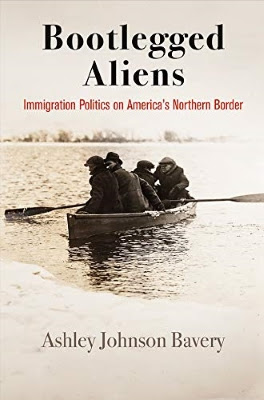
Join Professor Ashley Johnson Bavery for a discussion of her new book, Bootlegged Aliens. The book explores immigration on America’s northern border before World War II, situating Detroit, Michigan as America’s epicenter for unauthorized immigration. In this industrial center, thousands of Europeans crossed the border from Canada each year, prompting nativist backlash and complicating the labor politics of the automobile industry. This event is jointly hosted by the Center for Comparative Immigration Studies at UC San Diego and UCLA Center for the Study of International Migration. UCLA professor Tobias Higbie will join as a discussant.
Ashley Johnson Bavery is assistant professor of history at Eastern Michigan University. Her work has appeared in the Journal of Urban History and the Journal of American History and her book, Bootlegged Aliens: Immigration Politics on America’s Northern Border (2020) won the First Book Award from the Immigration and Ethnic History Society.
Tobias Higbie is a professor of history and labor studies at UCLA, the chair of the Labor Studies and the associate director of the Institute for Research on Labor and Employment. His research explores social movements, migration, and the politics of community in the United States. Higbie’s most recent book, Labor’s Mind: A History of Working Class Intellectual Life (2019), recovers the social world of self-educated working people and the politics of working-class identity during the early 20th century.
Canadian Studies Program
213 Moses Hall #2308
Canadian Studies Program | Univ. of California, Berkeley, 213 Moses Hall #2308, Berkeley, CA 94720

Repatriating Indigenous artefacts; free speech; Black History Month; Queen’s Jubilee

An item from one of our fellow Canadian organizations in the Bay Area.


Canadian Studies Announcements
In this issue:
  • Tomorrow: “Models for Repatriation of Indigenous Cultural Property from First Nations, Canada”
  • Cosponsored event: “Legal and Constitutional Protections for Free Speech in Academia in the US, UK, and Canada”
  • Canada celebrates Black History Month
  • Elizabeth II marks 70 years as Queen of Canada
  • External event: Book talk on Bootlegged Aliens: Immigration Politics on America’s Northern Border
TOMORROW
Panel Discussion: Models for Repatriation of Indigenous Cultural Property from First Nations, Canada
Tuesday, February 8 | 12:30 pm PT | Online | RSVP here
How can repatriation be built from mutual respect, cooperation and trust? North American museums and institutions have historically engaged in the collection and categorization of Indigenous cultural property and knowledge without the consent or active involvement of Indigenous people. The Native American Graves Protection and Repatriation Act (NAGPRA) was enacted in 1990 to return Native American “cultural items” to lineal descendants and culturally affiliated American Indian tribes, Alaska Native villages, and Native Hawaiian organizations. Despite this and further state legislation, many institutions including the University of California, have obfuscated or denied repatriation claims. Across the border, the Canadian government does not currently have legislation addressing the repatriation of Indigenous Ancestors and cultural heritage, but is working to create national support for repatriation through legislation Bill C-391. Some Canadian provinces have passed repatriation acts or provincial museum polices that have facilitated the return of ancestors and belongings. This panel discussion seeks to learn from what is being done in Canada. What is the cultural and nuanced work that builds successful repatriations? How can repatriation and indigenizing the institution from within preserve and strengthen tribal cultural heritage?
Join Canadian Studies affiliate Sabrina Agarwal (Professor of anthropology and chair of the UC Berkeley NAGPRA Advisory Committee) in conversation with Dr. Louis Lesage (Director, Nionwentsïo Office, Huron-Wendat Nation), Lou-ann Neel (Curator and Acting Head of Indigenous Collections and Repatriation Department, Royal BC Museum), and Michelle Washington (Repatriation Specialist, Royal BC Museum) to explore these questions and hear about their experiences in repatriation.
Image: Kwakwaka’wakw house posts from British Columbia in the Hearst Museum of Anthropology, UC Berkeley.
COSPONSORED EVENT
Legal and Constitutional Protections for Free Speech in Academia in the US, UK, and Canada
Friday, February 11 | 10 am PT | Online | Join via Zoom
The Public Law and Policy Program and the Anglo-American Legal Studies Program at the UC Berkeley School of Law invite you to an expert discussion comparing traditions and laws around free speech in university settings in three common law jurisdictions: the United Kingdom, United States, and Canada.
Professor Eric Kaufmann of the University of London, who is Canadian, will be participating from London. He will discuss his research on freedom of speech in academia in the U.S., the U.K. and Canada as well as proposed legislation in the U.K. parliament to protect free speech in colleges and universities in the UK.
Professor Nadine Strossen of the New York School of Law and former head of the ACLU will join from New York. She will comment on Professor Kaufmann’s findings, her own work on this subject, and legal and policy implications of the proposed legislation.
Professor Keith Whittington of Princeton University and Dean Erwin Chemerinsky of the UC Berkeley School of Law will participate from Berkeley. They will also comment on Professor Kaufmann’s research and recommendations for legislation.
Steven Hayward of UC Berkeley will serve as moderator.
Please visit the Public Law and Policy website for more information.
Canada Celebrates Black History Month
In both the United States and Canada, February is Black History Month. Originating in the US in the 1970s, the commemoration was adopted by Canada in 1995 as celebration of the contributions of African-descended people to Canadian society and culture. Black people have resided in Canada since the early colonial period, and made up 3.5% of its population as of 2016.
In Canada, the government has updated its official Black History Month website to reflect this year’s theme: “February and Forever: Celebrating Black History today and every day”. Prime Minister Trudeau issued an official statement, affirming that “Black history is Canadian history” and encouraged Canadians of all backgrounds to learn more about that history. He also reaffirmed his commitment to combatting racism and discrimination towards people of African descent, and pledged a number of targeted programs to help the Black community.
Official celebrations will take place next week, on February 17th, via Facebook Live. The Canadian Embassy in the US is also promoting a slate of special events through its Connect2Canada page.
For topical reading, we recommend Canadian Studies affiliate Cecil S. Giscombe’s new book of poems Similarly, which Publisher’s Weekly called “a powerful, understated meditation on place, ancestry and time” set in the landscapes of the US and Canada.
Elizabeth II Marks 70 Years as Queen of Canada
On Sunday, Queen Elizabeth II celebrated her Platinum Jubilee, marking seventy years as monarch of Canada. The Queen, who turns 96 in April, ascended to the throne in 1952, and is currently the world’s oldest and longest-serving monarch.
Prime Minister Trudeau sent his congratulations to the Queen in an official statement thanking her for her seven decades of service. Noting that this is the first Platinum Jubilee in Canadian history, the Prime Minister recognized the many milestones the Queen has overseen during her reign, including the 100th anniversary of Confederation in 1967 and the Constitution Act of 1982.
Political scientists agree, saying the Queen has created a strong legacy in Canada, and adapted along with Canada as it became an independent state. Simon Fraser University professor Andrew Heard says that the Queen’s personal interactions with ordinary Canadians and genuine affection for Canada have been key to her success as a public figure. During her reign, the Queen has made 31 visits to Canada, including 20 official tours. Over time, she has evolved to present herself in a distinctly Canadian capacity. Heard says Canadians’ support for the monarchy is largely based on the Queen’s personal popularity – an act which may be difficult for her successor to follow.
Official celebrations of the Queen’s Jubilee will take place in June across Canada, Britain, and other Commonwealth realms. While festivities will be more muted than previous jubilees due to pandemic restrictions, the Canadian government has announced a number of special initiatives, including beacons in Ottawa and other major cities; commemorative stamps and coins; and grants for community celebrations such as parades, concerts, and festivals.
EXTERNAL EVENTS
Book Talk: Bootlegged Aliens: Immigration Politics on America’s Northern Border
Friday, February 18 | 12 pm PT | Online | RSVP here
Join Professor Ashley Johnson Bavery for a discussion of her new book, Bootlegged Aliens. The book explores immigration on America’s northern border before World War II, situating Detroit, Michigan as America’s epicenter for unauthorized immigration. In this industrial center, thousands of Europeans crossed the border from Canada each year, prompting nativist backlash and complicating the labor politics of the automobile industry. This event is jointly hosted by the Center for Comparative Immigration Studies at UC San Diego and UCLA Center for the Study of International Migration. UCLA professor Tobias Higbie will join as a discussant.
Ashley Johnson Bavery is assistant professor of history at Eastern Michigan University. Her work has appeared in the Journal of Urban History and the Journal of American History and her book, Bootlegged Aliens: Immigration Politics on America’s Northern Border (2020) won the First Book Award from the Immigration and Ethnic History Society.
Tobias Higbie is a professor of history and labor studies at UCLA, the chair of the Labor Studies and the associate director of the Institute for Research on Labor and Employment. His research explores social movements, migration, and the politics of community in the United States. Higbie’s most recent book, Labor’s Mind: A History of Working Class Intellectual Life (2019), recovers the social world of self-educated working people and the politics of working-class identity during the early 20th century.
Canadian Studies Program
213 Moses Hall #2308
Canadian Studies Program | Univ. of California, Berkeley, 213 Moses Hall #2308, Berkeley, CA 94720

Happy Year of the Tiger! 🐯 Protecting academic free speech; innovating Inuit throat singing

A newsletter from one of our fellow Canadian organizations in the Bay Area.


Canadian Studies Announcements
In this issue:
  • Happy Year of the Tiger!
  • Next week: “Models for Repatriation of Indigenous Cultural Property from First Nations, Canada”
  • Cosponsored event: “Legal and Constitutional Protections for Free Speech in Academia in the US, UK, and Canada”
  • The New Yorker reviews Tongues, the new album from Inuit singer Tanya Tagaq
  • Grant deadline tomorrow: British Library Visiting Fellowships
  • External event: “Boeing 737 MAX: Money, Machines, and Morals in Conflict”
  • External event: “Canadian Minister of Northern Affairs Dan Vandal: Building A Strong, Sustainable North”
  • External event: Book talk on Bootlegged Aliens: Immigration Politics on America’s Northern Border
Happy Year of the Tiger!
Canadian Studies wishes a happy and prosperous Year of the Tiger to our friends around the world! While the Lunar New Year is often most associated with (and referred to as) the Chinese New Year, it is actually celebrated by a variety of East Asian cultures. While COVID is dampening celebrations for the third year in a row, the CBC checked in with several Ottawa families to see how they were continuing their cherished New Year traditions in spite of the pandemic. And in San Francisco, Chinatown business owners hope this New Year is the turning point for a better 2022.
Image: Chinese New Year vector created by Freepik – www.freepik.com.
NEXT WEEK
Panel Discussion: Models for Repatriation of Indigenous Cultural Property from First Nations, Canada
Tuesday, February 8 | 12:30 pm PT | Online | RSVP here
How can repatriation be built from mutual respect, cooperation and trust? North American museums and institutions have historically engaged in the collection and categorization of Indigenous cultural property and knowledge without the consent or active involvement of Indigenous people. The Native American Graves Protection and Repatriation Act (NAGPRA) was enacted in 1990 to return Native American “cultural items” to lineal descendants and culturally affiliated American Indian tribes, Alaska Native villages, and Native Hawaiian organizations. Despite this and further state legislation, many institutions including the University of California, have obfuscated or denied repatriation claims. Across the border, the Canadian government does not currently have legislation addressing the repatriation of Indigenous Ancestors and cultural heritage, but is working to create national support for repatriation through legislation Bill C-391. Some Canadian provinces have passed repatriation acts or provincial museum polices that have facilitated the return of ancestors and belongings. This panel discussion seeks to learn from what is being done in Canada. What is the cultural and nuanced work that builds successful repatriations? How can repatriation and indigenizing the institution from within preserve and strengthen tribal cultural heritage?
Join Canadian Studies affiliate Sabrina Agarwal (Professor of anthropology and chair of the UC Berkeley NAGPRA Advisory Committee) in conversation with Dr. Louis Lesage (Director, Nionwentsïo Office, Huron-Wendat Nation), Lou-ann Neel (Curator and Acting Head of Indigenous Collections and Repatriation Department, Royal BC Museum), and Michelle Washington (Repatriation Specialist, Royal BC Museum) to explore these questions and hear about their experiences in repatriation.
Image: Kwakwaka’wakw house posts from British Columbia in the Hearst Museum of Anthropology, UC Berkeley.
COSPONSORED EVENT
Legal and Constitutional Protections for Free Speech in Academia in the US, UK, and Canada
Friday, February 11 | 10 am PT | Online | RSVP forthcoming
The Public Law and Policy Program and the Anglo-American Legal Studies Program at the UC Berkeley School of Law invite you to an expert discussion comparing traditions and laws around free speech in university settings in three common law jurisdictions: the United Kingdom, United States, and Canada.
Professor Eric Kaufmann of the University of London, who is Canadian, will be participating from London. He will discuss his research on freedom of speech in academia in the U.S., the U.K. and Canada as well as proposed legislation in the U.K. parliament to protect free speech in colleges and universities in the UK.
Professor Nadine Strossen of the New York School of Law and former head of the ACLU will join from New York. She will comment on Professor Kaufmann’s findings, her own work on this subject, and legal and policy implications of the proposed legislation.
Professor Keith Whittington of Princeton University and Dean Erwin Chemerinsky of the UC Berkeley School of Law will participate from Berkeley. They will also comment on Professor Kaufmann’s research and recommendations for legislation.
Steven Hayward of UC Berkeley will serve as moderator.
Please check the Public Law and Policy website above for forthcoming RSVP information.
The New Yorker Reviews Tongues, the New Album from Inuit Throat-Singer Tanya Tagaq
Canadian Inuit singer Tanya Tagaq has worked hard to bring the Inuit tradition of throat-singing to a wider audience. But her award-winning performances are anything but conventional, blending the ancient Inuit techniques with contemporary music production and spoken word poetry. Last week Sheldon Piece, music writer and editor for The New Yorker, gave a glowing review to Tagaq’s latest album, Tongues, which he calls her boldest and most experimental yet:
“The Canadian Inuit throat singer Tanya Tagaq makes music that seems to cleanse the body. The form that she practices uses guttural sounds and breaths to produce a physical performance of groans, gasps, and sighs, conjuring a sonic landscape which is by turns rhythmic and melodic. Her performing, at once animalistic and operatic, brings a spirit of experimentation to an old tradition… It is her technique and vision that have made her one of the most celebrated and innovative practitioners of her culture’s visceral style.”
Read the full piece online via The New Yorker.
Grant Deadline Tomorrow: British Library Visiting Fellowships
Application deadline: February 1, 2022, 9:00 am PT
Applications are due tomorrow for the 2022 Visiting Fellowships at Eccles Centre for American Studies at the British Library in London. These fellowships are open to academics, postgraduate students, creatives and independent scholars and cover all regions of the Americas, including Canada. For more information about the fellowship programme, please look here. The deadline for applications is 5pm GMT (9:00 pm PT) on Tuesday, 1 February 2022 and the Fellowship needs to be taken by 30 April 2024. For more information about the four themes, please look here.
EXTERNAL EVENTS
Boeing 737 MAX: Money, Machines, and Morals in Conflict
Tuesday, February 1 | 2 pm PT | Online | RSVP here
Canadian Studies faculty affiliate Brian Barsky addresses the troubled development of the Boeing 737 MAX, which crashed twice within its first two years of commercial flight, leaving no survivors. Professor Barsky has been personally involved in the investigation of this disaster. He was featured prominently in a recent Smithsonian documentary, and his full-page op-ed in The Globe and Mail was debated in the Parliament of Canada. Professor Barsky will elucidate how these tragedies were the consequence of a corporation prioritizing profits over safety as well as of regulatory capture of the government agency which was derelict in its duty to protect the public. This event is sponsored by the Berkeley Retirement Center.
Canadian Minister of Northern Affairs Dan Vandal: Building a Strong, Sustainable North
Friday, February 4 | 10 am PT | Online | RSVP here
The Government of Canada, Indigenous peoples, and 6 territorial and provincial governments came together to develop Canada’s Arctic and Northern Policy Framework, a transformative vision of the future where northern and Arctic people are thriving, strong and safe. The Framework includes goals relating to eight overarching themes—people and communities, strong economies, comprehensive infrastructure, environment and biodiversity, science and Indigenous knowledge, global leadership, safety, security and defence, and reconciliation. It incorporates regional and distinctions-based lenses while integrating domestic and international dimensions. Canada’s Minister of Northern Affairs, Daniel Vandal, will discuss federal, Indigenous, and community-driven partnerships and programs to address short-term and long-term climate change adaptation and mitigation, supporting healthy ecosystems in the Arctic and North in a conversation by moderated by Jothsna Harris.
Book Talk: Bootlegged Aliens: Immigration Politics on America’s Northern Border
Friday, February 18 | 12 pm PT | Online | RSVP here
Join Professor Ashley Johnson Bavery for a discussion of her new book, Bootlegged Aliens. The book explores immigration on America’s northern border before World War II, situating Detroit, Michigan as America’s epicenter for unauthorized immigration. In this industrial center, thousands of Europeans crossed the border from Canada each year, prompting nativist backlash and complicating the labor politics of the automobile industry. This event is jointly hosted by the Center for Comparative Immigration Studies at UC San Diego and UCLA Center for the Study of International Migration. UCLA professor Tobias Higbie will join as a discussant.
Ashley Johnson Bavery is assistant professor of history at Eastern Michigan University. Her work has appeared in the Journal of Urban History and the Journal of American History and her book, Bootlegged Aliens: Immigration Politics on America’s Northern Border (2020) won the First Book Award from the Immigration and Ethnic History Society.
Tobias Higbie is a professor of history and labor studies at UCLA, the chair of the Labor Studies and the associate director of the Institute for Research on Labor and Employment. His research explores social movements, migration, and the politics of community in the United States. Higbie’s most recent book, Labor’s Mind: A History of Working Class Intellectual Life (2019), recovers the social world of self-educated working people and the politics of working-class identity during the early 20th century.
Canadian Studies Program
213 Moses Hall #2308
Canadian Studies Program | Univ. of California, Berkeley, 213 Moses Hall #2308, Berkeley, CA 94720