Tag Archives: Doughboy Foundation

WWI DISPATCH February 2022

An item from the organization formerly known at the World War One Centennial Commission.


View this in your browser

Header 10292020

February 2022

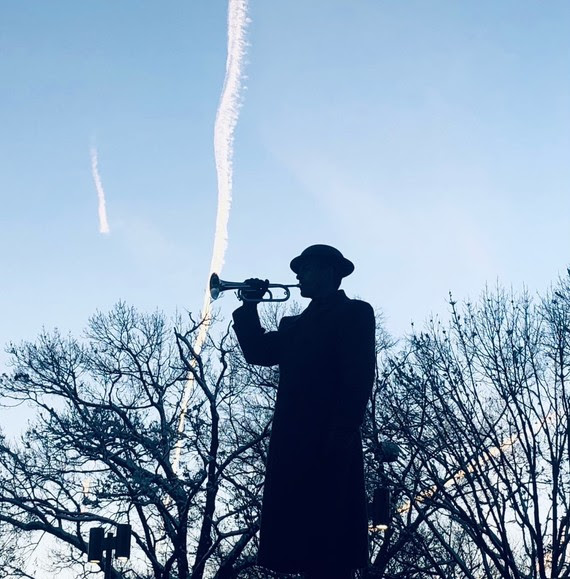
Taps Bugler with sky

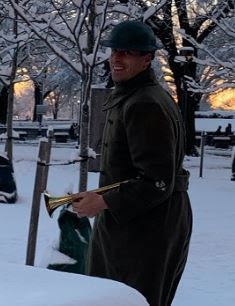
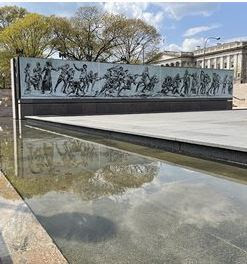
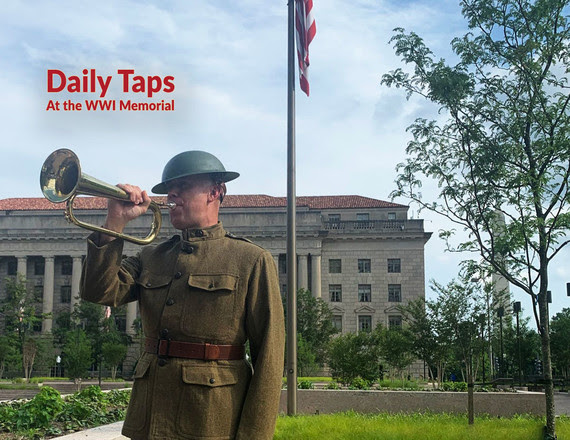
Sponsored by The Doughboy Foundation, a bugler in World War I uniform sounds Taps every evening at 5 p.m., seven days a week, rain or shine, at the National World War I Memorial in Washington, DC. Planning is in progress for a live stream of Daily Taps on YouTube, with the ability to honor specific veterans, groups or organizations for that day, week, or month. Click on this image to learn more, and find out how you can support this effort, and help ensure that this daily tradition will continue at the National World War I Memorial in perpetuity.

Contrasting lives: WWI Black Veterans Everett Johnson and Robert Chase

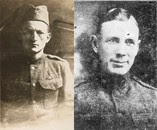
Johnson and Chase

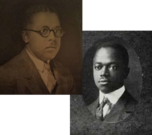
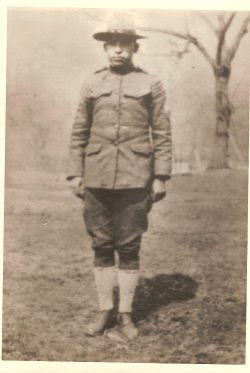
Battery E, 349th Field Artillery Commander Lieutenant Everett Warren Johnson (1896-1964) and one of the non-commissioned officers in his unit, Sergeant Robert Chase (1891-1958), entered the war from similar backgrounds. Johnson volunteered for an officer training program and Chase was drafted, but they fought on the same battlefield and chose similar post-war professions. Click here to read the entire story, and learn just how “War impacted their lives in profoundly different ways.


Unconventional Memorials Created by the Forgotten Female Veterans of World War I

Allison Finkelstein

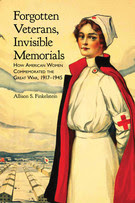
Why does the memory of World War I remain so much stronger in Great Britain than in the United States?” Seeking the answer to this question led historian Allison Finkelstein “on a long path to the publication of my first bookForgotten Veterans, Invisible Memorials: How American Women Commemorated the Great War, 1917-1945.” Click here to read more, and learn about “significant but too often overlooked aspects of World War I’s history that have renewed relevance today.


New “Hello Girls” musical honors military exploits of women in World War I

Rosemarie Chandler

After spending her childhood on Luke Air Force Base, Rosemarie Chandler finds it fitting that she’s playing one of the first women in combat during World War I in “The Hello Girls” production by the Phoenix Theatre Company. “The Hello Girls” stars Chandler as Grace Banker, a switchboard operator in charge of a corps of women who went overseas during World War I. Click here to read more, and learn how being the child of two military parents gave Chandler an interesting perspective on the challenges faced by the first women in Army service during and after World War I.


Call for Papers: “Lesser-Known Stories
of the Great War: Women, Minorities, Civilians, and the Untold”
Park U/First Division Museum logos

This symposium, hosted by the First Division Museum and sponsored by The
Great War Institute at Park University will be held May 13-14, 2022, at the First Division Museum, 1s151 Winfield Road, Wheaton, IL., 60189. Paper and panel proposals in all fields of history related to “Lesser-Known Stories of the Great War: Women, Minorities, Civilians, and the Untold” are invited. The symposium is particularly interested in proposals for complete sessions, including panelists, chairs, and commentators. All proposals should be submitted no later than March 1, 2022. The symposium encourages aspiring and young historians, including graduate students, to present their work. For questions about submitting a proposal, please contact us at gsrcentre@park.edu.


Orange County NY Historian hosting Europe trip to pay tribute to 369th New York Infantry Regiment in World War I

Harlem Rattlers logo

Orange County Historian Johanna Yaun will host a trip to Belgium and France next year to honor the soldiers who served in the 369th New York Infantry Regiment. The trip will take place from July 10 -19, 2023 and will explore locations that served as notable backdrops during World War I. Harlem’s Rattlers, the 369th New York Infantry Regiment, later nicknamed the Harlem Hellfighters, was a regiment of soldiers of African American descent from New York City, the Hudson Valley and other parts of the county. Click here to read more, and find out how you can join this limited-space tour to sites of significance related to the 369th. 


Fighting For Respect – African Americans in World War I France

Fighting For Respect

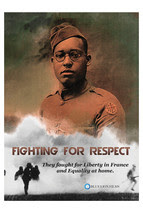
Blue Lion Films, Inc, the authors of the award-winning documentary ‘Paris Noir – African Americans In The City Of Light’ has launched a new film in their series examining the African American experience in France. ‘Fighting For Respect – African Americans in WWI‘ digs deep into the often overlooked yet compelling story of 200,000 Black soldiers willing to fight for democracy abroad while it was violently refused them at home. The film shows why their story still matters today. Click here to read more, and learn how this film grew out of director Joann Burke’s “deep passion and commitment to tell the exciting but also heartbreaking stories of African American soldiers during WW1.”


The Great Forgotten: A Television Series Honoring Nurses Who Served in WWI

The Great Forgotten logo

Kacie and Karen Devaney are a mother-daughter team who wrote an original full length play entitled The Great Forgotten, the story of the American nurses who served in France during World War I, which had a sold-out run in the 2015 New York City International Fringe Festival. After years of aiming for Broadway, the team changed course and dived into “the arduous climb of transitioning from playwrights to television writers.” The result? Click here to read more, and find out how the duo pushed through the challenges of the last two years to go “from play to Pilot, to a fully fleshed out season with nine episodes’ ideas and a detailed Show Bible Long and Short,” and learn what comes next.


Group is closer to finding remains of World War I soldier from McKean County

Cpl. James Uber

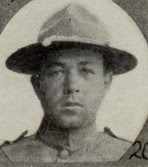
James L. Uber has been missing in action since Oct. 8, 1918, and the Meuse-Argonne Offensive in France in World War I. However, since his dog tag made its way to the Pennsylvania National Guard Museum in 2019, a group of volunteers have a pretty good idea of where the young corporal is buried. Click here to read the full Pennsylvania newspaper’s interview with the Doughboy MIA team that is closing in on accounting for Uber, one of over 4,000 Americans still MIA from World War I.


Mustering Out: the Navy’s First Black Yeowomen

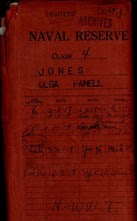
Olga Jones service record

Writing on the National Archives’ Rediscovering Black History web site, researcher Cara Moore Lebonick takes a look at the first Black yeowomen to serve in the U.S. Navy who were later referred to as the “Golden Fourteen.”  Known as  Yeoman (F) (also as Yeowoman and Yeomanette), these pioneers in Naval service were headed by Armelda H. Greene, who enlisted August 13, 1918 becoming the first Black Yeoman (F). Click here to read more about how Greene and those that joined after her formed a WWI Navy active unit consisting of all Black females – the first Black female non-nursing unit of the Navy.


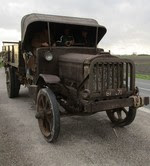
Driving a 1918 Liberty B truck back to the Western Front under its own power. What could possibly go wrong?

Liberty TRuck

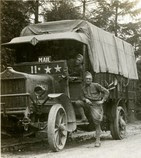
We are taking a couple of trucks over to Belgium for the Armistice commemorations, would you like to come?” That sounded like a good idea to Tim Gosling in 2018, but as his memoire of the trip reveals, that didn’t last. The first clue that the trip might be an adventure was “when the transporter was unable to take the Liberty all the way to Belgium so it would have to be unloaded at the channel tunnel and then driven under its own power from Calais to Ypres.” And then…no, we won’t spoil the story. Click here to read the whole tale of a memorable journey in a century-old American truck that was, looking back at it from three years later, “a remarkable exercise and great fun.”


Halyburton and Grimsley: The Story of America’s first POWs in World War I

Halyburton and Grimsley

On the night of November 2, 1917, Company F of the 16th Infantry Regiment, First Infantry Division, held off a night raid from German forces at Bathlémont, France, and sustained the first of many combat casualties of the American Expeditionary Forces in World War I (1917-1918).  Among these casualties were Sergeant Edgar M. Halyburton and Private Clyde Grimsley, who were captured by the Germans and became some of the first American prisoners of war (POW) in the conflict. Click here to read the entire article, and learn how both men performed their military duties with distinction in the POW camps until liberated at war’s end.


The Decision That Changed The World – America’s Entry Into World War I

The Approaching Storm cover

World War I? Why are you writing about that war?” says Neil Lanctot, “was an all-too-common attitude I encountered when I shared with family and friends that my new book would explore America’s path to involvement in the Great War.” But Lanctot knew there was a long-overlooked story to tell: “How did America come to make the fateful decision to join the Allies in 1917, a decision that actually changed the course of the 20th century?” Click here to read more, and see how a focus on some key characters in the process led to interesting discoveries on America’s path to involvement in World War I.


Battle Of Argonne Forest: America’s Deadliest Battle

Argonne Plan of Attack

The Meuse-Argonne Offensive was a critical Allied forces operation of World War I, during the Hundred Days Offensive. It lasted for a bloody 47 days, starting on September 26th of 1918 and ending on November 11th by armistice. Writing on the Rebellion Research web site, Tony Cao analyzes the American effort in the epic struggle. Click here to read the entire article, and learn how “At Argonne, undertrained American Doughboys learned how to conduct mobile warfare through bloody experience.”


Windows On The Past

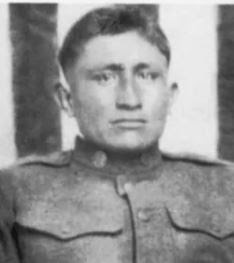
Sam Swaskegame

Historic photos are fractions of time frozen forever. They are windows on the past.” Jim Hinckley takes a look through one such window–photo of the Mohave County Courthouse at the dedication of a World War I memorial in 1928–and shows how the image is a key that unlocks some fascinating facts. Click here to read the entire article and learn about rare WWI memorials dedicated to  brave warriors, and how the experience of the war changed the county


Family Research and Service Projects Lead to Better Understanding of Doughboy Heroes

Russell Silverthorn

On November 13, 2021, I met my great uncle who died in France during World War One,” says Ann Silverthorn. She adds: “To be more exact, I met the young man who personified my uncle in a local play called A Doughboy’s Story.” American Legion Post 494 in Girard, PA was the site of this meeting, which was the end of (or perhaps a waypoint on) a “rewarding journey.” Click here to read the entire article, and learn how family history research sparked an interest in WWI, which led to remarkable commemorative efforts for the centennial of the war.


Doughboy Family Memories Etched in Architectural Art

Benjamin Dunham

When Ben Dunham encountered the etching in an antique booth in New Bedford, he thought it looked familiar. Then I signaled to my wife and asked, “Doesn’t this look like one of the cathedrals done by the brother of your great grandmother’s second husband?” The distant relative was the British artist James Alphege Brewer, and Dunham’s purchase of the etching with that tenuous familial link led to a cascade of collecting, and a book: Etched in Memory: The Elevated Art of J. Alphege BrewerClick here to read the entire story, and learn about the significance of this and other Brewer etchings in regard to the Doughboys of World War I.


Arlington National Cemetery’s Tomb of the Unknown Soldier Centennial Commemoration

Tomb Soldier 11112021

In 2021, Arlington National Cemetery (ANC) served as the designated government leader of the Tomb of the Unknown Soldier Centennial Commemoration, recognizing the 100th anniversary of the Tomb’s creation at ANC on November 11, 1921. The ANC team produced a wealth of content for the public about the history and meanings of the Tomb of the Unknown Soldier, much of which focused on World War I, which will be shared with Dispatch readers in the coming months.  Click here to read more, and learn about  ANC’s amazing Commemorative Guide to the Tomb of the Unknown Soldier


Mrs. Dawson’s Wartime Memories

Dawson book

“It was a thoughtful gift; the giver knew that I had an interest in the history of the Great War and it was a book full of World War 1 photography. It was over a hundred years old but in bad shape. The binding was broken and unravelling, and the cover almost fell off when I opened it.”  But Thomas Emme was not discouraged. Click here to learn how his painstaking restoration of the WWI volume rescued a book that was “Too special to throw out, too damaged to keep.


Doughboy MIA for February 2022

Leonard Charles Aitken

A man is only missing if he is forgotten.

Our Doughboy MIA this month is1st LT Leonard Charles Aitken.

Born in Reno, Nevada on 10 June 1897, Leonard Aitken grew up in California, where he joined the California National Guard at 18 years of age. When the trouble broke out with Mexico, he reported for duty in June 1916 and served along the border with the hospital corps, attending elements of what would, a year later, become the 160th Infantry, 40th Division. Following America’s declaration of war on Germany, on 7 April 1917, Aitken reported to the Officers Training School at San Diego and upon graduation was shipped to France in August 1918 as a 2nd lieutenant with the 158th Infantry, 40th Division. There, on 20 October 1918, he was sent as a replacement officer to the 372nd Infantry, 93rd Division, then holding a section of the line in the Alsace sector near Hill 607. On 7 November, while leading his platoon on a night action, Aitkens and his men captured several prisoners but unknowingly walked into the line of fire of a German machine gun nest, which opened up on them, killing or capturing all but two enlisted men of the patrol and freeing the prisoners. Without hesitation Lieutenant Aitken immediately advanced against the position with the intent of eliminating it, but he was shot twice in the chest and killed in the endeavor. The end result was that they captured 1 officer (Aitkens) and 22 men; however, the date of Aitkens’ death is given as 8 November 1918.

Following the Armistice, Graves Registration Service (GRS) officials went on the search for Aitkens’ remains, but had little luck. Their hardest clue was a report that German officers had buried Aitkens with full military honors “in the church yard of the tiny hamlet of La Paive, some 40 miles east of Epinal, France.” There being no town by that name anywhere in that area, this was almost certainly actually the town of La Pariee which is indeed in the area of the action of 7 November. Nothing was ever found however, and his remains continued to be unlocated in the years following the war. As investigations continued, in January 1924, GRS sent a letter to Aitkens’ father requesting a civilian dental chart, but also admitting in the letter that in all probability he was among the Unknown burials, though how this information was considered is not stated in his surviving file. A final attempt at some kind of identification came in December 1926 when the case files of Aitkens and one other officer from the 372nd Infantry were checked against a set of Unknown remains at the Meuse-Argonne Cemetery morgue. It was a long shot, however, as the remains being checked came from a French cemetery in the Marne sector some 300 kilometers northwest of where both officers in question were at the time of their deaths. Not surprisingly, neither officer’s remains were a match and Aitkens’ case was officially closed in 1932 without resolution.

Would you like to help solve Lt. Aitken’s case? Please consider a donation to Doughboy MIA and help us make as full an accounting of our American service personnel still listed as missing in action from WW1 as possible. Can you spare just ten dollars? Give ‘Ten For Them’ to Doughboy MIA and help us make a full accounting of the 4,423 American service personnel still listed as missing in action from WW1. Make your tax deductible donation now, with our thanks.


Merchandise from the Official
Doughboy Foundation WWI Store
Books --Lest We Forget & Honoring the Doughboys

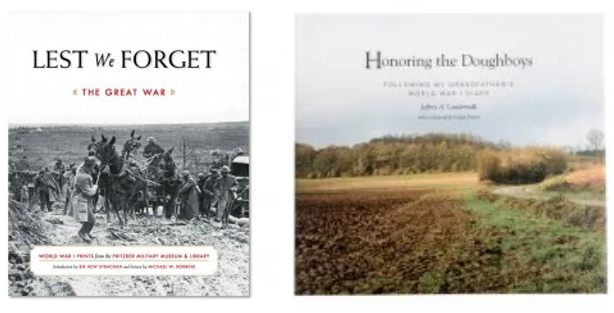
Lest We Forget: The Great War World War I Prints from the Pritzker Military Museum & Library. One of the nation’s premier military history institutions pays tribute to the Americans who served and the allies they fought beside to defeat a resourceful enemy with a lavishly illustrated book.  It is an official product of the United States World War One Centennial Commission and is a tribute to those who served in the Army, Navy, Marine Corps, and what would become the Air Force. It serves as a lasting reminder that our world ignores the history of World War I (and the ensuing WWII) at its peril―lest we forget.

Honoring the Doughboys: Following My Grandfather’s World War I Diary is a stunning presentation of contemporary photographs taken by the author that are paired with diary entries written by his grandfather, George A. Carlson, who was a soldier in the U.S. Army during World War I. Jeff Lowdermilk followed his grandfather’s path through France, Belgium, Luxembourg, and Germany and returned with these meticulously crafted photographs and his own engaging stories that bring the diary to life for contemporary readers. Lowdermilk’s passion for World War I and military history began as a young boy when he listened to his grandfather tell his stories about serving as an infantryman– a “Doughboy”–in Europe during the Great War.

Proceeds from the sale of these books will help finish the new National World War I Memorial in Washington, DC.

This and many other items are available as Official Merchandise of the Doughboy Foundation.


Apps image Feb 2022

Click or scan the QR Code below to download the Virtual Explorer App for the National World War I Memorial, and explore what the Memorial will look like when work is completed.

QR Code for Virtual Explorer App download


Education Thumb Drive image

Free Self-Contained WWI History Web Site on YOUR computer

Sources, lessons, activities, videos, podcasts, images

We have packaged all the content we created for “How WWI Changed America” into a format that is essentially a web site on a drive. Download the content onto any drive (USB, external, or as a folder on your computer), and all the content is accessible in a web site type format even without an internet connection. Click here to learn more, and download this amazing educational resource for home or classroom use.


Genealogy book FREE DOWNLOAD


you can help - shop using amazon smile


Doughboy MIA


Pershing Sponsors

Pershing Sponsors


Sergeant Henry Veal, II

A Story of Service from the Stories of Service section of ww1cc.org

Henry Veal, II

Submitted by: Johnette Brooks {granddaughter}

Sgt Henry Veal, II served in World War 1 with the United States Army . The dates of service are: Known 30 APR 1918 – 30 AUG 1918.

Story of Service

18 FEB 1895, Henry was born in the Spring Hill District 2 of Milledgeville, GA. He was the baby son of eleven (11) children of Henry Veal, I and Lucy Ann Hearst of Deepstep, GA. Henry, II’s father was a minister and a farmer. Henry, II (Sr.) grew up a few doors down from his future bride, Mamie Solomon on the highway that would later (13 AUG 2011) be named in their honor.

He joined Green Pastures Baptist Church as a youth and attended school until the 5th Grad . On 5 JUN 1917, Henry registered for the WWI Draft.

He was inducted in Milledgeville GA on 29 APR 1918 and was entrained on 30 APR at Camp Gordon in the 157th Depot Brigade until September 21, 1918. he departed Newport News VA on the USS Mercury headed for Brest, France.

Seven (7) days after boarding the ship, he was promoted to Sgt. on 21 OCT 1918 and then Mess Sergeant to the White Officers on the same day. He served overseas in France from 13 Oct 1918 to 13 AUG 1919 and was honorably discharged from the Army on August 30, 1919. He was reduced back to the rank of Private on 27 FEB 1919 while still serving in France, likely to avoid paying the Sergeant’s pension upon his discharge. Seven (7) days after returning from France, he received his final Army payment of $4,278.95.

Read Sergeant Henry Veal, II’s entire Story of Service here.

Submit your family’s Story of Service here.


Honor the Stories of Service of ALL Who Served.

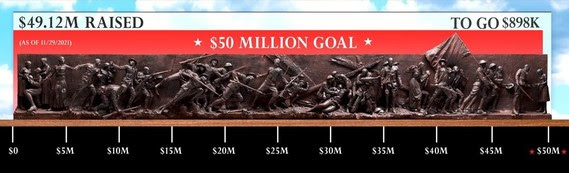
Do Your Bit to Help Build the new National World War I Memorial.

Fundraising Progress Maquette 11292021


RESOLVED – Cpl. Uber, U.S. Army MIA

An item from the organization formerly known at the World War One Centennial Commission, which may be of interest to members.


Doughboy MIA letter header
Five start 260

Hi Friend,

One year ago, I shared the story of Corporal James L. Uber: a 29-year-old Pennsylvania boy killed in action on October 8, 1918 while serving in France as part of Company E, 112th Infantry Regiment, 28th Division National Army. His body, interned in a shallow grave where he fell, was never recovered; his family was never given a last resting place to remember him and ease their grief.

But today, I am writing with some good news.

Cpl. James Uber

On Thursday, January 27th from 8:00 to 9:00 PM EST– I’ll be presenting the latest findings in the Cpl. Uber case, a detailed look at a year-long investigation and our journey onto the battlefields of France to recover one of our brave young American boys. This is your chance to learn what we are doing to give more of these missing soldiers, sailors, Marines, and airmen a final resting place – and how you might be able to help.

You can access this Zoom briefing by signing up here.

I firmly believe that a man is only missing if he is forgotten. That’s why I founded Doughboy MIA, the only nonprofit in the world working to find our missing American boys from WWI and bringing them home. And you can help.

Even if you can’t make it, but are interested in learning more, please sign up. We’ll be sending a full recording of the briefing to those who do, along with updates as we head back to France later in the year for more search and recovery operations.

Help remember James and the sacrifice he made for this country. Sign up and get involved.

Warmly,

Robert

Robert J. Laplander

Directing Manager – Doughboy M.I.A.

www.ww1cc.org/mia

(414) 333-9402

A Man Is Only Missing If He Is Forgotten

Doughboy MIA helmet image

WWI DISPATCH January 2022

A newsletter from the organization formerly known as the World War One Centennial Commission.


View this in your browser

Header 10292020

January 2022

Taps in the Snow January 2, 2022 tight

“…nor snow. nor dark of night…”

Daily Taps at the National WWI Memorial sounded despite inclement DC weather

Snow bugler 01032022 tight

The powerful winter storm that dumped some 10 inches of snow in the DC area on Monday, January 3 did not stop the sounding of Taps at the new National World War I Memorial in Washington. This solemn nightly tribute in honor of the Americans who served in WWI and the service of all U.S. veterans and active military personnel, sponsored by The Doughboy Foundation, was sounded as scheduled at 5:00 pm in this public gathering place for reflection on “the war that changed the world.” The daily sounding of Taps at the National World War I Memorial, every day in perpetuity, is a key objective of the Doughboy Foundation’s ongoing work. You can help make this program a permanent, living part of daily life in our nation’s capital by donating to the endowment that will ensure its funding into the future.


Connecticut’s 1st Official State Troubadour Connects to World War I

Connecticut's 1st Official State Troubadour

Tom Callinan, designated as as Connecticut’s 1st Official State Troubadour in legislation passed by the CT General Assembly, anticipated that his services might be called upon for the commemoration of the Centennial of World War I. What he didn’t anticipate was how his own family tie to WWI, his great uncle Jerry Coleman, would become so central a figure in that work. Click here to read more, and learn how a WWI Doughboy accompanies performances of both original and historic music about Americans serving during the Great War.


The Trucks the Doughboys Left Behind: Surplus Disposal in Europe after WWI

Trucks the Doughboys Left Behind

Writer Tim Gosling notes that “Amongst the many millions of postcards sent home to the friends and families of the Doughboys of the American Expeditionary Force is a small but reoccurring theme. It is a picture of an army truck usually with a proud Doughboy either leaning upon it or sitting in the driver’s seat and on the back the words something along the lines of “This is the truck that I am driving”. World War One introduced the driving of mechanical transport to a great number who it might otherwise have passed by. What it also did is establish a bond between military drivers and their machines, something which has happened ever since.” Click here to read more about the very American bond between man and machines, and how most of the beloved trucks that served in WWI were left behind in Europe when the Doughboys came home.


Built Fast and Not Meant to Last: The story of Camp Sherman’s WWI Buildings

Camp Sherman Buildings snip

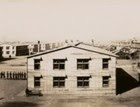
In 1923, President Warren G. Harding created the Mound City National Monument by setting aside a portion of land from Camp Sherman, Ohio, a World War I training cantonment just outside of Chillicothe. Ohio historian Paul LaRue wondered what became of the structures built to house and train US troops on the grounds of Camp Sherman after that donation. Click here to read more, and learn how the temporary buildings that supported Doughboy training at Camp Sherman later became, in many cases, permanent structures in the local communities.


Frontenac High School in Kansas sees Glimpses from the Great War

Glimpses from the Great War poster

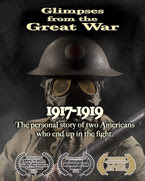
A hundred years later, why should the Great War have any meaning for today’s high school students? “Why we fight wars today probably hasn’t changed a whole lot,” explains Brady Hill, history/ government teacher at Frontenac High School in Kansas. “Diplomacy fails, other means fail, and having that understanding is important,” On a conceptual level this makes sense, but it’s hardly appealing to today’s teens. Hill believes it’s the personal views and hearing first-hand experiences of individual Doughboys that bring America’s role in World War I alive for his students. Click here to read more, and learn how the award-winning documentary Glimpses from the Great War helped the students get a first-hand view from men who served in World War I.


Red poppies will bloom this spring at the new National World War I Memorial in Washington, DC

Memorial American Legion Auxiliary article

A new article appeared on the American Legion Auxiliary web site last week to highlight the National World War I Memorial in Washington, DC. The article noted that the “long-awaited memorial to World War I and the 4.7 million Americans who served in the war is now a reality” as “the last of the 20th century wars to receive its own memorial in our nation’s capital.”  Click here to read the entire article, and learn how the iconic red poppy blossoms will bloom later this year in landscaped areas of the memorial.


Veterans Day launch of new comic book featuring WWI hero Dr. Frank Boston

Dr. Frank Boston comic book launch

The Boston Legacy Foundation returned to the National World War I Memorial in Washington, D.C. on November 11th, Veteran’s Day, to continue to celebrate the legacy of Dr. Frank Boston, a WWI Veteran, alongside all of those who have served their country and to celebrate the release of the Doc Boston Adventures comic book. Click here to read more, and learn how the “Doc Boston Adventures”, based upon a true story Boston and his team saving lives, updated to reflect America today and introduce a unique and diverse group of young first responders.


He fought for self-determination in a time of assimilation. He left these objects.

John B. McGillis

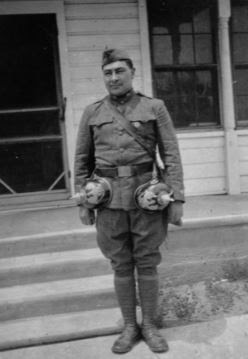
Photographer Nīa MacKnight never met her great grandfather John B. McGillis, but she did have a window into his storied life as an Anishinaabe man in early 20th-century America: a steam trunk where he stowed away undated photographs and stray objects such as an address book, a pair of horn-rimmed glasses, and a single eagle feather. McGillis also served in World War I, and later secured a position at the U.S. Bureau of Indian Affairs where he worked towards improving employment opportunities for Indigenous people. Click here to read more, and see how MacKnight is using her skills as a documentary photographer and interviews with relatives and family friends, to piece together McGillis’ history, and reflecting on questions of identity and self-determination that persist to this day.


Woodrow Wilson seizes U.S. railroads

Woodrow Wilson railroads snip

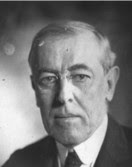
The American railroad system faltered under the heavy demands of a wartime economy in 1917, resulting in materials being unable to be loaded and shipped on trains. On December 26, 1917, President Wilson issued a declaration that he had nationalized the railroad system, and he ordered Secretary of War Newton Baker to take possession of the railroads on December 28, 1917. The National Constitution Center looks back at “one of the broadest acts of presidential power” which occurred during World War I. Click here to learn how Congressional action was repeatedly needed to return the railroads to private ownership at war’s end.


The bravery of Jesse Clipper, first Black from Buffalo to sacrifice his life in WWI

Jesse Clipper

Jesse W. Clipper was working as a singer and dancer in Buffalo, New York before he was drafted into the Army for World War I. Unfortunately, he never made it home from that war as he died on February 21, 1919, some three months after the war ended in November 1918. Today, Clipper is remembered as the first Black from Buffalo who sacrificed his life in the First World War. Click here to read more, and learn about ongoing efforts in Buffalo to uncover more information about Clipper’s family, and his life before his service and loss in WWI.


Remembering My Grandfather,
Giovanni Carusone

Giovanni Carusone

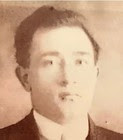
World War I Veteran, Italian Immigrant, Proud American, Husband, Father, Grandfather, a Paschall resident of Southwest Philadelphia—and our Hero.” That’s how Denise Clofine starts this profile of her grandfather, who she notes “left Italy telling his mother he was visiting America to see the great land of opportunity. His true intention was to join America in fighting for our freedom.”  Click here to read more, and learn about Carusone’s service during World War I, and his life after the war in in the Paschall neighborhood of Southwest Philadelphia.


Historian chronicles the grassroots work to recognize women’s sacrifices, service during World War I

Forgotten Veterans, Invisible Memorials: How American Women Commemorated the Great War, 1917-1945

Over 16,000 women served overseas during World War I. Yet as Armistice Day marked the war’s final chapter, the stories of women who sacrificed—in overseas hospitals or as wives and mothers back home—were destined to become footnotes. More than a century later, University of Maryland graduate Allison Finkelstein is rewriting that narrative, revealing the grassroots efforts spearheaded by women of the WWI generation to honor this service, not carved in marble statuary, but through community service and advocacy and in hospitals and respite houses. Click here to read more about “Forgotten Veterans, Invisible Memorials: How American Women Commemorated the Great War, 1917-1945” and how the book tells the stories behind “the work to commemorate wartime sacrifices through living memorials—intangible commemorations grounded in continued service to the country.”


Building named for WWI vet Henry Owl, first American Indian student at Carolina

Henry Owl

The University of North Carolina at Chapel Hill has announced that it will honor Cherokee historian and teacher Henry McClain Owl  by placing his name on the Student Affairs building. Owl (1896-1980) was the first American Indian and the first person of color to enroll at the University, as a graduate student in history in 1928. Click here to learn more about Henry Owl’s service in World War I, and his work after the war ended to ensure voting rights for Native Americans.


Talking About War: PTSD in WWI & now

Talking About War

World War I “proved to be a grisly example of the hellishness of war. Technology-enhanced was manufactured, making it easier to kill. Machine guns, rapid-fire artillery, poison gas, and tanks, weapons that could take away life at any time, either in an instant in the best-case scenario, or after agonizing minutes if the soldier was not lucky enough. Talk about the war? The returning veterans of World War I would never want to do that.” So begins Dr. Arturo Osorio’s exploration of Post Traumatic Stress Disorder (PTSD) in and after the Great War. Click here to read more, and learn how talking about it–usually the last thing a vet wants to do–is often the best way to begin PTSD recovery.


Digging to Victory: How Bellingham Conserved Food During World War I

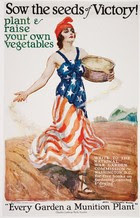
Gardening poster

Saving food was a central part of the American home front during World War I. The need for food was dire for America’s soldiers and allies. The conflict had devastated agriculture in Europe as men marched off to war and fields disappeared under shelling. Submarine warfare disrupted international trade. Jennifer Crooks takes a look back at how the people of Bellingham, WA leaned into the campaigns for food conservation. Click here to read more about how schools, businesses, and individuals got onboard with the efforts to conserve key items, and plant gardens to grow their own food.


Woodside, New York’s Doughboy Park Gets New Plaza, Seating Area

Woodside, NY's Doughboy Park

NYC officials recently celebrated the newly reconstructed $1.8 million plaza and seating area in Woodside’s Doughboy Plaza with a ribbon-cutting ceremony. The facility now has a brand new bluestone plaza, making it a worthy space to recognize and honor all of the soldiers who gave their lives in service to their country. Click here to read more, and find out how The Returning Soldier statue (later called “The Woodside Doughboy”) erected by the Woodside Community Council in remembrance of the local men and women who served in World War I, has been given a new and much improved setting.


World War I News Digest January 2022

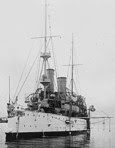
USS Olympia

World War I was The War that Changed the World, and its impact on the United States continues to be felt a century later, as people across the nation learn more about and remember those who served in the Great War. Here’s a collection of news items from the last month related to World War I and America.

USS Olympia: The little cruiser with a battleship’s guns

Ending 2021 on a Positive Note

How World War I Shaped “Lord of the Rings” 

The Devil Dogs of Belleau Wood: US Marines of World War One

American Red Cross of WNY honors unclaimed WWI veterans

WWI nurse Gladys Watkins & the Legion Post Named for her

American Railroads During World War I

WWI nurse from Patchogue, NY receives military honors

Cleanup at WWI chemical weapons dump in D.C.’s Spring Valley 

Ferdinand Foch, WWI commander of Allies, feted in Spokane 

Vancouver’s police chief was ‘Fighting Forester’ in WWI


Doughboy MIA for January 2022

Robert Alsleben

A man is only missing if he is forgotten.

Our Doughboy MIA this month is Private Robert August Alsleben Company A/308th Infantry Regiment/77th Division.

Robert Alsleben was the 5th of 11 children born to Heinrich (Henry) and Cecelia Alsleben, a family of German immigrant farmers settled in Minnesota. Robert was born 01MAY1894 in Penn Township, McLeod County, Minnesota and worked the family farm up until his induction into the army on 28MAY1918 at New Auburn, Minnesota. He was received into the service at Camp Lewis, Washington in 43rd Company/11th Battalion/166th Depot Brigade until he was transferred to Camp Kearney, near San Diego, California in July and assigned to Company F/160th Infantry/40th ‘Sunshine’ Division. What little training Alsleben received was given here, and that wasn’t much as his unit spent almost half of their time at Camp Kearney (which was only a month) under quarantine for a possible Scarlet Fever outbreak. At the beginning of August, the 40th packed up and boarded trains for the Port of Embarkation at New York, sailing overseas 08AUG1918.

In France, the 40th Division was reassigned as the 6th Depot Division – meaning it became a replacement pool – and filtered its men into combat units depleted by casualties. Private Alsleben was transferred to Company A/308th Infantry/77th Division, being taken onto unit strength upon arrival on 23SEPT1918. Three days later, Company A (along with Company D) spearheaded the 308th’s drive into the Argonne Forest at the opening of the massive Meuse-Argonne Campaign. At this point, Alsleben had been in the army just two days shy of 4 months and had spent better than half of that time either in quarantine or travel.

A statement later given by a comrade says Alsleben was shot through the abdomen and right upper thigh while going over the top on the afternoon of 27SEPT1918, the second day of the Argonne fight, and killed instantly. No one, however, knew anything about his burial and as neither he nor his remains were ever found, he was declared as missing in action on 22OCT1918.

The story then gained new light when an International Red Cross report was received 16 APR1919 that contained a list of names from the Germans and dated 01MAR1919 showing that Alsleben had been captured that same day he was wounded and died of his wounds on 28SEPT1918 at Landwehr Infantry Field Hospital #13 in Grand Pre and had been buried in the German military cemetery there. No grave number was reported however, and when GRS officials went to look for him, they were unable to locate any remains, nor was a grave number found in surviving hospital records.  In 1922, attempts were made by the German government to contact the head doctor who had worked at the hospital, but records do not say if this was successful or not. For a time, it appears there was some speculation Alsleben may have been recovered by the French and moved to the German military cemetery at Buzancy, but records do not say whether this lead was followed up on. Nothing more is known at this time.

Active investigation was suspended in the case in February 1929 and PVT Alsleben is memorialized on the Tablets of the Missing at the Meuse-Argonne American Cemetery at Romagne-sous-Montfaucon, France.

Can you spare just ten dollars? Give ‘Ten For Them’ to Doughboy MIA and help us make a full accounting of the 4,423 American service personnel still listed as missing in action from WW1. Make your tax deductible donation now, with our thanks.

Remember: A man is only missing if he is forgotten.


Merchandise from the Official
Doughboy Foundation WWI Store

tote bag

Function and style are combined in this lightweight and compact Canvas & Leather Tote. You can show your American pride while carrying this Made in the USA dark khaki tote. Plenty of room for keys, wallet, tablet and documents. A distressed “U.S.” imprint is prominently displayed on the bag and an exclusive fabric garment label commemorates the U.S. Centennial of World War One.

This versatile canvas tote features:

  • Constructed of heavy duty, touch dyed canvas and lined with 400 denier nylon
  • Handles made of 6 Oz. top grain oil tanned leather, backed with 1” webbing
  • Handle is attached to bag with distinctive “X” tacks.
  • Dimensions: 18.5” W (seam to seam) x 13.5”H x 5.0”
  • T-bottom style gusset
  • Vintage Military style makes it great for him or her
  • Made in USA

Proceeds from the sale of these books will help complete the new National World War I Memorial in Washington, DC.

This and many other items are available as Official Merchandise of the Doughboy Foundation.


Virtual Explorer logo new

Click or scan the QR Code below to download the Virtual Explorer App for the National World War I Memorial, and explore what the Memorial will look like when work is completed.

QR Code for Virtual Explorer App download


Education Thumb Drive image

Free Self-Contained WWI History Web Site on YOUR computer

Sources, lessons, activities, videos, podcasts, images

We have packaged all the content we created for “How WWI Changed America” into a format that is essentially a web site on a drive. Download the content onto any drive (USB, external, or as a folder on your computer), and all the content is accessible in a web site type format even without an internet connection. Click here to learn more, and download this amazing educational resource for home or classroom use.


Genealogy book FREE DOWNLOAD


you can help - shop using amazon smile


Doughboy MIA


Pershing Sponsors

Pershing Sponsors


Theodore E. Fournier

A Story of Service from the Stories of Service section of ww1cc.org

Theodore  E  Fournier

Submitted by: Brian A. Huseland {great-nephew}

Theodore E Fournier was born around 1899. Theodore Fournier served in World War 1 with the United States Army. The enlistment was in 1917 and the service was completed in 1918.

Story of Service

My great-uncle Theodore Everett Fournier served in the 103rd Infantry, Company C. After his parents told Teddy in his teen years that he was adopted, he left home and enlisted in the Minnesota National Guard, 2nd Infantry, finding comfort in serving his country.

In 1916, they patrolled the U.S.-Mexico border because of Pancho Villa’s raids. In 1917, the boys were drafted into the American Expeditionary Forces, and trained at Camp Cody, NM, as part of the 34th “Sandstorm” Division. However, as some American regiments had encountered heavy losses in Europe, the 34th became a replacement division, and was broken up.

Teddy was shipped out from New York City on June 29th, 1918 on the ship Demosthenes. He carried with him standard issue uniform and equipment, and a precious item: an enlisted men’s prayer book. He arrived in mid-July and was assigned to the 103rd about the time of the Meuse-Argonne offensive. After resting and training the new recruits, the regiment boarded trains for Verdun, France. Teddy’s regiment prepared for the St. Mihiel Offensive as part of the 26th Division, encountering occasional gas and gunfire.

Read Theodore E. Fournier ‘s entire Story of Service here.

Submit your family’s Story of Service here.


Honor the Stories of Service of ALL Who Served.

Do Your Bit to Help Build the new National World War I Memorial.

Fundraising Progress Maquette 11292021


The Doughboy Foundation · PO Box 17586 #123 · Arlington, VA 22216

Please support “Daily Taps at the WWI Memorial”

This item from the formerly named World War One Centennial Commission may be of interest to some of our members.


Five start 260

Donate >

Bugler playing daily taps at the WWI Memorial

Please Help Make Daily Taps a Reality


Dear Michael,

Almost immediately after the National WWI Memorial in Washington, D.C, opened to the public on April 16, 2021, we teamed up with “Taps for Veterans”  Director Jari Villanueva, a retired military bugler and Taps historian. Our goal was to explore the feasibility for a bugler in WWI uniform sounding taps at the Memorial every evening at 5pm, 7 days a week, rain or shine!

Honoring our Veterans at the WWI Memorial with taps is both an issue of logistics and a matter of financial support.

It was the generosity and financial dedication of some of the program’s early supporters that made it possible to carry this out through the rest of 2021.

Success in ’21 is followed by some exciting news for 2022

First, early in the coming year, we will be announcing the details about a wonderful Founding Sponsor for Daily Taps at the WWI Memorial. Their generous year-end gift is going to carry us well into 2022.

Secondly, this spring we will start to live stream Daily Taps at the WWI Memorial on YouTube with the ability to honor specific veterans, groups or organizations for that day, week or month. The technology is being tested and readied now.

Finally, we are working very hard to build an endowment for the program, large enough to guarantee that this poignant and moving daily tradition will continue at the WWI Memorial in perpetuity – our ultimate goal.

We could really use your help!

Though we made a lot of exciting progress in 2021, we are still in “early days”. We are depending on supporters like you, to help us make this program a living part of daily life in our nation’s capital. Please make a year-end, tax deductible contribution to the Doughboy Foundation for “Daily Taps at the WWI Memorial”.

Make your support “In Honor Of:” to dedicate your donation to someone or something you care about.

We wish all of you a wonderful and safe new year.

Thank you

Dans Signature

Dan Dayton
President, Doughboy Foundation


Click to Donate


The Doughboy Foundation · PO Box 17586 #123 · Arlington, VA 22216

A letter from Doughboy Foundation President Dan Dayton this Veterans Day week

An item from the organization formerly known as the World War One Centennial Commission.


doughboy foundation logo For Mailings

Dear Michael:

November 11th marks the first Veterans Day for the National World War I Memorial in Washington, D.C.  

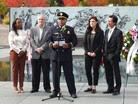
If you are in the National Capital region, please join us at the Memorial for our Bells of Peace Ceremony.  Special guest, Admiral Mike Mullen, the 17th Chairman of the U.S. Joint Chiefs of Staff, will join Terry Hamby, Chairman of the U.S. WWI Centennial Commission, and myself for the event.
 
The Ceremony begins at 10:45am EST and will include a wreath laying, the reading of the Archibald MacLeish poem, “The Young Dead Soldiers Do Not Speak”, the 11am tolling of the Bells of Peace by the Naval History and Heritage Command, and a special performance of Taps echoing from multiple buglers in WWI uniform. The ceremony will remember the WWI Armistice that went into effect at the 11th hour of the 11th day of the 11th month in 1918, and honor all Americans who served in WWI.

Bugker at wwi memorial

It is the beginning of a poignant 2021 Veterans Day which also marks the centennial of the internment of the Unknown Soldier at Arlington Cemetery.

The Unknown was chosen from the many unidentified Doughboys who fell in the fields of Europe, to symbolize the service and sacrifice of the 4.7 million who put on the American uniform during WWI.

Across the nation at 11am local, there will be “Bells of Peace” tolling ceremonies held by cities, veterans organizations, DAR Chapters, churches, schools, media organizations and individuals. [CLICK HERE] to learn how you can participate wherever you are.

Also at 11am local, hundreds of buglers organized by Taps for Veterans will sound taps in a “The National Salute.” [CLICK HERE] for more information.

Thank you for taking this Veterans Day to remember all those who served in WWI, the War that Changed the World.

 All the best,

 Dan

 Dans Signature

Daniel S. Dayton
President
The Doughboy Foundation