“Bells of Peace” is transforming into an annual tradition.
In 2018 we launched the Bells of Peace initiative to create a national bell tolling at 11am local on 11/11 as a WWI Armistice Centennial remembrance.
Tens of thousands of individuals, communities and organizations participated including a proclamation from every state in the U.S., every branch of the military service, hundreds of churches, posts, chapters, cities and communities.
As we transition out of the centennial period, and based on your responses and requests, we are going to promote “Bells of Peace” as an annual moment of remembrance when we stop, and take a few minutes on Veterans Day to reflect, remember and honor those who served and sacrificed in what was suppose to be “The War to end all Wars” – but instead became “The War that Changed the World”.
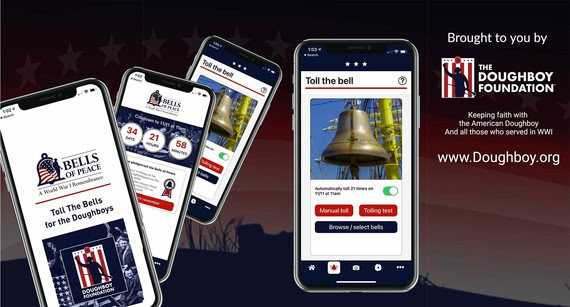
Your are receiving this email because you downloaded the ” Bells of Peace” Participation App in the past and we wanted to let you know the new 2020 version has now published with some important new features and updates including:
Built-in testing capabilities and diagnostics to help ensure that your tolling plans come off just as intended. If your smartphone speaker is muted, we will let you know. If you are not connected to the internet which could affect your clock, we will let you know.
We have brought back the social sharing that allows participants to post their plans, ideas, and tolling to FB, Insta, Twitter or Youtube with the hashtag #BellsOfPeace, which will allow us to bring the posts right into the App. The concept is to build a community of participation and grow this over the years to come.
At 1am on 11/12, the countdown timer will now automatically reset and start to countdown to November 11, 2021. That is also the Centennial for the internment of the Unknown Soldier. More on that over the coming year.
In this Pandemic year, getting a group together for a commemoration may be challenging. This makes the Bells of Peace Participation App even more useful.
A great idea for 2020 is to have a “Bells of Peace Zoom Tolling”.
We will publish an article into the App on how to do that. There is a …More section with updating article capability built in.
In the meantime, make sure you have the latest version installed. If your phone does not auto install the update, delete the app and install it again.
Go to your smartphone app store and search for “Bells of Peace” or use the links below.
Whilst many people associate our work with the vast cemeteries and memorials of France and Belgium, we also maintain stunning cemeteries and memorials across Great Britain. Across England, Scotland and Wales the CWGC commemorates over 300,000 Commonwealth service personnel at more than 12,000 locations. To highlight this commitment we have created a new digital experience, Our War Graves, Your History, for you to explore. Using this new digital resource, we encourage you to learn about our work, discover the history of the world wars and explore the heritage of our organisation on your doorstep.
2020 has been a year like no other, and though the world may look very different the CWGC continues to care for the Commonwealth service personnel who fell during the two World Wars. While you might not be able to travel further afield to visit the battlefields of the two World Wars – from the Western Front to the Far East – we encourage you to explore our work across Great Britain through this interactive resource and reconnect with your local history and heritage.
There has never been a better time to rediscover your local history than now, with the Commonwealth War Graves Commission.
Across Great Britain, we commemorate over 300,000 service personnel at more than 12,000 locations. Use our interactive map to find cemeteries and memorials in your region, and discover our remarkable sites of remembrance, meet our dedicated teams, learn about your local history and explore highlights from the CWGC Archive.
From isolated cemeteries on the west coast of Scotland to sprawling inner city necropolises, and from dramatic architectural masterpieces to intimate local churchyards, with so much to discover, where should you begin? In our latest blog we highlight just six of the remarkable cemeteries and memorials we maintain across Great Britain.
From helping our Archives team maintain our records, to giving talks to schools and community groups, our volunteers help ensure that our history remains relevant to future generations. If you would be interested in volunteering opportunities with us then please register your interest here.
We received this from Dominion Command earlier today.
Her Excellency the Right Honourable Julie Payette receives inaugural poppy
OTTAWA, ON, 16 October 2020 – The First Poppy of The Royal Canadian Legion’s 2020 National Poppy Campaign was presented to Her Excellency the Right Honourable Julie Payette, Governor General and Commander-in-Chief of Canada today. For the first time, and due to the pandemic, a virtual presentation took place in lieu of the traditional ceremony held at Rideau Hall in Ottawa.
The Legion’s Dominion President, Thomas D. Irvine, CD offered the flower with words of thanks. “Veterans both past and present appreciate your personal engagement,” said Irvine. “Your example will be followed by millions in Canada and abroad. All will take comfort in this symbolic act, and through the continuing support for our Veterans shown by you and by Canadians.”
As Viceregal Patron of The Royal Canadian Legion, Ms. Payette accepted the symbolic poppy and expressed her support for the 2020 National Poppy Campaign.
“Of course, this year, the campaign looks different,” she said. “But the intent is still the same and is still as noble. We must support our veterans, as they supported us during challenging points in our history,” she shared. Her Excellency reflected her admiration for all Veterans who have served our country. “Thank you for all you have done and you still do, for Canada. And thank you to all Canadians, for supporting the National Poppy Campaign,” she said.
The Legion’s 2020 National Poppy Campaign launches each year on the last Friday in October, and will begin on October 30 this year.
“This year the poppy also reminds us of the special significance of 75th anniversary of the end of the Second World War,” said Vice Admiral (Ret’d) Larry Murray, Legion Grand President. “In this year of the pandemic, Remembrance also reminds us that our nation has been through even more challenging times than we’re experiencing now. Canadians persevered then and we will now.”
As the national symbol of Remembrance, the red poppy represents the ongoing thankfulness Canadians have for all fallen military and RCMP Veterans.
Funds donated locally during the National Poppy Campaign are distributed locally to help support Veterans and their families, communities, and to promote Remembrance.
About The Royal Canadian Legion
Founded in 1925, the Legion is Canada’s largest Veteran support and community service organization. We are a non-profit organization with a national reach across Canada as well as branches in the U.S., Europe and Mexico. With 260,000 members, many of whom volunteer an extraordinary amount of time to their branches, our strength is in our numbers.
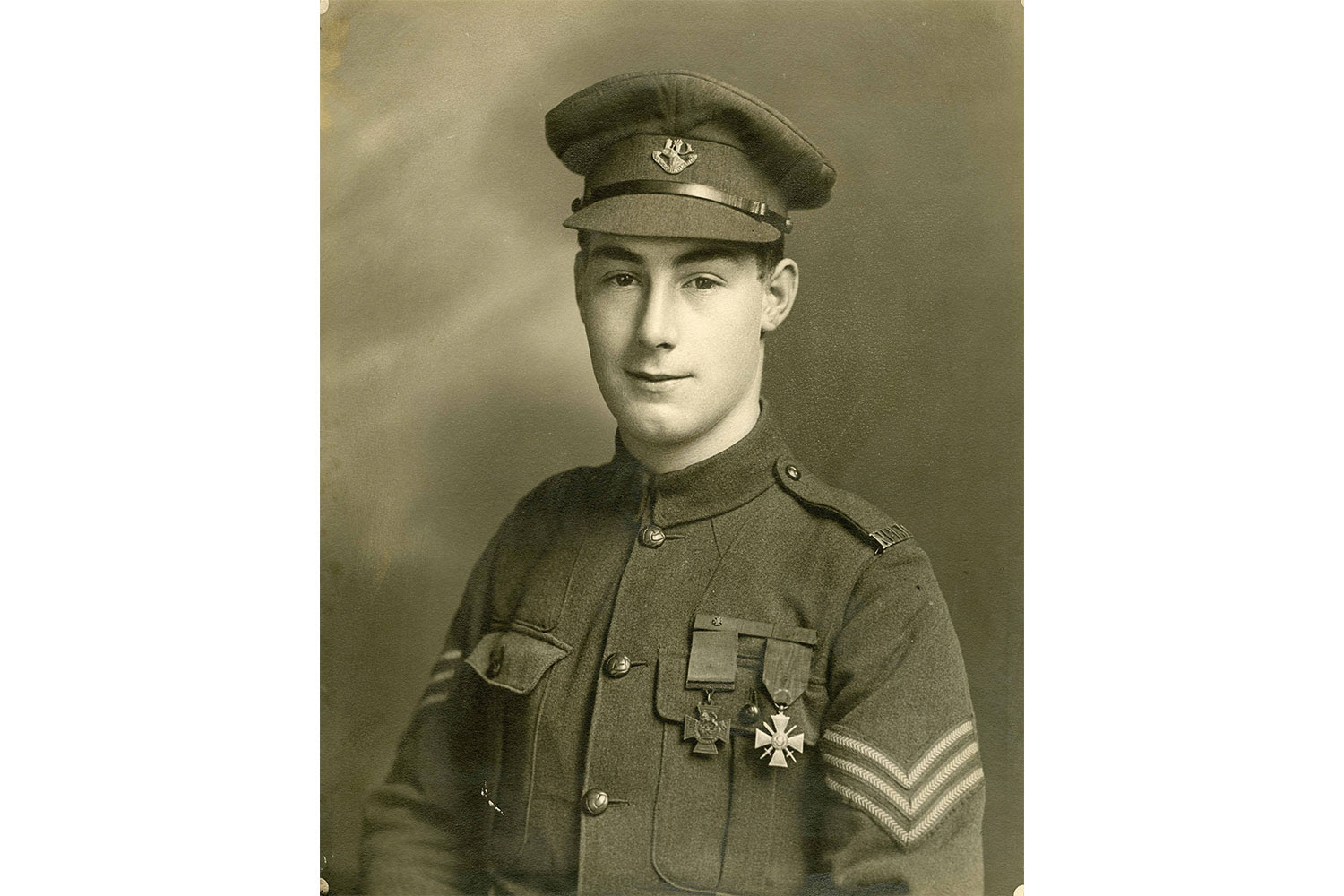
A sturdy lad who had worked from an early age beside his fisherman father, Thomas (Tommy) Ricketts was not asked for proof of his birthdate when he followed in the footsteps of his brother George and joined the Newfoundland Regiment in September 1916, at the age of 15. He was destined to become a hero before his 18th birthday.
Private Ricketts was a seasoned soldier by the time the Hundred Days Offensive began in 1918. Sent to the front in July 1917, he went over the top at the Battle of Langemarck in August, fought at the Battle of Poelcappelle in October. In November, he was wounded early on in the First Battle of Cambrai, which claimed his brother in December.
Unmanned spy vessel washes up on
Scottish island; nobody claims it
Story by Stephen J. Thorne
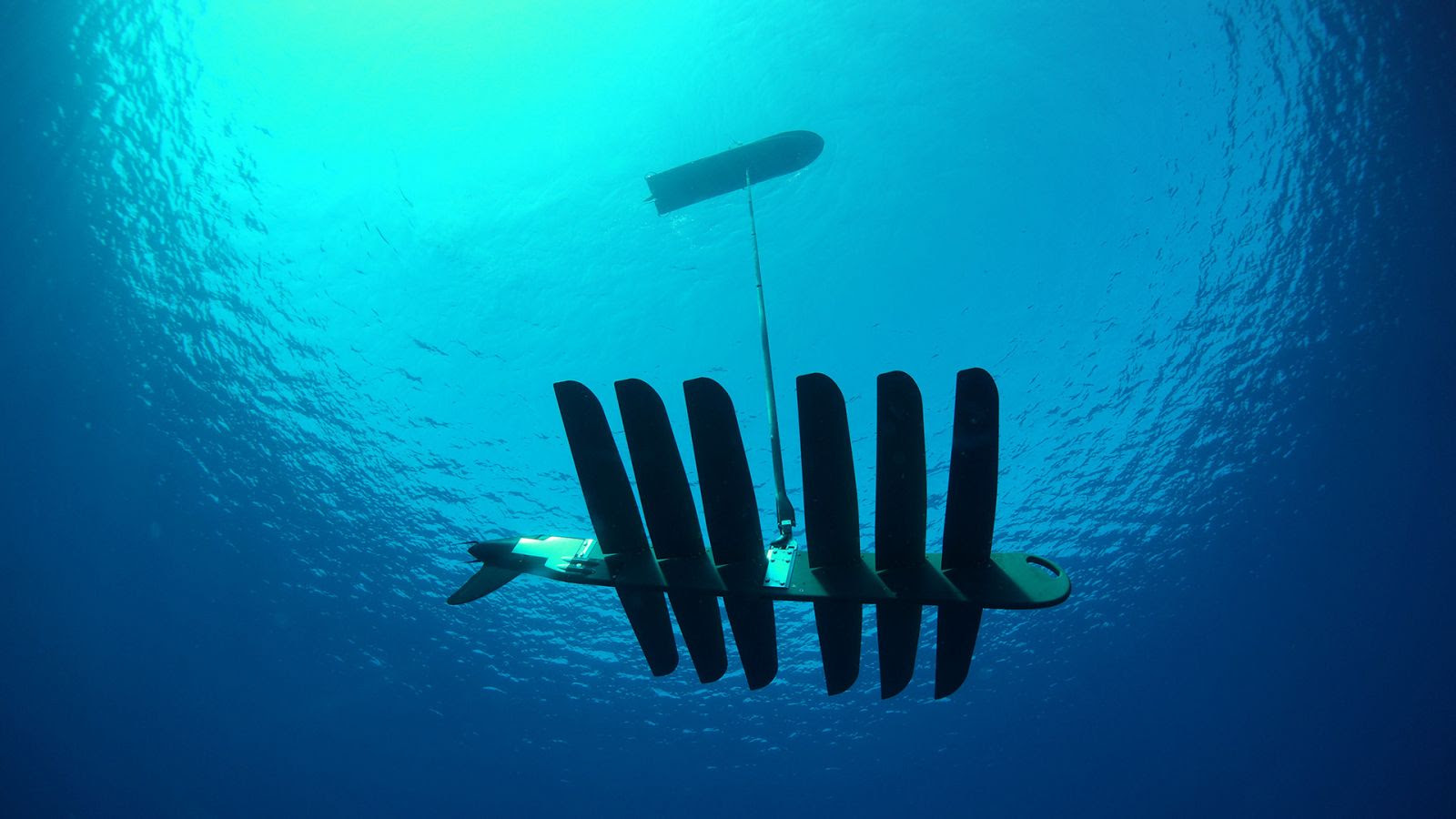
A mysterious, low-profile craft, identified as a robotic spy vessel, has washed up on Scotland’s Isle of Tiree not far from Britain’s nuclear submarine base. But after more than a week of public appeals by coast guard authorities, no one has claimed ownership.
A little more than three metres long, the craft looks like a surfboard with solar panels. It was identified as the surface element of a Wave Glider, an “unmanned surface vessel” made by California-based Liquid Robotics, part of Boeing Corp.’s defence, space and security division.








.jpg?1602876592401)
.jpg?1602876601288)
.jpg?1602876611627)
.jpg?1602876640979)
.jpg?1602876649316)
.jpg?1602876675676)
.jpg?1602876689264)
.jpg?1602876704800)
.jpg?1602266522450)



.jpg?1602601103788)

.jpg?1602599847240)

.jpg?1602600636241)
.png?1602601290653)


 Royal Canadian Legion, US Branch #25