Category Archives: Canadian Studies Program UC Berkeley

Happy Thanksgiving! 🦃 Plus: Nobel Prize; Making middle-class multiculturalism

A newsletter from one of our fellow Canadian organizations in the Bay Area.


Canadian Studies Announcements
In this issue:
  • Happy Thanksgiving from Canadian Studies!
  • Book talk tomorrow: Making Middle Class Multiculturalism
  • In the news: Faculty affiliate David Card wins Nobel Prize in economics
  • Pres. Biden recognizes Indigenous Peoples’ Day, which started in Berkeley
  • Photos: Our 4th Annual Canadian Family Thanksgiving
🍁 Happy Thanksgiving to Canadians Near and Far! 🍁
Dear Friends,
On behalf of all of us at Canadian Studies, I would like to wish a joyful (Canadian) Thanksgiving to you and your families. Here in Berkeley, we have a lot to be grateful for. With the pandemic winding down in California, we’re slowly returning to life as normal. We were even able to celebrate Thanksgiving in-person this weekend with members of the Bay Area’s Canadian Community for the first time in two years – see the pictures below! The day takes on particular poignancy as it also falls on Indigenous Peoples’ Day here in the US, a tradition that started in the city of Berkeley.
As we give thanks, we are most grateful for all of your support through these difficult times. We’ve really seen the value of a strong community over the last two years. I’m so proud to say that we have built such a community around Canadian Studies, because it’s your interest and encouragement that keeps us moving forward. We couldn’t do it without you.
With best wishes for a happy and delicious holiday,
Irene Bloemraad
Program Director
TOMORROW
Book Talk: Making Middle-Class Multiculturalism: Immigration Bureaucrats and Policymaking in Postwar Canada
October 12 | 12:30 pm PT | Online | RSVP here
In the 1950s and 1960s, immigration bureaucrats played an important yet unacknowledged role in transforming Canada’s immigration policy. Their perceptions and judgements about the admissibility of individuals influenced the creation of formal admissions criteria for skilled workers and family immigrants that continue to shape immigration to Canada. Bureaucrats emphasized not just economic utility, but also middle-class traits and values such as wealth accumulation, educational attainment, entrepreneurial spirit, resourcefulness and a strong work ethic. By making “middle-class multiculturalism” a basis of nation-building in Canada, they created a much-admired approach to managing racial diversity that has nevertheless generated significant social inequalities. Migration expert Jennifer Elrick will discuss insights from her forthcoming book examining the topic.
Jennifer Elrick is an assistant professor of sociology at McGill University in Montreal, Quebec. Her research interests lie in the area of state classifications (in censuses and immigration policy) and their relationship to social stratification along the lines of race, gender, and social class. Her work is multi-national in scope, focusing on Canada, Germany, and the United Kingdom.
IN THE NEWS
Faculty Affiliate David Card Wins Nobel Prize in Economics
Canadian Studies is proud to announce that David Card, a UC Berkeley economist and Canadian Studies faculty affiliate, was awarded half of the 2021 Sveriges Riksbank Prize in Economic Sciences in Memory of Alfred Nobel. The award recognizes his pioneering research in the field of labour economics, which has been hailed as “revolutionary”. We hope you will join us in congratulating Professor Card for this monumental achievement.
Born in Canada, Professor Card has taught at Berkeley for over twenty years. His research focuses on inequality and growth; his best-known work includes studies that challenged prevailing orthodoxies on the negative impacts of a higher minimum wage on employment figures, and of immigration on the wages of native-born workers.
Hear Professor Card’s reaction to the news and his thoughts on the policy implications of his research in a post-announcement interview with the Nobel Committee’s Adam Smith.
President Biden Recognizes Indigenous Peoples’ Day, Which Started in Berkeley
Today, Americans honor the Native people of our country, their diverse cultures, and their numerous contributions to our history and society. It is also a time to reflect on the historical and present treatment of Indigenous peoples in the United States, and celebrate their resilience as vibrant, modern communities.
This year’s celebration bears special significance, as it is the first time the holiday has been formally recognized by the federal government. Berkeley was the first US city to officially celebrate Indigenous Peoples’ Day in 1992. The decision grew out of debates over the commemoration of the 500th Anniversary of Columbus’ arrival in the Americas and traditional Columbus Day celebrations, which many felt did not accurately account for the impact of European colonization on Native American communities. As a result, Berkeley opted to replace Columbus Day with a celebration of Native American cultures and peoples.
Since then, an increasing number of cities and states have opted to celebrate Indigenous Peoples’ Day alongside or in lieu of Columbus Day. And last Friday, President Biden signed a proclamation recognizing the holiday nationally for the first time ever. The document also affirmed a commitment by the President to honor tribal sovereignty and past treaties on the part of the government. Learn more about what some Native Americans have to say about the significance of the move via NPR.
Image: Indigenous Peoples’ Day celebration in Berkeley, 2012. Credit: Quinn Dombrowski on Wikimedia Commons.
Photos: Celebrating Our 4th Annual Canadian Family Thanksgiving
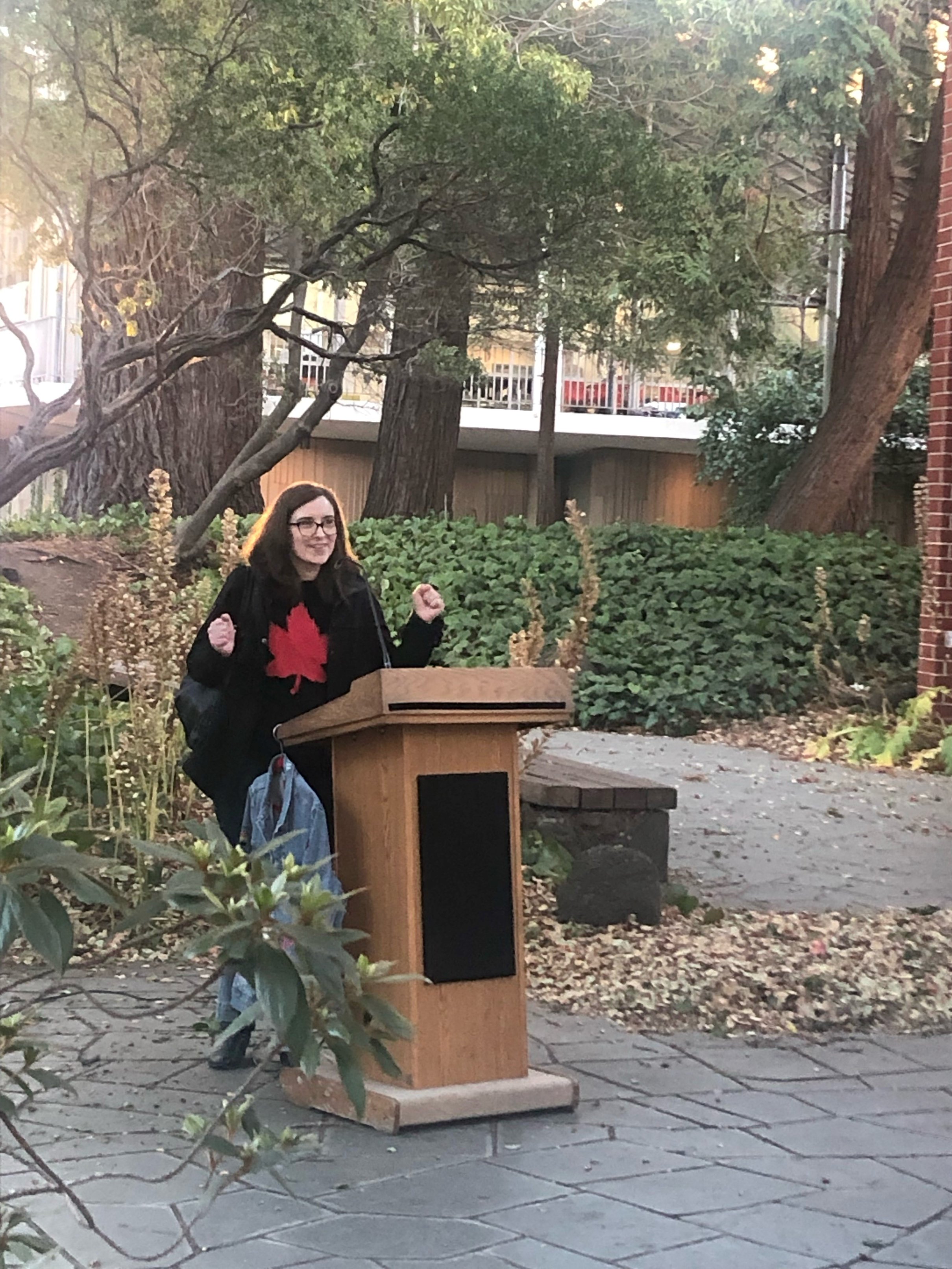
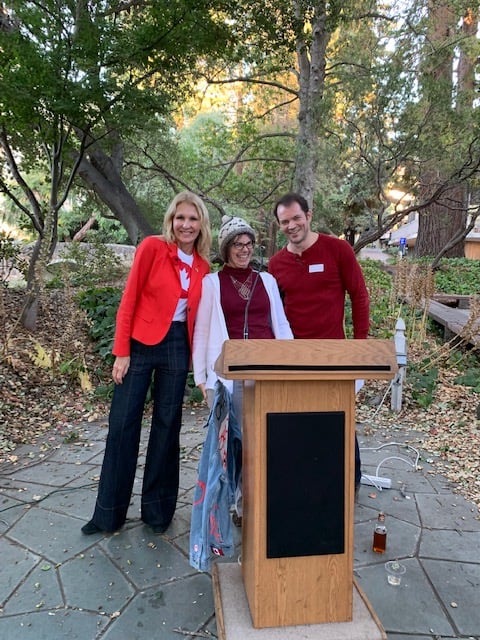
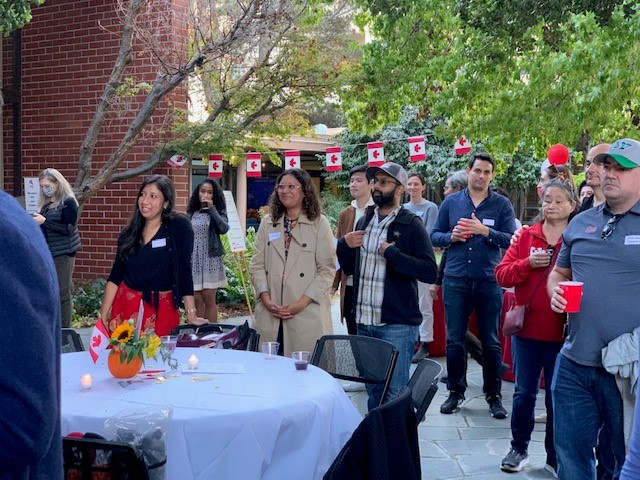
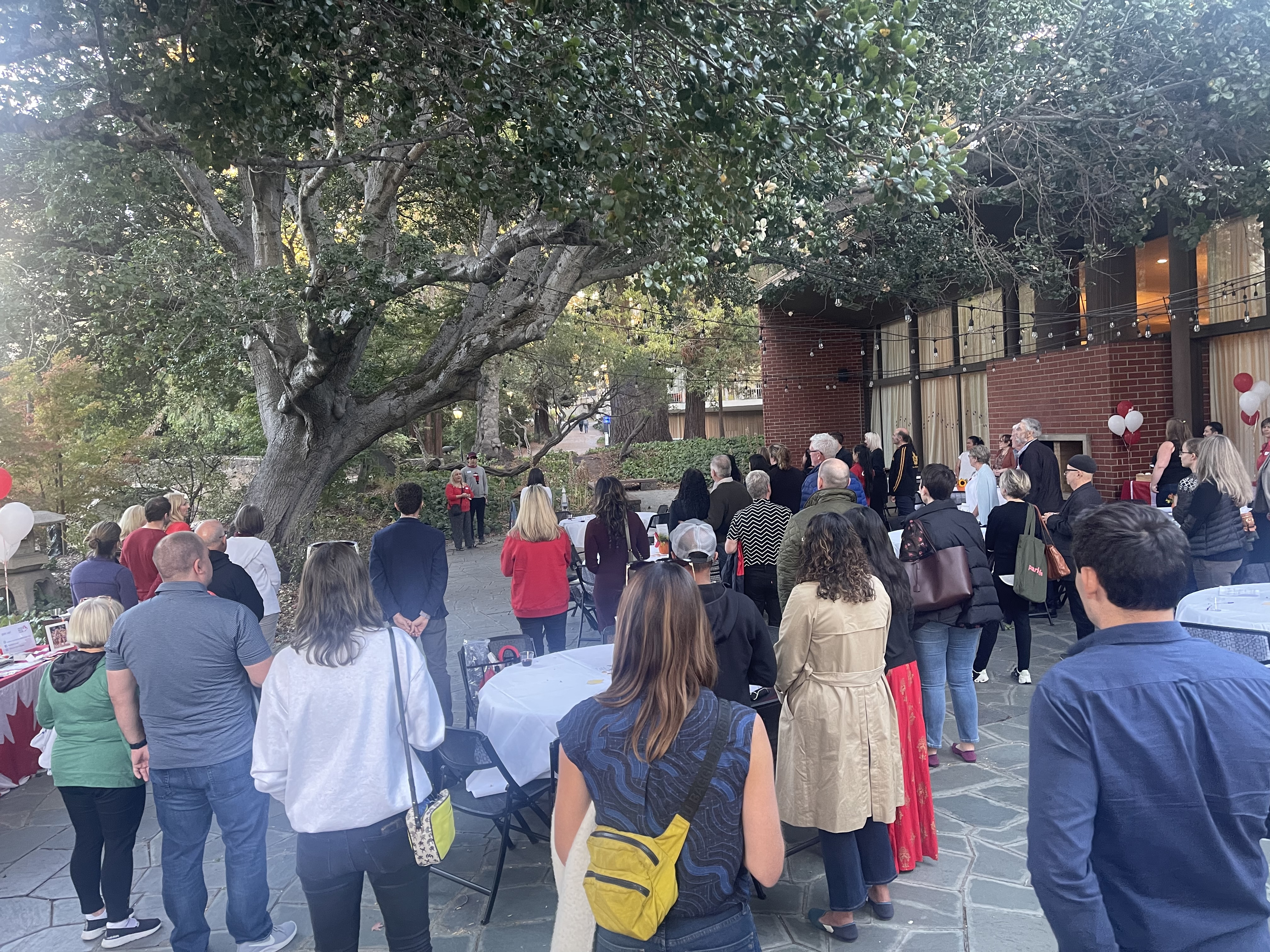
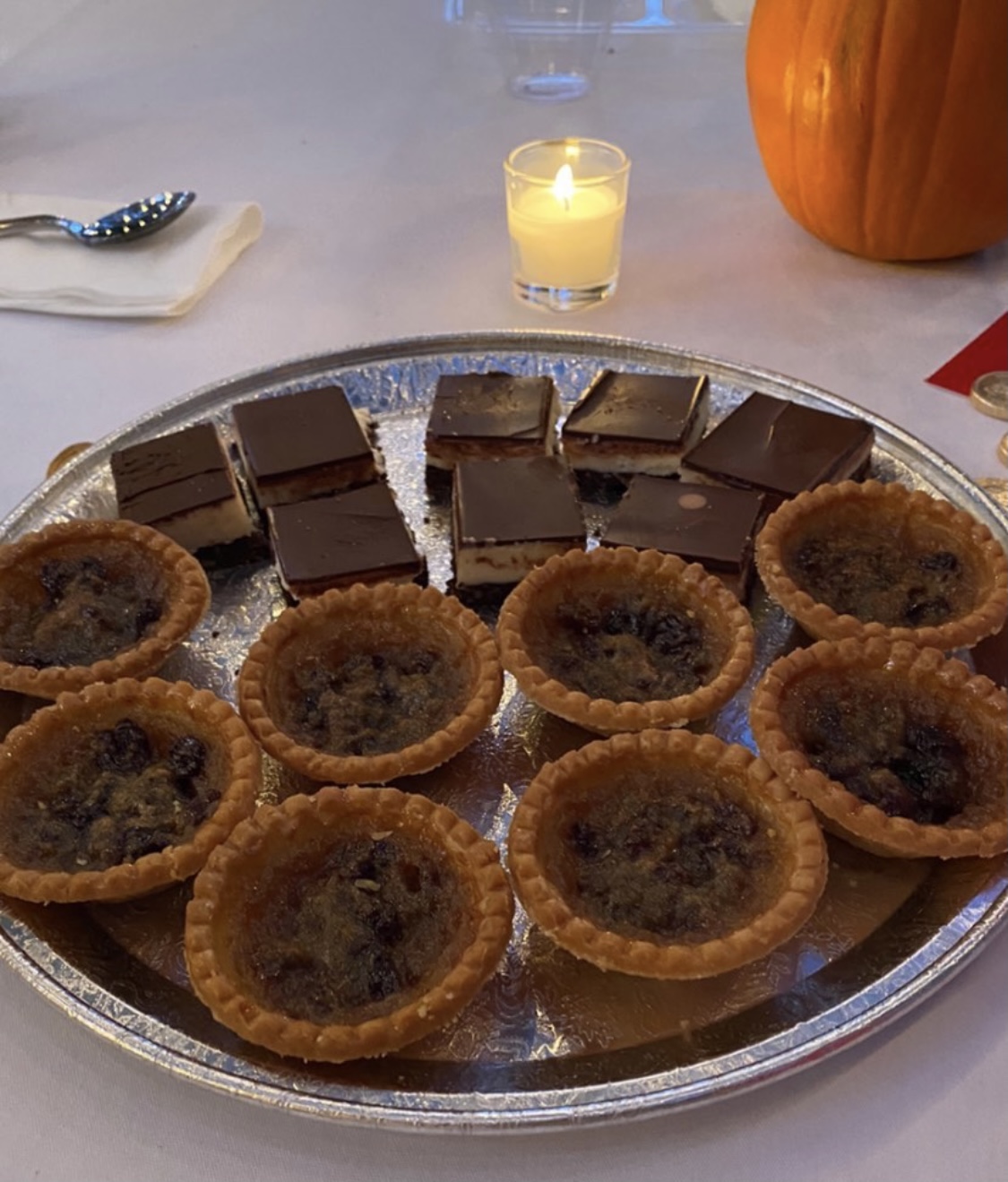
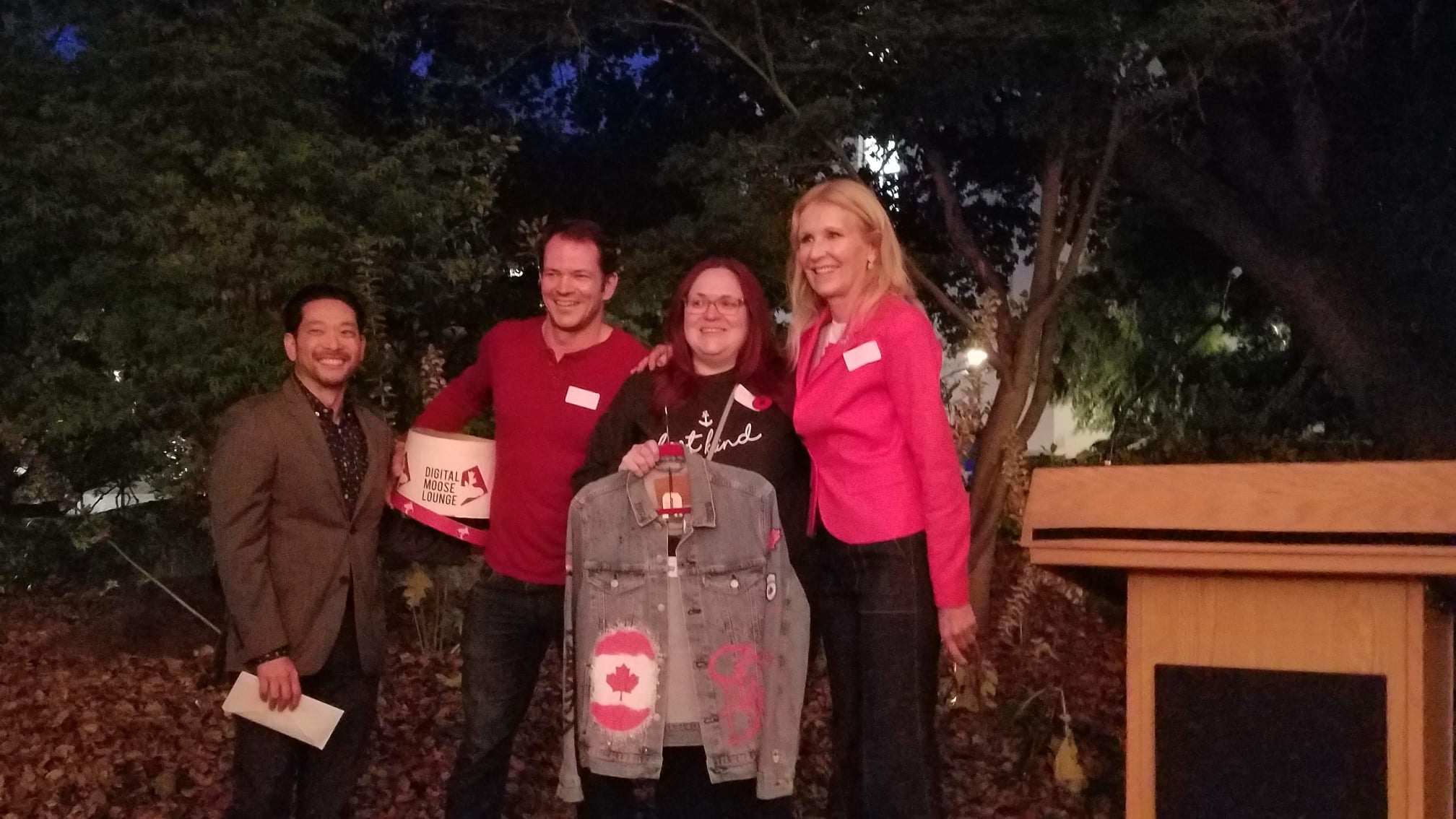
Last Saturday, Canadian Studies welcomed friends from across the Bay back to Berkeley for a special Thanksgiving celebration, our first since 2019! Our 4th Annual Canadian Family Thanksgiving, hosted jointly with the Digital Moose Lounge, was a roaring success. Canadians and friends of Canada alike had fun connecting in-person over a turkey dinner; guests enjoyed music, trivia, and a raffle with Canadian prizes, including woolen tuques, a Team Canada Olympic jacket, and two Air Canada tickets! But most appreciated was a renewed community connection as guests mingled, chatted, and shared Canadian Stories. We can’t wait to see you again next year!
Canadian Studies Program
213 Moses Hall #2308
Canadian Studies Program | Univ. of California, Berkeley, 213 Moses Hall #2308, Berkeley, CA 94720

Poppy Campaign: 4th Annual Canadian Thanksgiving

Earlier today the branch unofficially began its annual 2021 Poppy Campaign, as it participated in the 4th Annual Canadian Thanksgiving that was co-hosted Digital Moose Lounge and the Canadian Studies Program at the University of California at Berkeley.  Below are some pictures from the event that we located online.

Click on any image to enlarge.


Click on any image to enlarge.

Click on any image to enlarge.

Click on any image to enlarge.


Click on any image to enlarge.


Last DAY for Thanksgiving Dinner tickets!

Note this event deadline.  Also, a reminder that this event is the unofficial beginning to our annual Poppy Campaign.


It’s turkey time in the Bay Area
View this email in your browser

Get your tickets for Thanksgiving (last day to purchase!)

We’re celebrating Thanksgiving together again! 

Join the DML and UC Berkeley’s Canadian Studies Program 

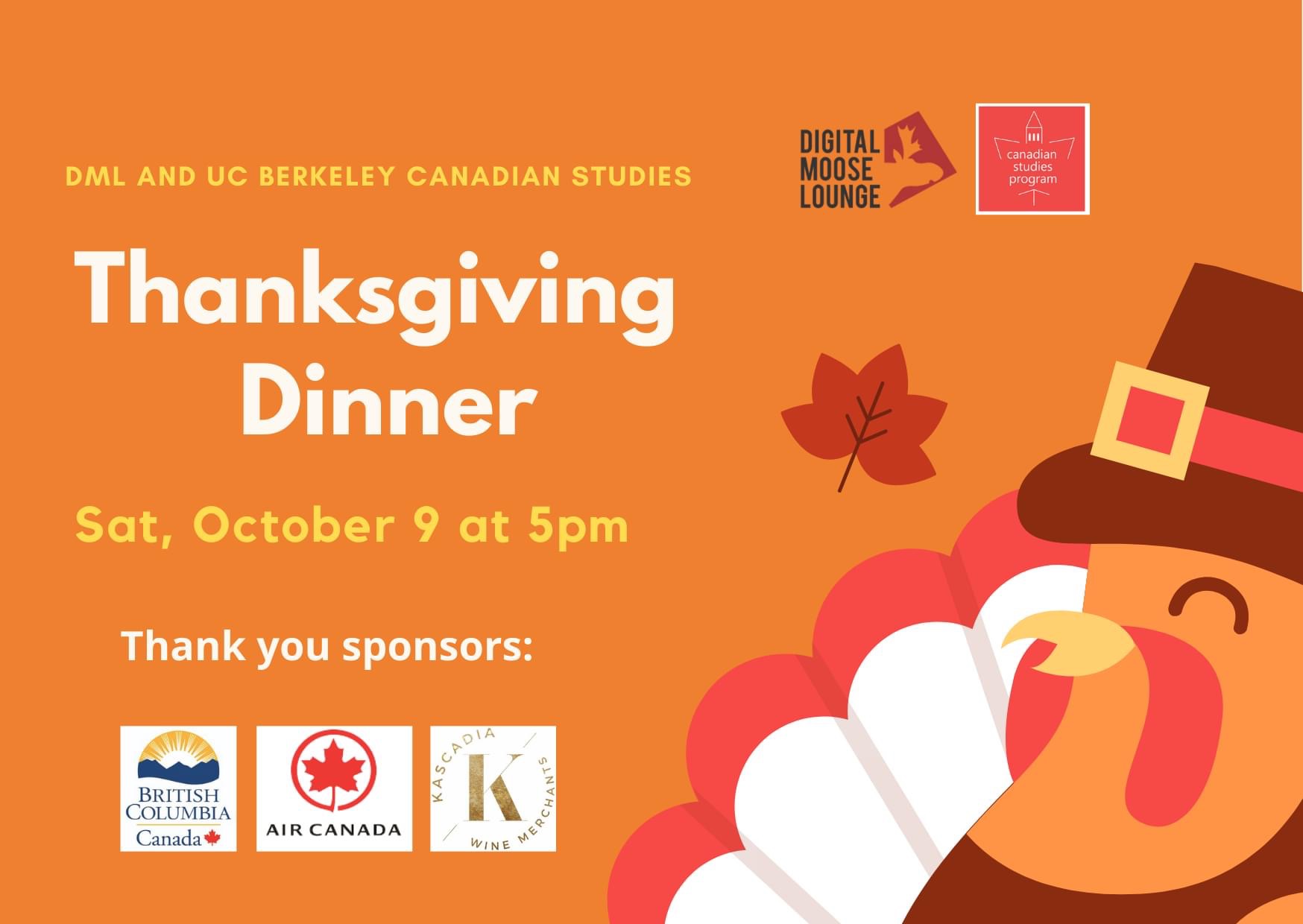
WHEN: SATURDAY, OCTOBER 9, 2021 5 PM

We are so excited to be hosting Thanksgiving dinner again this year. Come enjoy a catered turkey dinner, sip some BC wines and show off your Canadian trivia knowledge.

Tickets include dinner and dessert, two drinks, and a chance to win a trip for two anywhere in North America courtesy of Air Canada.

This year’s event wouldn’t be possible without the generous support of BC Trade, Kascadia Wine Merchants, the Canadian Consulate of San Francisco, Air Canada, and our gracious hosts, UC Berkeley Canadian Studies.

*Please note, this is an adult-only event and all guests are required to show proof of vaccination*

More information>>

Keep your antlers to the ground with all the latest news, updates and fun

Check out all our upcoming events

Visit our site
Twitter
Facebook
Website
Copyright © 2021 Digital Moose Lounge, All rights reserved.
You are receiving this email because you subscribed to our newsletter on our website.

Our mailing address is:

Digital Moose Lounge

1260 Birchwood Drive

Sunnyvale, CA 94089

Last chance for Thanksgiving! Plus: Making middle-class multiculturalism

An item from one of our fellow Canadian organizations in the Bay Area.


Canadian Studies Announcements
In this issue:
  • Canadian Thanksgiving is this Saturday – last chance for tickets!
  • Book talk next week: Making Middle Class Multiculturalism
  • In the news: Canada marks first-ever “National Day of Truth and Reconciliation”
  • External event: The 2021 Election’s Implications for Canadian Foreign Policy
  • Call for papers: ACSUS 2022 26th Biennial Conference
  • Call for papers: The Clean Water Act and Lake Champlain Basin
4th Annual Canadian Family Thanksgiving
October 9 | 5:00 pm | Alumni House, UC Berkeley | Purchase tickets here
Don’t miss your chance – join us this Saturday for our annual Canadian Thanksgiving dinner! Join us and our partners at the Digital Moose Lounge for a special meal celebrating the Bay Area’s Canadian community as we meet together for the first time since the pandemic. Mingle with your fellow SF Bay Canadians while enjoying entertainment and a delicious boxed turkey dinner. There will also be special prizes, including a raffle of Air Canada tickets! The dinner will take place outdoors and will observe all relevant public health measures.
Tickets are selling out fast, so buy yours today through the Digital Moose Lounge.
We’re also looking for volunteers to help staff the event. A limited number of half-priced tickets are available to volunteers; please contact us for more information.
UPCOMING EVENT
Book Talk: Making Middle-Class Multiculturalism: Immigration Bureaucrats and Policymaking in Postwar Canada
October 12 | 12:30 pm PT | Online | RSVP here
In the 1950s and 1960s, immigration bureaucrats played an important yet unacknowledged role in transforming Canada’s immigration policy. Their perceptions and judgements about the admissibility of individuals influenced the creation of formal admissions criteria for skilled workers and family immigrants that continue to shape immigration to Canada. Bureaucrats emphasized not just economic utility, but also middle-class traits and values such as wealth accumulation, educational attainment, entrepreneurial spirit, resourcefulness and a strong work ethic. By making “middle-class multiculturalism” a basis of nation-building in Canada, they created a much-admired approach to managing racial diversity that has nevertheless generated significant social inequalities. Migration expert Jennifer Elrick will discuss insights from her forthcoming book examining the topic.
Jennifer Elrick is an assistant professor of sociology at McGill University in Montreal, Quebec. Her research interests lie in the area of state classifications (in censuses and immigration policy) and their relationship to social stratification along the lines of race, gender, and social class. Her work is multi-national in scope, focusing on Canada, Germany, and the United Kingdom.
IN THE NEWS
Canada Marks First “National Day for Truth and Reconciliation”
September 30 was Canada’s first-ever National Day for Truth and Reconciliation. Originating from the Indigenous-led grassroots campaign known as “Orange Shirt Day”, the new commemoration honors survivors of Canada’s residential school system as well as the children who perished in the schools.
Canada’s residential schools operated for over a century, and were intended to forcibly assimilate Indigenous people into European-Canadian society. Attendance was compulsory for Indigenous children from 1894 to 1947. Children were intentionally separated from their communities, with the goal of eliminating Indigenous cultural practices; meanwhile, within the schools, they endured neglect, deprivation, and abuse.
In 2013, Indigenous writer and residential school survivor Phyllis Webstad established “Orange Shirt Day” on September 30, to promote awareness of the system’s impact on Indigenous communities. Webstad had arrived at the school wearing a new orange shirt, which was taken from her on arrival: it now symbolizes “stripping away of culture, freedom and self-esteem experienced by Indigenous children over generations.”
After several high-profile gravesite discoveries at former residential schools brought renewed attention to the issue earlier this year, the Canadian Government officially recognized the commemoration as a national statutory holiday called “National Day for Truth and Reconciliation”. Public commemoration and acknowledgement of the devastating impact of the system on Indigenous families and communities is vital to the reconciliation process.
EXTERNAL EVENT
Conversations on Canada: Solo Canada? The 2021 Election’s Implications for Canadian Foreign Policy
October 6 | 11 am PT | Online | RSVP here
The 2021 Canadian election included debates over just a few international relationships and issues, mainly China, climate change, and the evacuation of Kabul. On these issues and more, the relationship with the United States is important: border restrictions, COVID, Buy American provisions, USMCA implementation, Enbridge Line 5, and the extradition of Meng Wanzhou. On a growing range of issues Canada is looking for a partnership with the United States, but Canadians increasingly wonder if they are talking to themselves and if Americans are listening.
Dr. Christopher Sands, director of the Wilson Center’s Canada Institute and a Canadian Studies Program board member, will address these challenges in a conversation moderated by Dr. Christopher Kirkey, director of the Center for the Study of Canada and Institute on Québec Studies, SUNY Plattsburgh.
Call for Papers: ACSUS 2022 26th Biennial Conference
Deadline: November 1, 2021
In celebration of the its 50th anniversary, the Association for Canadian Studies in the United States (ACSUS) will host its 26th biennial conference, March 24-27, 2022, in Washington, D.C. The conference is open to all proposals with a significant Canadian focus. ACSUS welcomes papers and panel proposals from graduate students, professors, independent scholars,
and practitioners on all diverse and critical perspectives related to the theme, ‘Canada: Near and Far’. How is Canada perceived and portrayed from outside its borders, and by the international community? How is Canada understood by its expatriates? What role do non-governmental agencies around the world play in shaping Canada’s relationships with the world? What is ACSUS’s role in these larger questions? Proposals that touch on these themes through diverse and critical perspectives are especially encouraged, though, as always, submissions on all subjects addressing Canada and Canadian-American relations are welcome.
For more information on proposal guidelines and for submission information, please visit the conference’s website.
Call for Papers: The Clean Water Act and Lake Champlain Basin: Origins, Implementation, Impacts
Deadline: December 31, 2021
The Institute on Quebec Studies and the Lake Champlain Research Institute at SUNY Plattsburgh, in partnership with Groupe d’études et de recherche sur l’international et le Québec (GERIQ), École nationale d’administration publique (ÉNAP), and Observatoire sur les États-Unis, Chaire Raoul-Dandurand, Université du Québec à Montréal (UQÀM), are co-organizing a two-day authors’ workshop to investigate and review the 1972 U.S. Clean Water Act (CWA), and the implementation and impact of the Act on the Lake Champlain Basin. The goal is to produce a book volume with a leading university press.
This scholarly research colloquium and publication initiative – to be held in conjunction with the 50th anniversary of the CWA – will bring together social scientists, applied scientists, and leading practitioners from the United States and Canada. They invite single-discipline, multidisciplinary, comparative, and applied case study proposals that offer original perspectives.
For more information, please read the call for papers here.
Canadian Studies Program
213 Moses Hall #2308
Canadian Studies Program | Univ. of California, Berkeley, 213 Moses Hall #2308, Berkeley, CA 94720

Canadian Thanksgiving tickets now on sale! 🦃

An item from a fellow Canadian organization in the Bay Area.


Canadian Studies Announcements
In this issue:
  • Canadian Thanksgiving tickets now on sale – volunteers needed!
  • Upcoming book talk: Making Middle Class Multiculturalism
  • Opinion: Canada needs to reimagine foreign policy in a leaderless world
  • Call for papers: Atlantic Canada Studies conference
4th Annual Canadian Family Thanksgiving
October 9 | 5:00 pm | Alumni House, UC Berkeley | Purchase tickets here
Canadian Studies is pleased to announce that our annual Canadian Family Thanksgiving will be happening as scheduled this October! Join us and our partners at the Digital Moose Lounge for a special meal celebrating the Bay Area’s Canadian community as we meet together for the first time since the pandemic. Mingle with your fellow SF Bay Canadians while enjoying entertainment and a delicious boxed turkey dinner. The dinner will take place outdoors and will observe all relevant public health measures.
Tickets may be purchased through the Digital Moose Lounge.
We’re also looking for volunteers to help staff the event. A limited number of half-priced tickets are available to volunteers; please contact us for more information.
UPCOMING EVENT
Book Talk: Making Middle-Class Multiculturalism: Immigration Bureaucrats and Policymaking in Postwar Canada
October 12 | 12:30 pm PT | Online | RSVP here
In the 1950s and 1960s, immigration bureaucrats played an important yet unacknowledged role in transforming Canada’s immigration policy. Their perceptions and judgements about the admissibility of individuals influenced the creation of formal admissions criteria for skilled workers and family immigrants that continue to shape immigration to Canada. Bureaucrats emphasized not just economic utility, but also middle-class traits and values such as wealth accumulation, educational attainment, entrepreneurial spirit, resourcefulness and a strong work ethic. By making “middle-class multiculturalism” a basis of nation-building in Canada, they created a much-admired approach to managing racial diversity that has nevertheless generated significant social inequalities. Migration expert Jennifer Elrick will discuss insights from her forthcoming book examining the topic.
Jennifer Elrick is an assistant professor of sociology at McGill University in Montreal, Quebec. Her research interests lie in the area of state classifications (in censuses and immigration policy) and their relationship to social stratification along the lines of race, gender, and social class. Her work is multi-national in scope, focusing on Canada, Germany, and the United Kingdom.
Opinion: Canada needs to reimagine a foreign policy for a leaderless world
With the recent federal election confirming a continuation of PM Trudeau’s Liberal government, Canadians are looking for signs of new policies and government priorities. A recent opinion published in The Globe & Mail, co-written by five Canadian political thinkers, argues that Canada needs to radically re-imagine an independent foreign policy. With authors including Jeremy Kinsman, a former diplomat who has spoken at Canadian Studies events multiple times, and former minister of foreign affairs Lloyd Axworthy, the piece argues that Canada’s leaders must give renewed attention to international affairs. Canada can no longer merely follow a United States that is increasingly disinterested in global leadership, as illustrated by the recent Afghanistan debacle. Canadians, they contend, are eager for greater global engagement, and the US’ withdrawal is an opportunity for Canadian initiative on rights issues worldwide.
Call for Papers: Atlantic Canada Studies Conference
Deadline: November 15, 2021
UNB’s Atlantic Canada Studies Centre cordially invites submissions of paper and panel proposals for the 2022 Atlantic Canada Studies Conference, taking place in Fredericton, NB from May 11-14, 2021. They welcome paper and panel proposals which consider a variety of topics related to the study of Atlantic Canada, and which offer new approaches to questions of peoples, places, and ideas in the writing of this region. Applicants should prepare 15-minute presentations and limit panels to 3 papers. Papers can be presented in English, French, or any Wabanaki language.
For more information on proposal guidelines and for submission information, please visit the conference’s website.
Canadian Studies Program
213 Moses Hall #2308
Canadian Studies Program | Univ. of California, Berkeley, 213 Moses Hall #2308, Berkeley, CA 94720