Category Archives: Doughboy Foundation

WWI DISPATCH February 2021

A newsletter from the folks behind the World War One Centennial Commission.


View this in your browser

Header 10292020

February 2021

Coming Soon all white text

Dispatch subscribers: keep an eye on your email for a personal invitation to watch a Live Broadcast of The Inaugural Raising of the Flag of the United States of America over the National World War I Memorial in Washington, DC, featuring award-winning actor Gary Sinese and many other notable speakers. Not a subscriber? Subscribe now to be sure you receive your own invitation to watch this historic broadcast.

Sculpture video NJ

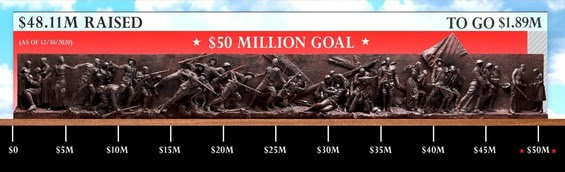
It’s 58 feet long and 10 feet high:
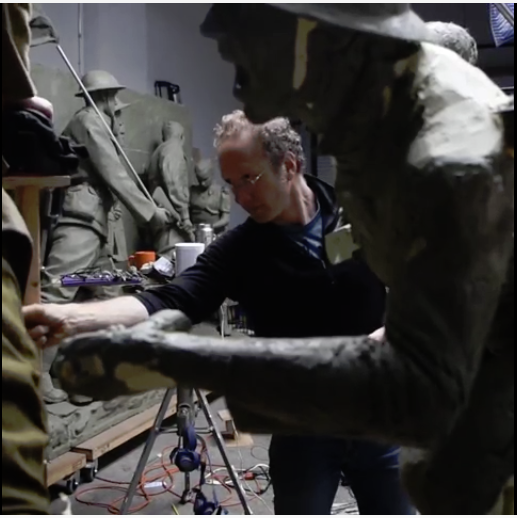
New Jersey sculptor’s World War I monument will speak for a nation

An in-depth look at the process of creating the sculpture for the new National World War I Memorial in Washington, DC was recently published on the NorthJersey.com web site, and later picked up for national viewership by USA Today. Reporter Jim Beckerman interviews sculptor Sabin Howard and the whole team at his studio. Click here to read the entire interview, and watch the absorbing video.


Teaching and learning WWI in 2021 animated gif square

Last Chance: sign up for webinar today!

Click here to register TODAY to attend this FREE 2021 webinar for educators and learners about the challenges, opportunities and importance for teaching and learning about “The War That Changed the World”. “WWI Education Webinar: Strategies and Tools for Teaching (and Learning) WWI in 2021” on Feb 26, 2021 1:00 PM EST — today.

https://attendee.gotowebinar.com/
register/1274955613107522318

After registering, you will receive a confirmation email containing information about joining the webinar. Can’t attend today? Register anyway to receive a link to the recording later.


New Book Gives Voice to the Men of the Famous Lost Battalion of World War I

The Lost Battalion: As They Saw It.

In the history of American participation in WWI, two stories remain the most recognized: that of Sergeant York, and that of the ‘Lost Battalion.’ Now another chapter in the tale of the Lost Battalion has been told in a new book by WWI author and historian Robert J. Laplander titled The Lost Battalion: As They Saw It. Most know the general story. Between October 2nd and October 7th, 1918 Major Charles Whittlesey of the 77th Division led nearly 700 men into the narrow Charlevaux Ravine during the battle in the Argonne Forest. They were quickly surrounded by the Germans and during their five-day siege in that ravine endured starvation, continual enemy attacks, a mistaken artillery barrage by their own forces, and an eventual casualty rate of nearly 72%. Click here to learn more about this new book that tells the Lost Battalion’s story through the words of its survivors..


Black heroes highlighted in call for Peace Cross restoration funding

Peace Cross MD

The Bladensburg World War I Memorial, known as the Peace Cross, in Prince George’s County, Maryland, which includes the names of four Black soldiers who died in World War I, needs money for restoration. Calls for funding are being made specifically during Black History Month. “Funds are needed to begin this vital endeavor. To address the need, the Department of Parks and Recreation is fundraising to repair the Peace Cross,” Department Resource Development Officer Tracy Wright said in a news release. “We encourage the community to join us and help support the restoration of this historical monument which honors our fallen Black heroes.” Click here to learn more about the Peace Cross, the heroes it honors, and how its restoration can be supported.


Women Answered Call in World War I

Marguerite Martin

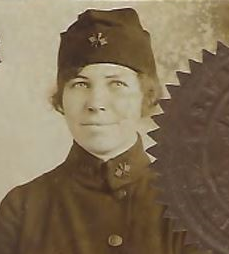
In World War I telephone operators were needed in Europe. General John J. Pershing, commander of the American Expeditionary Forces during World War I, quickly saw that women—American women–would be better at telephone work than the men. The Signal Corps was all male, and they were not only assigned to string lines but to handle all communications, and were not doing well at the latter task. A call was put out throughout America for women to serve in Europe as operators. The preferred candidates were fluent in French and English. One of the women who answered the call was Marguerite Martin. Click here to read Marguerite’s story, and learn how important the “Hello Girls” were to the American Expeditionary Forces in World War I.


Des Moines Hosted First-Ever African American Officer Training camp

Des Moines graduates

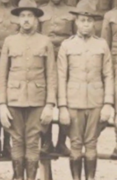
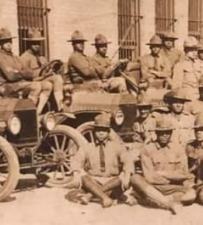
A page of Des Moines history is also part of Black history. In 1917, a thousand African American college-educated young men came to Des Moines for the Officer Training Program. They were joined by 250 Black non-commissioned officers for training from May through October. “Des Moines has a really proud legacy of having Fort Des Moines, which is a camp where the first Black officers for the U.S. Army were trained,” said Leo Landis, curator of the State Historical Museum of Iowa. Click here to read more, and learn about one of the soldiers who came back after his military days: James B. Morris, who is remembered still at the State Historical Museum of Iowa.


Creede, CO and WWI—A Knitter’s Tale

Mary_Elting_Folsom

“Grandma, do you know how to knit?”

It was the summer of 2000 and eleven-year-old Lizzie, a beginning knitter, hoped she’d found a mentor—her ninety-four-year-old grandmother, Mary Elting Folsom. Lizzie’s question took Mary back to 1917, several months after the US entered World War I.

“Yes, Lizzie, I do know how to knit. I learned during the summer of 1917, when I was eleven. Surprisingly, my teacher was a British army recruiter who had come to my home town of Creede, Colorado.”

Located high in the San Juan mountains of southern Colorado, Creede was a silver mining town when Mary was born in 1906. Click here to read Mary’s story, and learn the surprising reason that a British army recruiter was there in 1917 to provide knitting lessons to her.


African American suffragist supported U.S. troops in World War I for YWCA

Addie Waites Hunton

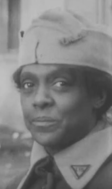
When Kathy Coker was doing research at the Richmond, VA Public Library, In preparation for Black History Month, she uncovered the fascinating story of Addie Waites Hunton, an African American suffragist, activist, writer, political organizer, educator, and officer of the the Young Women’s Christian Association (YWCA). If all that wasn’t enough to make Hunton a noteworthy historical figure, she also became involved in the YMCA’s work abroad during World War I, travelling to France in June 1918 to work with the black troops of the American Expeditionary Forces. Click here to read the entire amazing story of Addie Waites Hunton, and the astonishing and outsized role she played in American history.


French-Built and American Flown: Meet the WWI Nieuport 28 Fighter Plane

Nieuport 28

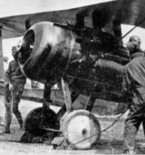
When the United States military went “over there” to take on the Huns (the Germans) during the First World War, what it lacked in equipment it more than made up for in determination. This meant that Americans often relied on foreign equipment, and in the case of aircraft the American Expeditionary Force (AEF) used what it could get. After the French rejected the Nieuport 28C.1, which was introduced in mid-1917, in favor of the far sturdier and more advanced Spad XIII, the newly arrived Americans adopted the Nieuport 28 as a stop-gap measure, and quickly the American pilots made do with what they could. Click here to read more about how American aviators with obsolete equipment were nevertheless able to perform prodigious aviation feats in WWI. 


How Rockford’s WWI Camp Grant led to an African American community center

Rockford IL

Rockford, IL is home to one of the oldest African American community centers in Illinois, a direct descendant of World War I’s Camp Grant. For more than a year, Joyce Higgins has been the executive director of the African American Resource Center (AARC) at Booker Washington Community Center, 524 Kent St, but she’s been involved at the center for decades. “The Booker Washington Center would not even exist if it wasn’t for segregation,” she said. “It’s an excitement to tell this history…there’s so much of it.” Click here to read the story of how one of the 16 cantonments used to train soldiers in WWI gained a second life in the community after the conflict ended.


A rifle and a shovel — As a wagoner in World War I, early Pablo Beach, FL resident made his mark in history

Jesse Butler headstone

The oldest headstone in Lee Kirkland Cemetery, the historic African-American graveyard in Jacksonville Beach, belongs to Jessie Butler, a native Floridian who performed back-breaking work in a seaside mining camp known as Mineral City before serving his country overseas in World War I. The upright marble headstone, issued by the U.S. Government, denotes the little-known unit he served in during the war, and, most importantly, his rank – that of wagoner. Click here to read how Jesse Butler’s special capabilities played an important role supporting the U.S. Army in World War I.


Elgin’s Black Soldiers Served Proudly in U.S. Armed Forces during World War I

Elgin IL soldiers

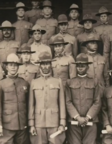
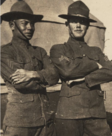
In the period leading up to WWI, the 8th Regiment of the Illinois National Guard would make history. This unit would become known as the 370th U.S. Infantry and was made up entirely of Black soldiers, officers and commanders. The 370th Infantry would see combat in France, becoming the first U.S. regiment in the French region of Alsace-Lorraine. Among its ranks was Elgin’s own Lewis P. Andrews. Click here to read his story, and learn how the 370th fought with such distinction in France and Belgium that the Germans who fought them gave the soldiers the nickname of Schwarze Teufel, “Black Devils,” for their ferocity in combat.


WWI Changed Us: How the Philippines Shaped America’s First World War

Philippines and WWI

Ever since U.S. troops occupied the Philippines in 1898, generations of Filipinos have served in and alongside the U.S. Armed Forces, including during World War I. Join historian Christopher Capozzola at the National World War I Museum and Memorial as he reveals the forgotten history of the military relationship between the U.S. and Philippines from the colonial-era Philippine Scouts to the present day. Learn how military service in the Philippines shaped the worldview of key World War I military figures (including General John J. Pershing), and how World War I affected the Philippines and other U.S. colonies. Click here to register for the free Zoom webinar, and learn more about this forgotten chapter of America’s WWI experience.


Doughboy MIA for February

Samuel Roach

A man is only missing if he is forgotten.

Our Doughboy MIA this month is Private Samuel Roach. Born February 12th, 1886, in Bradford, Ohio, Private Roach was an employee of the E.C. Atkins Saw Works in Indianapolis when he enlisted in the U.S. Army on October 16th, 1917. Sent to Ft. Thomas, Kentucky for muster, he took his training at Washington D.C., where he was assigned to Company D, 6th Engineer Regiment, 3rd Division. He left for overseas on December 6th, 1917, and was killed in action on March 29th, 1918 near Villers Bretonneux. He is memorialized on the Walls of the Missing at the Somme American Cemetery, Bony, France. Interestingly, he was initially reported to the state of Indiana as having been returned and interred at Arlington national Cemetery.

Can you spare just ten dollars? Give ‘Ten For Them’ to Doughboy MIA and help us make a full accounting of the 4,423 American service personnel still listed as missing in action from WW1. Make your tax deductible donation now, with our thanks.


Official WWI Centennial Merchandise

Coin Group

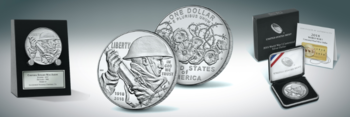
2018 World War I Centennial Silver Dollar Set

No longer available from the U.S. Mint!

These Official World War I Centennial Silver Dollar Sets are still available here on the WWI Centennial Commission’s online gift shop.

NOTE: Each set comes with 2 separate coins. Each set will accompany the Official Doughboy Design alongside your choice of Military Branch.

“The United Mint certifies that this coin is a genuine 2018 World War I Centennial Silver Dollar, minted and issued in accordance with legislation passed by Congress and signed by the President on December 16, 2014, as Public Law 113-212. This coin was minted by the Department of the Treasury, United States Mint, to commemorate the centennial of America’s involvement in World War I. This coin is legal tender of the United States.”

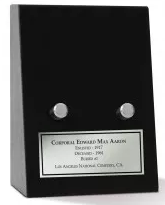
Coin stand personalized

Compliment your Centennial Silver Dollar with a special coin display stand with an engraved personalized plate to honor your World War I ancestor. This black wooden coin stand is 3-1/2 inches in height, 1-1/2 inches in width and 2-1/2 inches in length and features silver posts. This elegant stand is a perfect way to display your your Centennial Silver Dollar or any coins on your desk or shelf.

Proceeds from the sale of these items will help build the new National World War I Memorial in Washington, DC.

This and many other items are available as Official Merchandise of the United States World War One Centennial.


Memorial Camera

You can keep track of progress at the new National World War I Memorial through construction site time lapse video, or a live video feed from the site. Click here to take a look, and also find out how you can help finish this national tribute to the 4.7 million Americans who served, and the 116,516 who did not come home from World War I.


Virtual Explorer

Click or scan the QR Code below to download the Virtual Explorer App for the National World War I Memorial, and explore what the Memorial will look like when work is completed.

QR Code for Virtual Explorer App download


Education Thumb Drive image

Free Self-Contained WWI History Web Site on YOUR computer

Sources, lessons, activities, videos, podcasts, images

We have packaged all the content we created for “How WWI Changed America” into a format that is essentially a web site on a drive. Download the content onto any drive (USB, external, or as a folder on your computer), and all the content is accessible in a web site type format even without an internet connection. Click here to learn more, and download this amazing educational resource for home or classroom use.


Genealogy book FREE DOWNLOAD


you can help - shop using amazon smile


Poppy Seed Side Ad


Doughboy MIA


Pershing Sponsors

Pershing Sponsors


email us


websitefacebooktwitter


Frank Clyde Mercer

A Story of Service from the Stories of Service section of ww1cc.org

Frank Clyde Mercer

Submitted by: Michael Conn {Great Grandson}

Frank Clyde Mercer was born around 1887. Frank Mercer served in World War 1 with the United States Army Air Corps. The enlistment was in 1918 and the service was completed in 1918.

Story of Service

The service of Franklin “Clyde” Mercer in the First World War began in support of the war effort as a 30-year-old, civilian, munitions worker for the Whitaker Glessner Company, a steel production company contracted to manufacture 155mm howitzer shells at its location in New Boston, a small Ohio village within the city of Portsmouth, Ohio.

Frank’s military draft paperwork show that he was employed with Whitaker Glessner on June 5, 1917, the date of his registration for the draft.

Eleven months later, on May 17, 1918, Frank would enter military service. He was accompanied by his uncle, Harzy Walls, 6 months his junior, who was also entering the service. Now 31 years of age, Frank departed the Ohio River Valley for Camp Sevier, a military training camp located in the upstate of South Carolina, near the city of Greenville.

It was here, following their formal induction and training into the Air Service of the National Army, that Harzy and Frank would part ways. Frank was assigned to the 15th Aero Construction Company as a carpenter and would spend the early summer months getting technical training at Camp Mills and Hazelhurst Field, near Garden City, New York while Harzy would train near Norfolk, Virginia at Camp Morrison with the 27th Balloon Company for the remainder of the war.

Read Frank Clyde Mercer’s entire Story of Service here.

Submit your family’s Story of Service here.


Honor the Stories of Service of ALL Who Served.

Do Your Bit to Help Build the new National World War I Memorial.

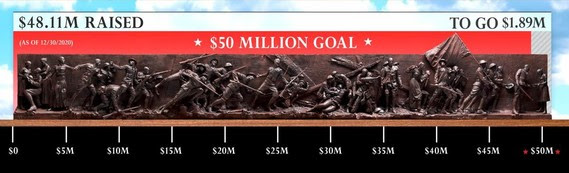
fundraising thermometer 1.89 to go


“WWI Education Webinar: Strategies and Tools for Teaching WWI in 2021”

This webinar may be of interest to some of our members.


Doughboy Foundation 2021 webinar logo

Fri. Feb 26, 2021 1pm ET

REGISTER

Teaching and learning WWI in 2021 animated gif square

Calling All EDUCATORS… and LEARNERS: Friday, February 26, 2021, 1pm EST


You are invited to register to join us live or access the webinar on-demand

Please Join our roundtable discussion with WWI educators as we explore their experiences and challenges in bringing World War I History into “classrooms, online, and hybrid environments” all of which is a part of 2021 education.

We assembled a group of educators from different parts of the US to explore issues about teaching WWI from a real-world practical perspective:

  • How teachers are adapting in teaching especially social studies, during the Pandemic
  • How do differing State standards affect teaching WWI
  • Practical practices, clever ideas and limitations when teaching WWI
  • How local WWI memorials can provide community engagement learning

We also explored and discussed the education tools created by the Doughboy Foundation during and after the Centennial of WWI. This includes the USB thumb drive Website “How WWI Changed America;” specific WWI handouts for the classroom to prompt learning and conversation; using the WWI Genealogy Research Guide to tie WWI into local community learning and the innovative “WWI Memorial Virtual Explorer App” that provides an interactive augmented reality field trip to the new WWI Memorial in Washington, D.C.

Even if you cannot attend live we invite you to register for this FREE 2021 Doughboy Foundation webinar for educators and learners about the challenges, opportunities and importance of teaching and learning about “The War That Changed the World”.

We will post the webinar as video-on-demand and send the link to all registrants whether you were able to join us live or later.

Many thanks to the supporters of The Doughboy Foundation for making this webinar possible. To learn more about the Doughboy Foundation, please visit https://doughboyfoundation.org .


REGISTER For the Webinar


WWI DISPATCH January 2021

An item from the World War One Centennial Commission.


View this in your browser

Header 10292020

January 2021

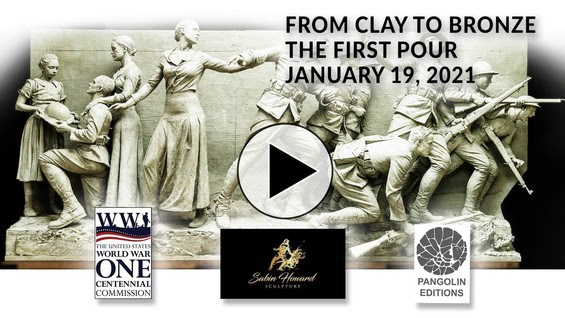
First Pour video image

On this date, the 58-foot long, 38-figure Memorial centerpiece sculpture titled “A Soldier’s Journey” reached a new milestone on its journey, as the sculpture’s first elements were cast into bronze in a “First Pour.” Click on the image above to view the video.

Honoring America’s WWI servicemen and women “in a noble and timeless medium fitting to their service.”

January 19, 2021 was a significant day for the new National World War I Memorial in Washington, D.C. On this date, the 58-foot long, 38-figure Memorial centerpiece sculpture titled “A Soldier’s Journey” reached a new milestone on its journey, as the sculpture’s first elements were cast into bronze in a “First Pour.” Click here to read more about, and watch a video of, the “First Pour” of the memorial sculpture at Pangolin Editions Foundry in the United Kingdom.

Education Webinar February square

New Education Webinar: Strategies and Tools for Teaching World War I in 2021

Calling All Educators… and Learners!

Please join our panel of World War I Educators on Friday, February 26, 2021, 1pm EST,: to learn some of the best practices now available for teaching World War I History in “classrooms, online, and hybrid,” all of which will be a part of 2021.

We assembled a small group of educators from different areas and parts of the country to explore issues about teaching WWI from a real-world practical perspective:

  • How teachers are adapting in teaching especially social studies, during the Pandemic.
  • How do differing State standards affect teaching WWI
  • Best practices, clever ideas, and limitations when teaching WWI
  • Is teaching WWI through advanced placement (AP) European History & World History an option;
  • How local WWI memorials can provide community engagement learning;
  • Feedback from students about what works;
  • and more.

Also on the agenda, we will introduce you to some of the education tools created by the Doughboy Foundation during and after the Centennial of WWI, including the USB thumb drive Website “How WWI Changed America;” specific WWI handouts for the classroom and to prompt learning and conversation; plus the innovative “WWI Memorial Virtual Explorer App” that provides an interactive augmented reality field trip to the new WWI Memorial in Washington, D.C.;  and more.

Click here to register today to attend this FREE 2021 webinar for educators and learners about the challenges, opportunities and importance for teaching and learning about “The War That Changed the World”.

 “WWI Education Webinar: Strategies and Tools for Teaching (and Learning) WWI in 2021” on Feb 26, 2021 1:00 PM EST

 https://attendee.gotowebinar.com/register/1274955613107522318

 After registering, you will receive a confirmation email containing information about joining the webinar.


Doc Hall’s WWI Casualty Records

Doc Hall

In the Spring of 2011, the late James “Doc” Hall (left) visited the National Archives at College Park, Maryland, to search for World War ll KIA records of the 35th Infantry “Cacti” Regiment, in which he served in Vietnam. During his visit, Hall came across the Graves Registration records for WW l. The names he uncovered reflected the profound diversity of those who served in the Great War: immigrants, native Americans and boys from cities and farms were called to serve. Hall’s discovery of a KIA named “Isaac His Horse Is Fast” fascinated him. Hall contacted two fellow Vietnam combat veterans, Richard “Dick” Arnold and William “Bill” Henson, and proposed an ambitious project: photographing the WW l records and recording their critical data to a spreadsheet. As Henson recalls: “None of us fully understood what we were to experience.” Click here to read the entire article about how three Vietnam veterans set off on a mission to remember those who preceded them in the nation’s service a century ago.


Candy Bar Market Exploded After WWI

Doughboy eating candy bar

Candy bars may seem quintessentially American, but they have origins in the World War I chocolate rations given to European soldiers. The American military followed suit, helping its Doughboys develop a sweet tooth they would bring home after the war. Throughout the 1920s, thousands of small, regional confectioners emerged to meet the demand, creating a candy boom brimming with catchily named bars based on popular expressions, pop culture icons, and even dance crazes. Click here to read more about the chocolate bar explosion, and the effort of new sweets makers to take a bite out of a candy business dominated by Hershey’s, the planet’s biggest chocolate maker.


Why Keep That? exhibition opens at National WWI Museum & Memorial
Why Keep That? snip

Collecting, cataloguing, conserving. The heart of a museum is its collection, but how do Museums make decisions and who gets to answer the question, “Why Keep That?”

Why Keep That?, the latest special exhibition at the National WWI Museum and Memorial, follows the journey of a collection item from the moment it is donated to the Museum, to the decision-making and archival process of our collections staff. To help illustrate, archival staff track the processing and digitization of a collection of 16 objects and share behind-the-scenes information about obtaining the artifacts, processing the items and storing and protecting them. Click here to read more about the exhibition, and how collections largely featuring ephemera – objects usually meant to be thrown away, like ticket stubs, advertisements and written scraps – are now preserved in a museum.


Hard Hat Turns 101; Impact on Industrial Safety Never Gets Old

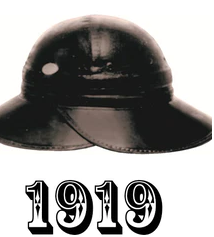
hard hat 1919

Luckily for industrial workers everywhere, Lt. Edward Wheatley Bullard of the U.S. Cavalry climbed out of the French trenches with an idea that would spark the industrial safety movement: the hard hat. Bullard, the son of a mining equipment supplier, was inspired by the metal helmets Doughboys wore to deflect the hail of bullets raining down on them courtesy of the Kaiser. When he returned home, he invented the first commercially available industrial hard hat, called the Hard Boiled hat. Prior to its invention and subsequent production in San Francisco, gold and copper miners in California and Nevada basically wore leather caps—which might not be all that good at stopping hail, let alone the rocks or tools potentially pouring down on them. Click here to learn more from Bullard’s great granddaughter about how this now 100-year-old equipment was invented and how it has redefined protecting the workforce.


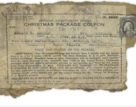
AEF ‘Christmas Package Coupon’ helped soldiers during World War I

Christmas package coupon

The War Department recognized that the United States Army soldiers fighting in France in 1918 were about to endure their second Christmas far from home. To help combat the Christmas blues, each soldier was issued one Christmas package coupon. The soldier filled in his address and sent the coupon home to someone who he thought might send him a Christmas package. Click here to learn more from Linn’s Stamp News about how this system worked, how the Doughboys benefited, and why this bit of WWI ephemera is so rare today.


The Volga Germans in Portland, Oregon during World War I

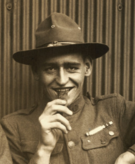
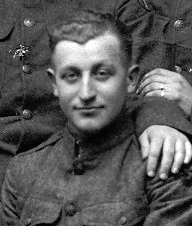
Charlie Bauer

The outbreak of World War I on July 28, 1914 was met with anxiety and fear by both the Volga German colonists living in Russia and their family and friends who had immigrated to the United States. The war exacerbated Russia’s Germanophobia and Slavophile tendencies. Ethnic Germans living In the United States faced Anti-German sentiment and propaganda reaching extreme levels after America entered the war in April 1917. Click here to learn more about how the war years were an anxious time for the Volga Germans living in Portland, OR. Although they valued their ethnic German heritage and language, they also considered themselves loyal Americans.


Forgotten for 100 Years

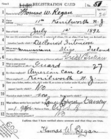
Thomas W Regan draft card

Michael T. Naya, Jr. normally writes articles focused on World War II and the Greatest Generation, but when his research introduced him to Kenilworth, NJ  resident Thomas W. Regan, a veteran of World War I, he decided to take time to write about him. Click here to read this thoughtful portrait of “an Irish immigrant who felt the need to serve his country so he answered the call to duty,” whose “story deserves to be remembered especially today.”


Doughboy MIA for Month

Leonard Charles Aitken

A man is only missing if he is forgotten.

Our Doughboy MIA this month is 1st LT Leonard Charles Aitken.  Born in Reno, Nevada on 10 June 1897, Leonard Aitken grew up in California, where he joined the California National Guard at 18 years of age. When the trouble broke out with Mexico, he reported for duty in June, 1916 and served along the border with the hospital corps, attending elements of what would, a year later, become the 160th Infantry, 40th Division. Following America’s declaration of war on Germany, on 7 April 1917, Aitken reported to the Officers Training School at San Diego and upon graduation, shipped to France in August, 1918 as a 2nd lieutenant with the 158th Infantry, 40th Division. There, on 20 October 1918, he was sent as a replacement officer to the 372nd Infantry, 93rd Division, then holding a section of the line in the Alsace sector near Hill 607.

On 7 November, while leading his platoon on a night action, Aitkens and his men captured several prisoners but unknowingly walked into the line of fire of a German machine gun nest, which opened up on them, killing or capturing all but two enlisted men of the patrol and freeing the prisoners. Without hesitation Lieutenant Aitken immediately advanced against the position with the intent of eliminating it, but he was shot twice in the chest and killed in the endeavor. The end result was that they captured 1 officer (Aitkens) and 22 men; however the date of Aitkens’ death is given as 8 November 1918.

Following the Armistice, GRS officials went on the search for Aitkens’ remains, but had little luck. Their hardest clue was a report that German officers had buried Aitkens with full military honors “in the churchyard of the tiny hamlet of La Paive, some 40 miles east of Epinal, France.” There being no town by that name anywhere in that area, this was almost certainly actually the town of La Pariee which is indeed in the area of the action of 7 November. Nothing was ever found however and his remains continued to be unlocated in the years following the war. As investigations continued, in January 1924, GRS sent a letter to Aitkens’ father requesting a civilian dental chart, but also admitting in the letter that in all probability he was among the Unknown burials, though how this information was considered is not stated in his surviving file.

A final attempt at some kind of identification came in December 1926 when the case files of Aitkens and one other officer from the 372nd Infantry were checked against a set of Unknown remains at the Meuse-Argonne Cemetery morgue. It was a long shot, however, as the remains being checked came from a French cemetery in the Marne sector some 300 kilometers northwest of where both officers in question were at the time of their deaths. Not surprisingly, neither officer’s remains were a match and Aitkens’ case was officially closed in 1932 without resolution.

Can you spare just ten dollars? Give ‘Ten For Them’ to Doughboy MIA and help us make a full accounting of 1st LT Leonard Charles Aitken and all the 4,423 American service personnel still listed as missing in action from WW1. Make your tax deductible donation now, with our thanks. Visit www.ww1cc.org/mia today to make your donation, and sign up there to get more information on other ways that you may be able to help.


Official WWI Centennial Merchandise

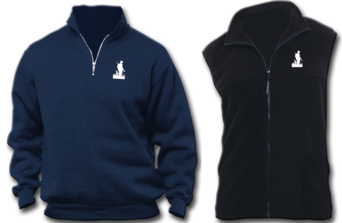
Jacket and Vest

You can wear your American pride and stay warm this winter with these two Made in the USA garments Inspired by the iconic image of a U.S. Doughboy. This poignant silhouette of a lone soldier in trench warfare serves as a reminder of those who sacrificed so much one century ago.

Sweatshirt features: Navy with white Doughboy embroidery. 80% cotton/20% polyester,  9.5 Oz. High quality heavy weight pre-shrunk fabric. Sweatshirt has ¼  zip pullover with cadet collar and silver metal zipper. Ribbed cuffs and waistband with spandex. Cover-seamed arm holes. Mens’ sizes available Small and Medium.

Vest features: Black with white Doughboy embroidery. 100% spun polyester, 12.5 Oz. Premium anti-piling fleece. Vest has full zip front with two side seam pockets. Mens’ sizes available S – 2XL.

Proceeds from the sale of these items will help to fund the building of the national World War One Memorial in Washington, D.C.

Certificate of Authenticity as Official Merchandise of the United States World War One Centennial is included.

These and many other items are available as Official Merchandise of the United States World War One Centennial.


Memorial Camera

You can keep track of progress at the new National World War I Memorial through construction site time lapse video, or a live video feed from the site. Click here to take a look, and also find out how you can help finish this national tribute to the 4.7 million Americans who served, and the 116,516 who did not come home from World War I.


Virtual Explorer

Click or scan the QR Code below to download the Virtual Explorer App for the National World War I Memorial, and explore what the Memorial will look like when work is completed.

QR Code for Virtual Explorer App download


Education Thumb Drive image

Free Self-Contained WWI History Web Site on YOUR computer

Sources, lessons, activities, videos, podcasts, images

We have packaged all the content we created for “How WWI Changed America” into a format that is essentially a web site on a drive. Download the content onto any drive (USB, external, or as a folder on your computer), and all the content is accessible in a web site type format even without an internet connection. Click here to learn more, and download this amazing educational resource for home or classroom use.


Genealogy book FREE DOWNLOAD


you can help - shop using amazon smile


Poppy Seed Side Ad


Doughboy MIA


Pershing Sponsors

Pershing Sponsors


email us


websitefacebooktwitter


J. Arthur Mayer

A Story of Service from the Stories of Service section of ww1cc.org

J. Arthur Mayer

Submitted by: John A Mayer {Son}

J. Arthur J. Arthur Mayer born around 1893. J. Mayer served in World War 1 with the United States Army. The enlistment was in 1918 and the service was completed in 1919.

Story of Service

Veterans Day has always seemed special to me. My Dad, J. Arthur Mayer, was a WW I veteran and I grew up hearing his reminiscences. On the one hundredth anniversary of Armistice Day I felt compelled to record some of those “rememberies.” Our once close-knit family has spread to the four corners and there is no one left in the immediate family who seems much interested, so I’ll post it here in his memory FWIW. (Yeah, we skipped a generation. Dad was born in 1893, and was 50 before I was born in 1944. I’m the age of my second cousins. Many of my first cousins were WW II veterans.)

Dad was 24 when he was drafted off the farm. He entered active duty in July 1918, and was sent to Camp Pike, Arkansas for basic training, I think for 4-5 weeks. He was one of the older men in his group, and was offered NCO Academy training. But he said it was so hot and humid and generally miserable there that when his group was given the opportunity to “go to Brest”- the debarkation point for the American Expeditionary Force in France – that he volunteered for that. He said it was to escape the misery of Arkansas, but I suspect he also felt some duty to go in place of his older married brothers who were starting families and other married men.

Read J. Arthur Mayer’s entire Story of Service here.

Submit your family’s Story of Service here.


Honor the Stories of Service of ALL Who Served.

Do Your Bit to Help Build the new National World War I Memorial.

Memorial Fundraising Thermometer December 2020