An item from the Legion Magazine.
|


.jpg?1574449375787)
.jpg?1574449392738)


.jpg?1574449471642)

.jpg?1574449516313)



|

An item from the Legion Magazine.
|
|
We noticed an item in this week’s newsletter from Canada’s History magazine that we wanted to share.
|
||||
|
[STUFF DELETED]
 |
Patriotic Arts: Influencing Canadians at WarIn this lesson, students will discuss how war has shaped Canada and its citizens and the influence of patriotism, propaganda and music on Canadians during war. Using novels, poems, war art, and songs, students gain experience analyzing primary sources. Read more |
[STUFF DELETED]
|
||||||||||||||||||||||||
|
One of our members passed this news item along and asked that we share it.
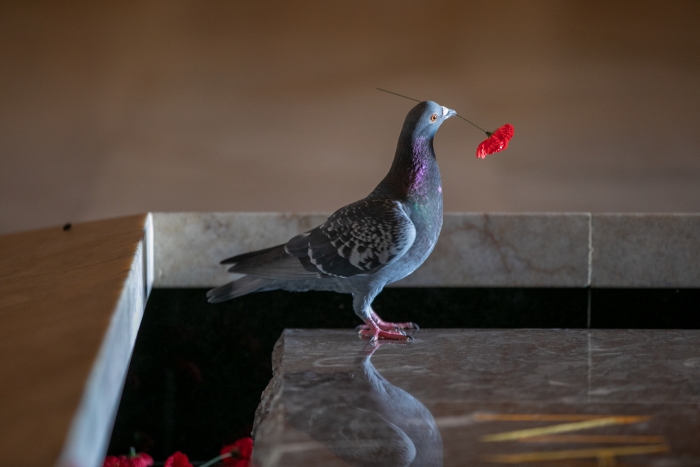
Poppies have become a lasting symbol of the endurance and perseverance of wounded soldiers, especially since they’ve been seen growing on battlefields after World War I. They’re particularly prominent on Remembrance Day, which honors those who have died in the line of duty and is celebrated across the UK and Commonwealth states. Observed since the end of World War I (as early as 1919), associations have sold cotton or silk poppies to raise money for veterans. In Australia, one animal decided to pay their respects by using poppies in a decidedly different way.
Since early October, the staff at the Australian War Memorial had noticed that poppies were disappearing from the Tomb of the Unknown Australian Soldier. It caused some confusion until the staff looked up. There they saw that a pigeon has been carefully crafting a nest on the ledge of a stained glass window. The fact that the pigeon was the poppy thief was actually a pleasant surprise given the role that these birds had during times of war.
To continue reading, click here.
Other coverage of this “thief” included:
A newsletter from one of our fellow Canadian organizations in the Bay Area.
|
||||||||||||||||||||||||||||||||||||||||||||||||||||||||||||
|
||||||||||||||||||||||||||||||||||||||||||||||||||||||||||||
|
We wanted to replicate this article from Legion Magazine in its whole.

Private Donald Alexander Pollock never made it overseas after the 24-year-old farm boy from Kramer, Sask., signed up with the Saskatchewan Regiment, on July 5, 1918.
“Canada Only” is written in red ink on his brief service record, which states the five-foot, six-and-a-half-inch, 127-pound soldier was discharged in December 1918 “in consequence of having died.”
Pollock, a chronic asthmatic, had contracted Spanish flu, brought it home to his remote Saskatchewan homestead, and passed it on to his twin brother Alexander.
The two died the same day—Nov. 15, 1918. They are buried side-by-side in a secluded spot on the old family homestead, Pollock under the familiar grey headstone administered by the Commonwealth War Graves Commission; his brother memorialized by a private marker.
Finding the Pollock brothers’ final resting place is best achieved with the help of the current landowner, George Carlson says a profile written as part of the commission’s new “To the Four Corners” program, an interactive website that tells stories like the Pollocks’ and takes viewers on virtual tours of its memorials and war graves around the world.

Dominique Boulais, who recently inspected the Pollock site on behalf of the commission’s Canada and Americas Area, said an ATV ride with Carlson saved him “hours of traipsing about with a GPS.”
“There was only one padded seat and it was for the driver,” Boulais said. “I sat on the steel grill facing the back receiving all the mud flying from the rear wheels and breathing the fumes from the exhaust pipe.”
Eventually, they reached the gravesite, located in a dip between folds in the land. “There wasn’t a single sound except the wind.”
The story highlights not just the plight of a single soldier but demonstrates the lengths and distances commission personnel go to preserve the memory and dignity of Commonwealth soldiers.

For more than a century, the commission has tended war graves the world over, beginning with the First World War and, since 1945, the Second, as well. That’s some 1.7 million war dead in 150 countries.
There are 110,000 Canadians among them—the vast majority buried close to where they fell. It wasn’t until the 1960s—and notably, during the Afghanistan war—that Canada started bringing its war dead home.
Many others, however, died as the result of war wounds, illnesses and other war-related causes and are thus buried in Canada—almost 19,000 commission-administered graves, in fact, located in nearly 3,000 cemeteries across the country. About 1,900 of those cemeteries have just a single war grave. Veterans Affairs Canada administers another 228,000 gravesites within the country’s borders, many of them soldiers, sailors or air crew who died outside the time period for which they would fall under the commission’s responsibility.
“It’s pretty mind-boggling when you actually think about it,” says David Loveridge, a former Canadian military helicopter pilot who is the commission’s director for Canada and the Americas.
“If you go to your local cemetery, there’s probably a war veteran buried there. When you look at the geographic spread, not only of our entire area, but also within Canada, it’s a large task.”

Following the year-long commemorations marking the 100th anniversary of the end of the First World War the 75th of the Second, Loveridge says the commission noted that a disproportionate amount of attention had been focused on the war dead of Western Europe, largely overlooking significant sacrifices of combatants and the commission’s work in other theatres.
The commission’s new Four Corners website features stories, videos and pictures of some of its most remote sites located on every continent except Antarctica.
“From jungle to desert; from isolated islands to hundreds of miles inside the Arctic Circle, the work of the Commonwealth War Graves Commission stretches to the four corners of the world, far beyond the former battlefields of Europe,” says a news release announcing the program.
“With the help of these virtual tours, the commission invites Canadians to experience the hard-to-reach places it still goes to remember the war dead. Fallen Canadian servicemen and women are scattered across the globe, from the Netherlands to Japan, from Turkey to Hong Kong, from Russia to Italy.”

The commission administers 19 sites in Iraq and most have deteriorated or been damaged due to more recent wars. During the First World War, when it was still Mesopotamia, Iraq was the scene of the British Empire’s largest operations outside of Europe. It suffered its worst defeat in the Siege of Kut.
The commission’s work within Iraq’s borders has stopped and started numerous times since it formally withdrew from the country in 1990. Sites have deteriorated as the salty soil has seeped into headstones, making them so brittle they crumble.

Iraq’s largest memorial, the Basra Memorial, was moved into the desert in the late-1990s from its original site on the banks of the Shatt al-Arab River. Now, after decades without regular maintenance, the memorial is showing signs of age and neglect. The commission site says the memorial is missing 30,000 names.
“When [it was] first unveiled in 1929, the names of most of the men of the Indian Army who it commemorates were not accurate,” says the commission. “Records at the time hadn’t been properly compiled and the commission could only be provided with the names of Indian officers, and British officers and men.

“Since then, an accurate list of the names has been compiled and all lie in the CWGC’s Iraq Roll of Honour, on display in the U.K., waiting for a time when conditions on the ground allow a more permanent solution.”
The war graves commission has made some progress in Iraq. During a gap in hostilities in 2012, it renovated Kut War Cemetery. In 2019, it renovated the cemetery on the former RAF base in Habbaniya, now occupied by the Iraqi army, and installed nearly 300 new headstones.
“The commission has to play the long game at times,” it says. “When your task lasts forever, you never know what progress the future might bring.”
––– ––– –––
Visit the To The Four Corners website at https://fourcorners.cwgc.org.
The original article is available at:
https://legionmagazine.com/en/2019/11/war-graves-commission-launches-virtual-tours-of-remote-sites/



 Royal Canadian Legion, US Branch #25