Author Archives: Michael K. Barbour

Unknown's avatar

About Michael K. Barbour

Michael K. Barbour is the Director of Faculty Development and a Professor of Instructional Design for the College of Education and Health Sciences at Touro University California. He has been involved with K-12 online learning in a variety of countries for well over a decade as a researcher, teacher, course designer and administrator. Michael's research focuses on the effective design, delivery and support of K-12 online learning, particularly for students located in rural jurisdictions.

Queen marks 100 years of RAAF at Runnymede

An item from the Commonwealth War Graves Commission.


Welcome to the CWGC’s latest newsletter.

Her Majesty The Queen has marked the centenary of the Royal Australian Air Force (RAAF) at the CWGC’s Runnymede Air Forces Memorial.

The Queen was welcomed to the ceremony by CWGC Director General Claire Horton CBE and The Honourable George Brandis, High Commissioner for Australia alongside representatives from the RAAF. A fly past and wreath laying in honour of the RAAF personnel who have given their lives in the past 100 years took place at the event yesterday (Wednesday 31 March).

Claire Horton said: “Today is an historic milestone for the Royal Australian Air Force and we are honoured that the Commonwealth War Graves Commission’s Runnymede Air Forces Memorial has been chosen to mark the occasion.

“Around the world, the sacrifice of men and women from the Commonwealth lives on through the memorials and graves that bear their names. A century on from their formation, the RAAF’s duties at home and abroad remain as strong as ever, as does our commitment at CWGC to remember their fallen forebears.”

Read More
All Eyes on Ieper for Cycling RaceLast Sunday, 28 March, one of Belgium’s premier cycling races started at the CWGC Ypres (Menin Gate) Memorial. The Gent to Wevelgem road cycle race, known officially as Gent–Wevelgem – In Flanders Fields, runs through the former Battlefield of the First World War. Click here to learn five fascinating CWGC connections to the world of cycling!
Our Year in Lockdown

Here at CWGC we’re charged with a job that was started over 100 years ago. Despite the dramatic changes the world has seen over the past year, our work continued and just like everyone else we found ways to adapt as we all faced a pandemic that would drastically change the way we lived, worked, and socialised. Join us as we take a look back at a year which surely none of us will forget.

CWGC Director of Horticulture appointed as Trustee of Royal Botanic Gardens, KewOur very own Director of Horticulture, David Richardson, has been appointed as a Trustee of The Royal Botanic Gardens Kew. David has worked for the Commission for over 30 years, and the CWGC has a historic connection with Kew. We look forward to strengthening our relationship in the years to come.
Discover our historic sites of remembrance near you with our new and improved CWGC App. Click on the links below to download the App:

Click here to download for Android
Click here to download for iOS

Facebook
Twitter
Link
LinkedIn
Email
Website
Copyright © 2021 Commonwealth War Graves Commission, All rights reserved.

Our mailing address is:
2 Marlow Road, Maidenhead, Berkshire, SL6 7DX

Announcing: C100’s 2021 Fellows Cohort!

An announcement from one of our fellow Canadian organizations in the Bay Area.


Hi Michael,

Here it is! The moment you’ve been waiting for…. meet the C100 Fellows 2021 Cohort!

We are proud to announce the founders who will make up this inaugural cohort of C100 Fellows in 2021 and will also be joining us (virtually) at 48Hrs in May 2021.

There are a number of reasons we are excited for you all to get to know these entrepreneurs. Despite moving the program online, C100 saw more demand than ever before for the program, with 355 Nominations, a 75% from the year before, and over 202 applications, a 55% increase. We are also thrilled to see that this cohort has the highest representation of female founders than ever before, making up one-third of the class.

We implore you, as a community at large, to join us by celebrating this news and supporting these ambitious Canadian entrepreneurs through mentorship, investment and partnership. 

“We’ve had a lot of awesome companies come through our Fellows program in the past, but this year may just be the best one yet!”

– Andre Charoo, C100’s Co-Chair and Founder & General Partner of Maple VC

This January, C100 Fellows was launched as a significant reboot and expansion of C100’s longstanding flagship event, 48Hrs in the Valley (now called “48Hrs”). The C100 Fellowship expands the founder experience from that of a 2-day event to that of an 8-month long program involving mentorship with growth-stage founders and expert operators from the C100 community, and peer networking across ecosystems and industries.

Click below to read more about the 21 exceptional Canadian-led early-stage companies that make up the 2021 C100 Fellows Cohort!

48HRS, BUT MAKE IT “OUT OF THE VALLEY”

The 48Hrs in the Valley event will now be called “48Hrs” and will serve as the kick-off to the 2021 Fellowship. The removal of “the Valley” is intentional. It marks not only the reality that the C100 will once again gather virtually in 2021, but it is also in recognition of our belief that exceptional Canadian talent and technology is everywhere.

With over 40% of C100’s members now located in tech hubs outside of Silicon Valley, we feel this reinforces the diversity and vibrancy of our network of mentors, talent, founders and investors contributing to the Fellowship.

48Hrs takes place May 19-20 and is a members-exclusive event. Not a Member? Apply today!

HOW CAN YOU GET INVOLVED?

Consider deepening your engagement with C100 as a Member.

C100 Members are entrepreneurs, investors, and operators in the technology field, with a special focus on Canadians living abroad who wish to connect with one another and to give back to Canada’s ecosystem. They enjoy high-value, intimate virtual events, a Members-only C100 Slack space, and exclusive Member communications. All prospective Members must have their application sponsored by at least one active C100 Member.

C100’s mission is to support, inspire, and connect the most promising Canadian entrepreneurial leaders through mentorship, investment, partnership, & talent. Apply to join as a member today!

Thank You to Our Partners

Foundational Partners

Corporate Partners

WWI DISPATCH March 31, 2021

A newsletter from the World War One Centennial Commission.


View this in your browser

Header 10292020

March 31, 2021

Sinise button with FC logo and date bold

With only two weeks to go, we are counting down the days until we raise the Flag of the United States of America for the first time over the newly constructed National WWI Memorial in Washington, DC. We are honored to celebrate this momentous occasion with each of you via live broadcast on April 16. Please click on the video above to hear more from our host, Award-Winning Actor, Gary Sinise.

First Colors Ceremony will Introduce America’s New World War I Memorial

First Colors Logo

The United States World War I Centennial Commission in cooperation with the Doughboy Foundation, the National Park Service and the American Battle Monuments Commission is sponsoring a major event to celebrate the inaugural raising of the American flag over the nation’s soon-to-open World War I Memorial in Washington, DC on Friday, April 16 at 10:00 a.m. EDT / 7:00 a.m. PDT. Click here to read more about this milestone event, and find out how to register to view the live broadcast of the historic ceremony. (The First Colors Ceremony is not an in-person event.)


Senators introduce Gold Medal legislation to honor “Hello Girls”

Hello Girls gold medal snip

A bipartisan group of U.S. Senators has introduced legislation to award the Congressional Gold Medal to the female military telephone operators who kept American and French GIs connected during World War I. The Hello Girls Congressional Gold Medal Act would award the medal to the women of the U.S. Army Signal Corps. Also known as the Hello Girls, the bilingual female switchboard operators connected more than 150.000 calls per day during the war, doing so at a rate six times faster than their male counterparts. Senate Veterans Affairs Committee Chairman Jon Tester, D-Mont., Ranking Member Jerry Moran, R-Kan., Sens. Maggie Hassan, D-N.H., and Marsha Blackburn, R-Tenn., introduced the legislation. Click here to read more about this new effort to recognize the Hello Girls with the Congressional Gold Medal.


How World War I’s Legacy Eclipsed the Deadly 1918 Pandemic

Doughboy pandemic snip

World War I came to an end on November 11, 1918—nine months after the first cases of what was referred to as the “Spanish Flu” were reported in the United States. Against the backdrop of the war, the 1918 influenza pandemic surged at a time when people were already experiencing scarcity in everyday supplies, coping with having loved ones serving overseas, and living in a wartime economy. A second global crisis had started before the first one ended. Click here to read more about how the legacy of World War I overshadowed the pandemic, making the unprecedented loss of life from the flu almost an afterthought.


WWI Helped Women Ditch the Corset

Corset article snip

Massive cultural shifts during and after World War I helped free women from confining roles—and the confining corsets that bound them to the previous age. Writing on the History.com web site, Jessica Pearce Rotondi notes that “The evolution of the bra re-shaped the image of what a woman could be, whether she was serving in the war effort, fighting for the right to vote, or dancing in a flapper-style dress at war’s end.” Click here to read more, and learn how an American socialite patented the “brassiere” on November 3, 1914, the year World War I broke out in Europe. 


Kentucky soldier’s New Testament headed to National WWI Museum

Arthur J. Douthitt

Nearly 100 years have passed since a New Testament carried by Arthur J. Douthitt into battle during World War I made its way back to his widow in Kentucky from France. Now, it will be donated to the National World War I Museum and Memorial in Kansas City, MO. Nicole Morton Goeser said she wants to share the story of her great uncle, a native of Stanley, KY with his own community. Click here to read more, and learn about how this Kentucky soldier’s Bible became and will remain a touchstone for memory of his service.


‘Hello Girls’ Kept World War I Communications Humming

Hello Girls 2

As the first American forces began arriving in France that summer, they found the communications network in disarray. In three years of combat, telephone lines were shot, shelled and bombed faster than they could be repaired. Army Gen. John J. Pershing, commander of American Expeditionary Forces in World War I, found this situation intolerable. He had, however, noted the efficiency and competence of Britain’s Women’s Army Auxiliary Corps as they expertly kept England-based phone lines humming. Click here to learn more about how Pershing, having recognized a good idea when he saw one, created the Hello Girls that supported the American Expeditionary Forces so effectively in WWI.


George Dilboy was first Greek-American awarded Medal of Honor in World War I

George Dilboy

Born in the Greek settlement of Alatsata, which is today located in western Turkey, George Dilboy and his family emigrated to America in 1908 when he was 12 years old. After returning to Greece to fight as a volunteer in the Greek Army in the First and Second Balkan Wars, Dilboy came back to Somervill, MA in 1914, where he went to school and worked for a few years before volunteering to fight in the U.S. Army in the Mexican Border War from 1916 – 1917, and then re-joining the U.S. Army as a private first class to fight in the trenches of France during World War I. Click here to read more, and learn about George Dilboy, who General John Pershing listed as one of the 10 greatest heroes of the war. 


The American farmers, gardeners, and victory gardens of World War I

Fruits of Victory poster

During WWI, Europe’s food supply had been seriously depleted. European farmers had been called to serve on the front lines, abandoning their farms and resulting in a mass farming crisis. Farmlands were quickly turned into battlefields, causing significant destruction of once rich soil. Europe’s ability to keep its soldiers and general population fed was becoming more and more difficult. As a result, the United States was called upon to shoulder the demand for mass quantities of food that was desperately needed overseas. Click here to learn more about the development of the National War Garden Commission in response to the food crisis that raged in Europe.


Commemorative Bricks Support Local Maryland WWI Memorial Restoration

Bladensburg memorial snip

A 40-foot-tall monument standing at the intersections of Bladensburg Road, Baltimore Avenue, and Annapolis Road in Bladensburg, Maryland, serves as a reminder of the 49 area residents who died in World War I. This monument, commonly referred to as the Peace Cross, is owned by the Maryland-National Capital Park and Planning Commission, Department of Parks and Recreation in Prince George’s County which has embarked on a mission to restore it. Click here to learn more about the Peace Cross, and the commemorative brick program developed by the department to support fundraising efforts for the Peace Cross’ restoration.


NY National Guardsman Led Fight for Tomb of the Unknown Soldier

Hamilton Fish III

The United States has a Tomb of the Unknown Soldiers today because a New York National Guard Major and freshman Congressman thought it was necessary 100 years ago. Hamilton Fish III, a 32-year old lawyer with a Harvard degree who could trace his roots back to the beginnings of New York, led Company K of what became known as the 369th Infantry Regiment, which went down in history as the Harlem Hellfighters. He earned a Silver Star, and the French War Cross. Fish thought that the United States, which had suffered 116,516 deaths – 53,402 in combat and 63,114 to disease– between April 1917 and November 1918, should have a memorial to an American Unknown Soldier. Click here to learn more about how Fish, then a Congressman, introduced the federal resolution to create an Unknown Soldier memorial on November 11, 1921.


The Jihad Legacy of World War I

Wolfgang G. Schwanitz

Writing for the Foreign Policy Research Institute web site, Senior Fellow in the Middle East Program Wolfgang G. Schwanitz notes that “Known as a pious Muslim, Egyptian President Abdel Fattah Al-Sisi said in 2015 that it is most difficult to change religious rhetoric and how people use their faith. The outcomes will take many years: ‘Radical misconceptions [of Islam] were instilled 100 years ago. Now we can see the results.’ He may been referring to the German-Ottoman jihadization of Islamism in the early 20th century. So, what happened in World War I?” Click here to read the answer to Schwanitz’s question, and learn how yet another key geopolitical aspect of the 21st Century had its origins in the chaos of World War I.


Doughboy MIA for March 2021

Corporal William Michael Barnett

A man is only missing if he is forgotten.

Our Doughboy MIA this month is Corporal William Michael Barnett, USMC ASN271629, 84th Company/3rd Battalion/6th Marine Regiment/4th Brigade/2nd Division A.E.F.

Born in Oswego, New York on June 1st, 1892, Barnett enlisted in the United States Marine Corps on August 3rd, 1917 at Syracuse, New York. He trained at Parris Island, S.C. and upon graduation from basic training was assigned to the 119th Company at Quantico on January 8th, 1918. With them he departed for France on February 25th, 1918, where he received advanced combat training in the Toulon Sector.

In late May, with the Germans threatening Paris direct, the 2nd American Division received hurried orders to shore up crumbling French lines near Château-Thierry. The 6th Marine Regiment (which along with the 5th Marines and 6th Marine Machine Gun Battalion composed the 4th Brigade of the 2nd Division) took up positions southwest of Belleau Wood and was ordered to seize the town of Bouresches, as well as clear the southern half of Belleau Wood itself. The operation began on June 6th and these attacks were the beginning of a month-long struggle that resulted in both Marine Corps glory and heavy casualties.

On June 13th, 1918, Barnett received assignment to the 84th Company, 6th Marine Regiment as a replacement for a combat casualty. By that time, he was a Corporal. After 40 days in the sector, during which time the regiment would incur 2,143 casualties, the 6th Marines were pulled off the line for rest and refitment before again being brought into the maelstrom, this time in the Battle of Soissons.

On July 16th, the regiment was rushed to the Villers-Cotterets Forest where, on the morning of July 19th, 1918 the 6th Marines attacked in force, alone, from the town of Vierzy toward Tigny but were stopped short of their objective by extremely heavy artillery and machine gun fire. It would prove to be the single costliest day the regiment would ever face with many companies seeing upwards of 50% casualties and some as high as 70%.

It was during the attack forward that morning that Corporal Barnett was killed in action by a German sniper. He was later buried in a temporary grave in a field just outside Vierzy. However, following the war Graves Registration Service personnel were never able to locate that grave.

Want to do your part? Stand up and dig in with us by visiting www.ww1cc.org/mia.

Can you spare just ten dollars? Give ‘Ten For Them’ to Doughboy MIA and help us make a full accounting of the 4,423 American service personnel still listed as missing in action from WW1. Make your tax deductible donation now, with our thanks.


Official Doughboy Merchandise Store

First Colors Commemorative Coin 500

“First Colors” Commemorative Coin

Exclusive new design for 2021! Double-sided Bronze alloy medallion design commemorates the Doughboys of WWI, and the first raising of our nation’s flag over the new National World War I Memorial in Washington, DC on April 16, 2021. Two-Color Soft Enamel, 1.75″ in diameter.

Our mission is to remember those who served in WWI. These commemorative gifts help make that happen.


Memorial Camera

You can keep track of progress at the new National World War I Memorial through construction site time lapse video, or a live video feed from the site. Click here to take a look, and also find out how you can help finish this national tribute to the 4.7 million Americans who served, and the 116,516 who did not come home from WWI.


Virtual Explorer

Click or scan the QR Code below to download the Virtual Explorer App for the National World War I Memorial, and explore what the Memorial will look like when work is completed.

QR Code for Virtual Explorer App download


Education Thumb Drive image

Free Self-Contained WWI History Web Site on YOUR computer

Sources, lessons, activities, videos, podcasts, images

We have packaged all the content we created for “How WWI Changed America” into a format that is essentially a web site on a drive. Download the content onto any drive (USB, external, or as a folder on your computer), and all the content is accessible in a web site type format even without an internet connection. Click here to learn more, and download this amazing educational resource for home or classroom use.


Genealogy book FREE DOWNLOAD


you can help - shop using amazon smile


Poppy Seed Side Ad


Doughboy MIA


Pershing Sponsors

Pershing Sponsors


email us


websitefacebooktwitter


Albert Robert Laske

A Story of Service from the Stories of Service section of ww1cc.org

Albert Robert Laske

Submitted by: Jean Burns {granddaughter}

Albert Robert Laske was born around 1894. Albert Laske served in World War 1 with the United States Army. The enlistment was in 1918 and the service was completed in 1918.

Story of Service

Feb. 1918, Albert “Bert” (24 yrs. old) received induction orders to enter the Army, during World War I. He is to serve in the 25th Spruce Squadron, Vancouver Barracks, in Vancouver Washington. This Squadron is to harvest wood that will be used to build the planes they need for the war. In Dec. 1918, Bert is discharged honorable and thanked for his service, but since the war is ending, his service is no longer needed.

About the 25th Spruce Squadron: “The states of Oregon and Washington form the backdrop for one of the most interesting dramas of the First World War. When the U.S. entered the War, it was quickly discovered that the nation had no capacity to build warplanes in quantity. Even though the U.S. had invented the airplane, by 1917 the European powers had already spent years developing it for warfare, and deploying it in deadly combat. Those nations were trying to produce enough machines to keep the skies occupied over the front lines in France.

Read Albert Robert Laske’s entire Story of Service here.

Submit your family’s Story of Service here.


Honor the Stories of Service of ALL Who Served.

Do Your Bit to Help Build the new National World War I Memorial.

fundraising thermometer 1.89 to go


75 Years in the Making: Panoramic Views and SOS

An item from a fellow veterans organization in the Bay Area.

Marines' Memorial: 75 Years in the Making

In last month’s “Marines’ Memorial: 75 Years in the Making,” we reviewed the first year of your Club: from acquiring the building to celebrating our first anniversary. Today, we dedicate this “Look Back” to the history of our 12th floor as we celebrate its reopening!

5-Course Meal in 1946: $1
Panoramic views for the past 75 Years: Priceless

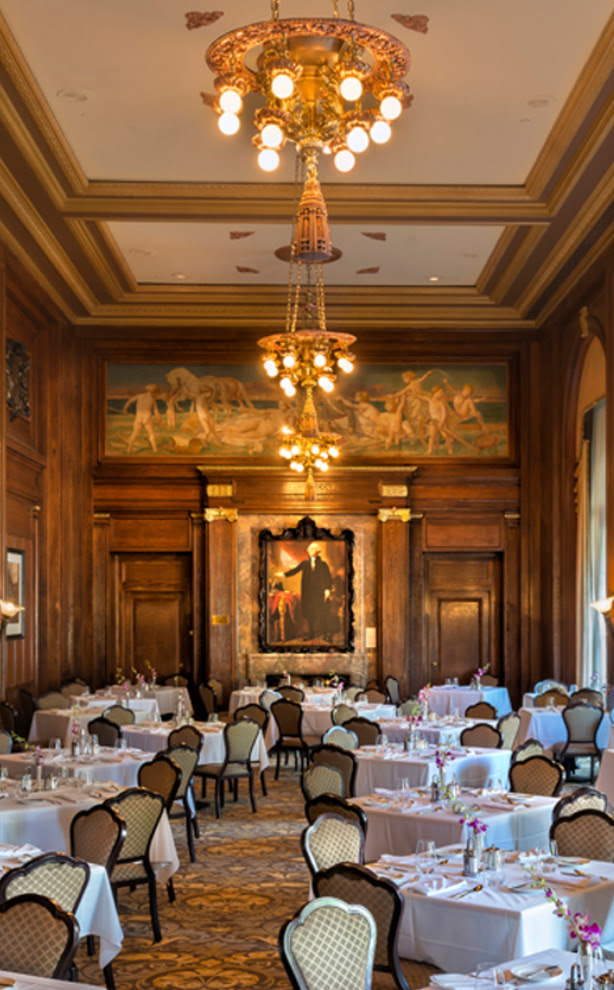
The Marines’ Memorial was founded as a revered gathering place for the men and women who served during WWII. That meant a one-stop-shop for entertainment, boarding, exercise and, some may argue most important, cocktails and dining.

Skyroom Photo

When the Club first opened in 1946, our 12th floor was called the “Skyroom,” where you could get a 5-course meal for under one dollar! For decades, the Skyroom was a spirited forum where Club members, their families, and guests convened for a generously poured high ball and a great Prime Rib.

Happy Hours featured huge trays of cubed “whatever the cooks could find in the refrigerator” and the beloved Helen Tweedy played the piano while singing your favorite tune. The staff, as they continue to be, were a major part of the experience, tenured and committed to the members.

Helen Tweedy

Crossroads cover

San Francisco has always been a foodies’ paradise and as other restaurants around the city began to grow in popularity, the Skryoom began to disappear off many “must visit” lists. So, in the early 2000’s, leading up to our 60th Anniversary, the Board of Directors and MMA leadership decided to create a dining experience as spectacular as the view. Thus, the Skyroom was rebranded, and The Leatherneck Steakhouse was born! Many of the elements of our beloved restaurant were based off a team-favorite steakhouse located in Palm Springs, CA.

Our most-loved meals have ranged from traditional favorites to over-the-top fare. These menu items have included fresh off the cob creamed corn, roasted brussels sprouts with hickory smoked bacon, a variety of Angus and USDA Prime meats, Truffle Tater Tots, and the sometimes divisive but always familiar, breakfast of SOS.

Recipe

Chesty's Bar & Grill

As our beloved Corps has evolved over the years, so has the Steakhouse. After an unprecedented year of forced closure, the 12th floor has recently reopened as Chesty’s Bar & Grill, an homage to Chesty Puller, the most decorated Marine in history, and the beloved Marine Corps Bulldog Mascot. This rebranding allows the Club to provide the camaraderie, libations, and views our members love, while working within the required pandemic guidelines and limited capacity.


No matter the name, or the menu, this spot and the many celebrations it has witnessed will forever be in the hearts of our members and supporters. What’s your favorite memory from the 12th floor?

Note from a little visitor

Last Man Bottle article

Last Man Bottle article

Mushroom relish recipe


An ad for the Club in 1946….

5-course meal

Crossroads cover 1995

Remembering Helen Tweedy

Donate Join or Renew
Facebook Instagram YouTube Web Site

Marines’ Memorial Association & Foundation

609 Sutter St.

San Francisco, CA 94102

Copyright © 2020, All rights reserved

Organizing against anti-Asian racism: the “Berkeley School” of economics

A newsletter from a fellow Canadian organization in the Bay Area.


Canadian Studies Announcements
In this issue:
  • Hildebrand Fellow Jae Yeon Kim on effective community organization
  • In the News: Affiliate economist David Card & the “Berkeley School” of economics
  • Upcoming event: Is Canada’s healthcare system a model for the US?
  • Upcoming event: “Canada’s Role in a Psychedelic Renaissance”
  • External event: Canadian Inuit film now showing in select Bay Area theaters
Hildebrand Fellow Jae Yeon Kim Discusses Effective Community Organizing in the Face of Racism
Across the United States and Canada, activists are organizing to counter an alarming rise in hate crimes towards Asians. While advocates have reported an increase in hate crimes against Asians since the beginning of the COVID-19 pandemic, the push sees renewed urgency following a recent string of high-profile incidents, including a spate of robberies and unprovoked attacks targeting Asian elders in the San Francisco Bay Area.
However, a shared experience of racism isn’t necessarily enough to organize a cohesive movement, as research by former Hildebrand Fellow Jae Yeon Kim shows. Kim, a political scientist who studies grassroots mobilization among marginalized populations, says today’s activists can learn a lesson from how Chinatown activists in Vancouver, Seattle, and San Francisco mobilized to protect their neighborhoods in the 1960’s and ’70s.
His Hildebrand-funded research, published last year in Studies in American Political Development, explored why the three movements succeeded. According to Kim, Chinese activists carefully curated their allies, forming strategic partnerships outside their immediate community while ensuring their message and cohesion was not diluted by an overbroad coalition. “Coalition-building,” says Kim, “is not an automatic response” among marginalized groups: it relies on trust, strategy, and commitment for greatest effect. Read a summary of his findings here.
UC Berkeley will be hosting a special panel on the history and present of anti-Asian violence on April 1st: learn more here.
In the News
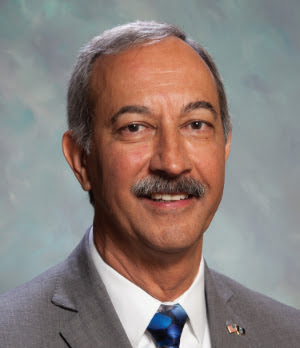
Professor David Card and the “Berkeley School” of Economics
recent article in The American Prospect profiled the growing influence of UC Berkeley’s economics department on current US policy. The department owes much of its reputation to its current chair, the Canadian labor economist (and Canadian Studies affiliate) David Card. As a young scholar, Card developed a reputation for iconoclastic, data-driven research that challenged then-current theoretical orthodoxies. When he relocated to Berkeley in 1997, Card’s preference for empiricism over theory was at odds with the department’s old guard and many of the larger schools of economics.
Today, however, it forms a central tenet among the department’s most notable figures – many of whom Card personally hired – and has been adopted by other leading schools, including Harvard, Princeton, and MIT. And with many Berkeley economists focusing on issues at intersection of economics and social policy, such as wealth inequality, the Berkeley model promises to only become more relevant as we seek data-driven answers to today’s most pressing problems.
Upcoming Events
Panel Discussion: The Canadian Healthcare System: A Model for the US?
April 6 | 12:30 p.m. | RSVP here
Most Canadians are proud of their national healthcare system, widely considered one of the best in the world. But when it comes to US healthcare reform, the Canadian example is much more divisive. A growing number of Americans view Canada as a model for a potential US single-payer system. However, for many others a “Canadian” system conjures images of long waits and rationing. Join Canadian Studies for a special panel exploring how Canada’s healthcare system really works, and why its perception in the US is so polarized.
Gregory Marchildon is a professor of comparative healthcare at the Institute of Health Policy, Management and Evaluation at the University of Toronto. He specializes in Canada’s healthcare system and has written extensively on comparative policy.
Amanda Aronczyk is a journalist and co-host of the NPR show Planet Money. Her 2020 episode “Frame Canada” investigated the US insurance lobby’s long-running PR campaign to block major healthcare reform by discrediting Canada’s healthcare system.
Daniel Béland is the director of the McGill Institute for the Study of Canada and James McGill Professor in the Department of Political Science at McGill University. He studies social policy and health care reform, and their relationship to fiscal policy.
Psychedelics, Eh? Canada’s Role in a Psychedelic Renaissance
April 27 | 12:30 p.m. | RSVP here
In the 1950’s, the Canadian province of Saskatchewan was on the cutting edge of research into hallucinogenic drugs. Under the province’s massive healthcare reforms, researchers received grants to pursue LSD treatments they thought could revolutionize psychiatry. What do these experiments say about Canada’s healthcare system and society at the time? And what can we learn from the program’s successes and failures at a time when psychedelics are attracting renewed scientific and public interest?
Erika Dyck is the Canada Research Chair in the History of Health & Social Justice at the University of Saskatchewan. She specializes in the history of psychiatry, and has written several books on the history of psychedelic research and eugenics in Canada.
Affiliate/External Events
Canadian Film Kuessipan Now Showing at Bay Area Theaters
The award-winning 2019 independent Canadian film Kuessipan is current receiving a limited theatrical release in several locations around the San Francisco Bay Area. Adapted from the acclaimed novel of the same name by First Nations author Naomi Fontaine, the drama tells the story of two girls in a Quebec Innu community who find their friendship tested when one begins to dream of leaving the reservation. Directed by Quebecoise filmmaker Myriam Verreault and co-written by Fontaine, the film stars Innu actors Sharon Ishpatao Fontaine and Yamie Grégoire. Learn more and find participating theaters here.
Canadian Studies Program
213 Moses Hall #2308
Canadian Studies Program | Univ. of California, Berkeley, 213 Moses Hall #2308, Berkeley, CA 94720